Ronzano Remi, Thetiot Melina, Lubetzki Catherine, Desmazieres Anne
Institut du Cerveau et de la Moelle épinière, Sorbonne Universités UPMC Université Paris 06, CNRS UMR7225-Inserm U1127, Paris, France.
Unit Zebrafish Neurogenetics, Department of Developmental & Stem Cell Biology, Institut Pasteur, CNRS, Paris, France.
Front Cell Neurosci. 2020 Feb 28;14:42. doi: 10.3389/fncel.2020.00042. eCollection 2020.
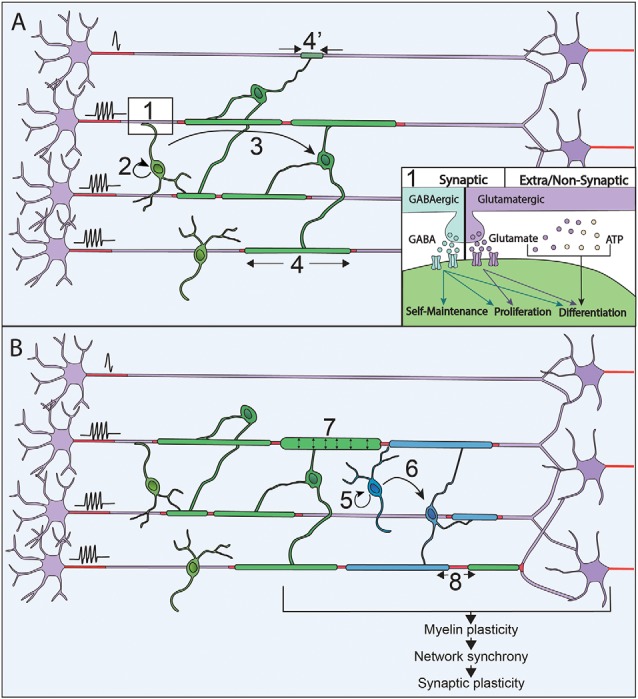
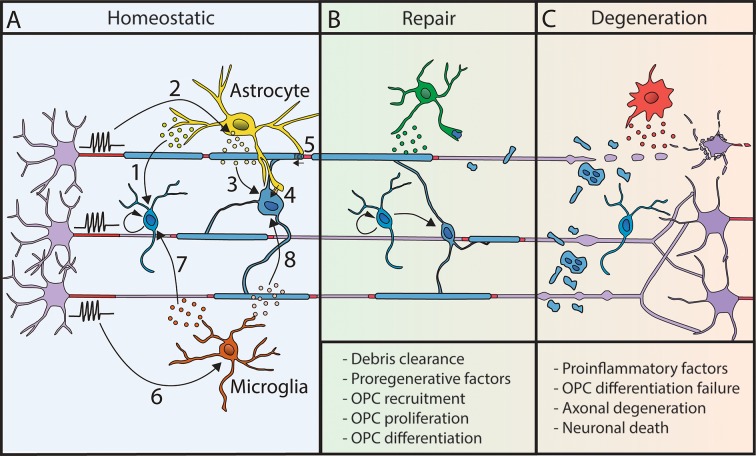
The plasticity of the central nervous system (CNS) in response to neuronal activity has been suggested as early as 1894 by Cajal (1894). CNS plasticity has first been studied with a focus on neuronal structures. However, in the last decade, myelin plasticity has been unraveled as an adaptive mechanism of importance, in addition to the previously described processes of myelin repair. Indeed, it is now clear that myelin remodeling occurs along with life and adapts to the activity of neuronal networks. Until now, it has been considered as a two-part dialog between the neuron and the oligodendroglial lineage. However, other glial cell types might be at play in myelin plasticity. In the present review, we first summarize the key structural parameters for myelination, we then describe how neuronal activity modulates myelination and finally discuss how other glial cells could participate in myelinic adaptivity.
早在1894年,卡哈尔(1894年)就提出了中枢神经系统(CNS)对神经元活动的可塑性。对CNS可塑性的研究最初聚焦于神经元结构。然而,在过去十年中,除了之前描述的髓鞘修复过程外,髓鞘可塑性已被揭示为一种重要的适应性机制。事实上,现在很清楚,髓鞘重塑伴随生命过程发生,并适应神经网络的活动。到目前为止,它一直被认为是神经元与少突胶质细胞系之间的两部分对话。然而,其他类型的胶质细胞可能在髓鞘可塑性中发挥作用。在本综述中,我们首先总结髓鞘形成的关键结构参数,然后描述神经元活动如何调节髓鞘形成,最后讨论其他胶质细胞如何参与髓鞘适应性。