Ghali Michael George Zaki
Department of Neurosurgery, Houston Methodist Hospital, Houston, TX, USA.
Asian J Neurosurg. 2020 Feb 25;15(1):16-21. doi: 10.4103/ajns.AJNS_146_18. eCollection 2020 Jan-Mar.
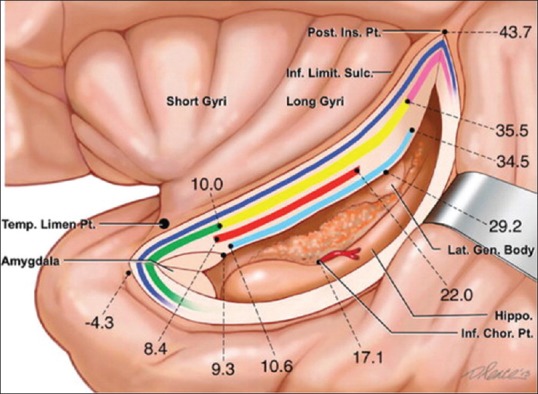
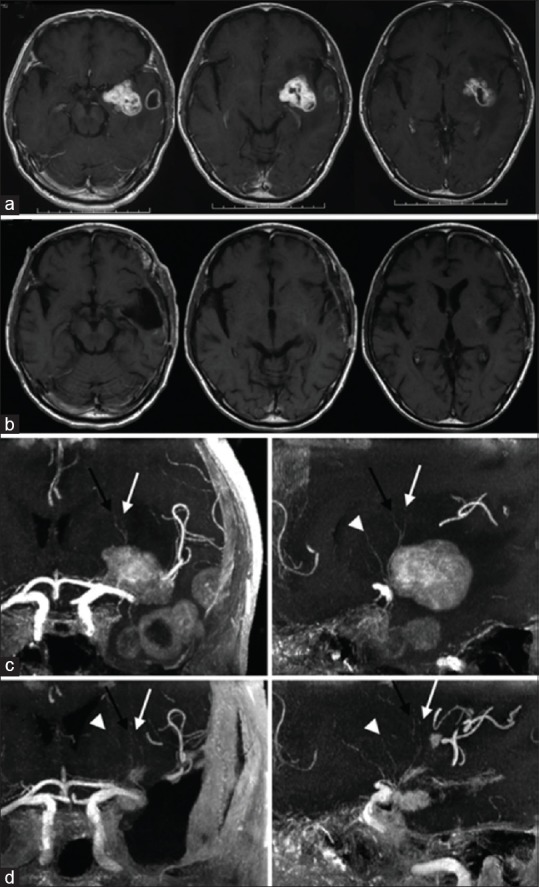
Insular gliomas represent 25% and 10% of low- and high-grade gliomas, respectively. Their resection proves challenging due to the intimate involvement of eloquent parenchyma and the lenticulostriate arteries (LSAs), limiting facility of achieving maximal safe resection. The majority of postoperative deficits following insular glioma resection is attributed to compromise of the LSAs. It is contemporaneously critical and challenging to preserve these vessels, given they are numerous and small, with an intraparenchymal course hidden from direct visualization during the operative intervention. A lesser degree of medially directed displacement of the LSAs predicts tumoral encasement of these vessels, which portends a decreased likelihood for achieving a gross total resection and increased probability of postoperative morbidity. Preservation of these vessels thus requires knowledge of their location during the entirety of the insular glioma resection and is facilitated by pre- and intra-operative imaging. Intraoperative real-time tracking, however, may prove rather challenging, especially with transcortical access. Conventional catheter digital subtraction angiography, computed tomographic angiography, magnetic resonance imaging and angiography, and three-dimensional ultrasound powered Doppler have proven effective modalities in assessing lenticulostriate position, and their use facilitates a greater extent of resection while minimizing the attendant morbidity consequent to LSA injury.
岛叶胶质瘤分别占低级别和高级别胶质瘤的25%和10%。由于其与功能区实质和豆纹动脉(LSA)紧密相连,切除具有挑战性,限制了实现最大安全切除的可能性。岛叶胶质瘤切除术后的大多数神经功能缺损归因于豆纹动脉受损。鉴于这些血管数量众多且细小,在手术干预期间其脑实质内走行无法直接可视化,保留这些血管同时具有关键性和挑战性。豆纹动脉向内侧移位程度较小预示着肿瘤包绕这些血管,这意味着实现全切的可能性降低且术后发病概率增加。因此,保留这些血管需要在整个岛叶胶质瘤切除过程中了解其位置,术前和术中成像有助于实现这一点。然而,术中实时追踪可能颇具挑战性,尤其是经皮质入路时。传统导管数字减影血管造影、计算机断层血管造影、磁共振成像和血管造影以及三维超声动力多普勒已被证明是评估豆纹动脉位置的有效方法,它们的使用有助于扩大切除范围,同时将豆纹动脉损伤导致的相关发病率降至最低。