Dhondrup Wüntrang, Tso Dungkar, Wangyal Rigdzin, Dhondrup Gönpo, Liu Zixuan, Dolma Tashi, Zhang Yi, Tidwell Tawni
Ethnic Medicine Academic Heritage Innovation Research Center, Chengdu University of Traditional Chinese Medicine, Chengdu, 611137, China.
Mongolian and Tibetan Medicine Hospital in Haixi State, Delingha, 817000, China.
Data Brief. 2020 Feb 25;29:105321. doi: 10.1016/j.dib.2020.105321. eCollection 2020 Apr.
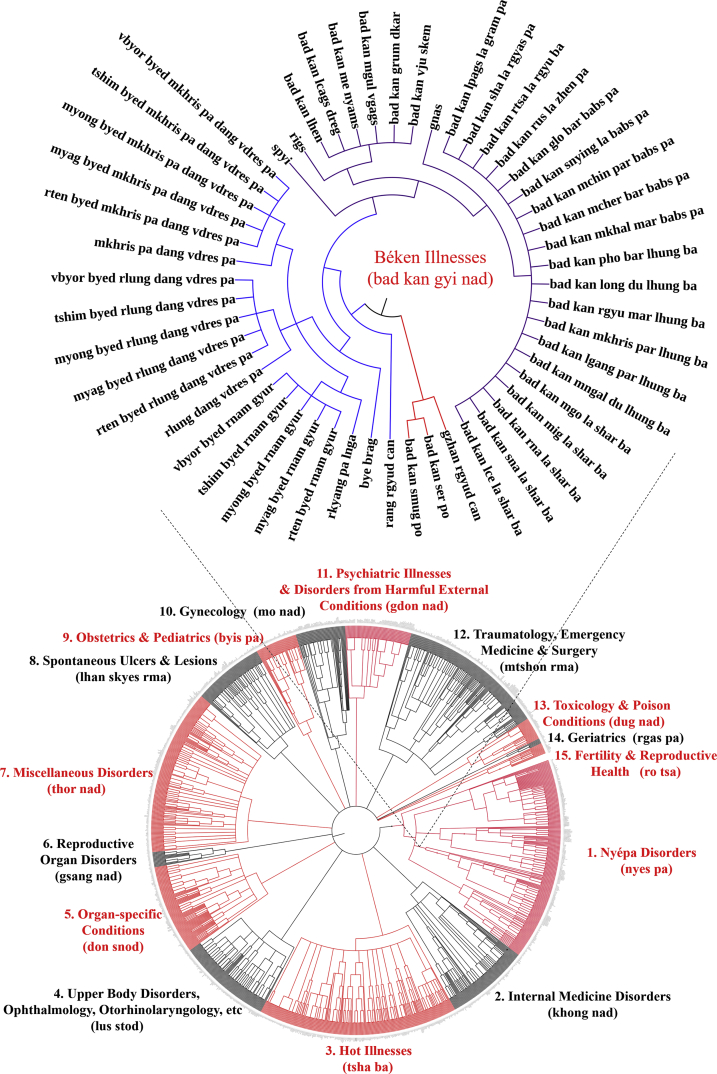
This article shares the comprehensive dataset and five visualized examples of disease categories in Tibetan medicine, or Sowa Rigpa (Tib. ), translated as the "knowledge field of healing." Sowa Rigpa is a scholarly Asian traditional medical system rigorously transmitted through canonical texts and oral teachings originating in Tibet with an extensive pharmacopeia, comprehensive treatment repertoire, and nuanced etiological explications of its nosology of diseases. This medical tradition is practiced across a broad region of Asia, particularly in Tibetan regions of China, Himalayan regions of India (Ladakh, Sikkim, Himachal Pradesh), Nepal, Bhutan, Mongolia, Russia, and recently in Europe and North America. The data herein depicts disease classifications listed in the encyclopedic compendium "Oral Instructions Treatise" () of the Tibetan medical classic, the (), compiled in written form during the twelfth century CE. Visualized examples depict etiological relations among diseases in five of the fifteen major categories of disease: rLung Illnesses, Béken Illneses, Pediatric Conditions, Eye Conditions and Tropical Infectious Diseases. Disease names were entered into spreadsheet format and categorized by etiological hierarchical structure. Data are written in Unicode Tibetan font to retain fidelity to entries in the classical text, with parallel columns in standard Wylie transliteration. Subsets of the data are visually depicted through a graphic platform called to demonstrate etiological associations. This dataset is the first publicly available enumeration of the specific diseases, classifications and etiological relationships from the Tibetan medical classic. The data are linked to the article entitled "Tibetan Medical Informatics: An Emerging Field in Sowa Rigpa Pharmacological & Clinical Research" (Dhondrup et al., 2020).
本文分享了藏医学(索瓦日巴,藏语称“治疗知识领域”)中疾病类别的综合数据集及五个可视化示例。索瓦日巴是一个学术性的亚洲传统医学体系,通过源自西藏的经典文本和口传严格传承下来,拥有丰富的药典、全面的治疗方法以及对疾病分类学细致入微的病因阐释。这一医学传统在亚洲广大地区盛行,尤其在中国的藏族地区、印度的喜马拉雅地区(拉达克、锡金、喜马偕尔邦)、尼泊尔、不丹、蒙古、俄罗斯,最近在欧洲和北美也有应用。本文中的数据描绘了公元12世纪以书面形式编纂的藏医经典《四部医典》之《诀窍医典》中列出的疾病分类。可视化示例展示了十五大类疾病中五类疾病之间的病因关系:隆病、培根病、儿科病症、眼科病症和热带传染病。疾病名称以电子表格形式录入,并按病因层次结构分类。数据用藏文Unicode字体书写,以保持与经典文本条目的一致性,同时设有标准威利转写的平行列。数据子集通过一个名为的图形平台进行可视化展示,以说明病因关联。该数据集是首个公开的藏医经典中特定疾病、分类及病因关系的枚举。这些数据与题为《藏医信息学:索瓦日巴药理学与临床研究中的一个新兴领域》(东珠普等人,2020年)的文章相关联。