Shimizu Motomi, Kimura Eiji
,.
J Vis. 2020 Mar 17;20(3):1. doi: 10.1167/jovi.20.3.1.
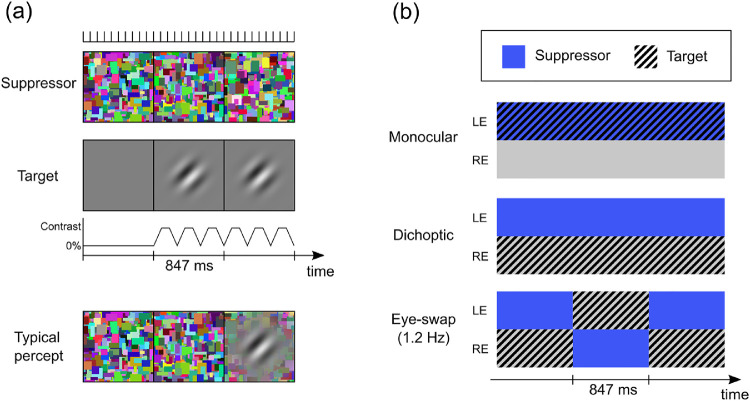
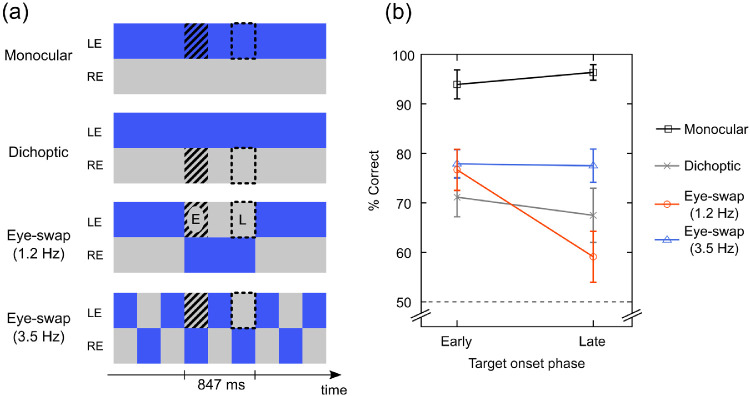
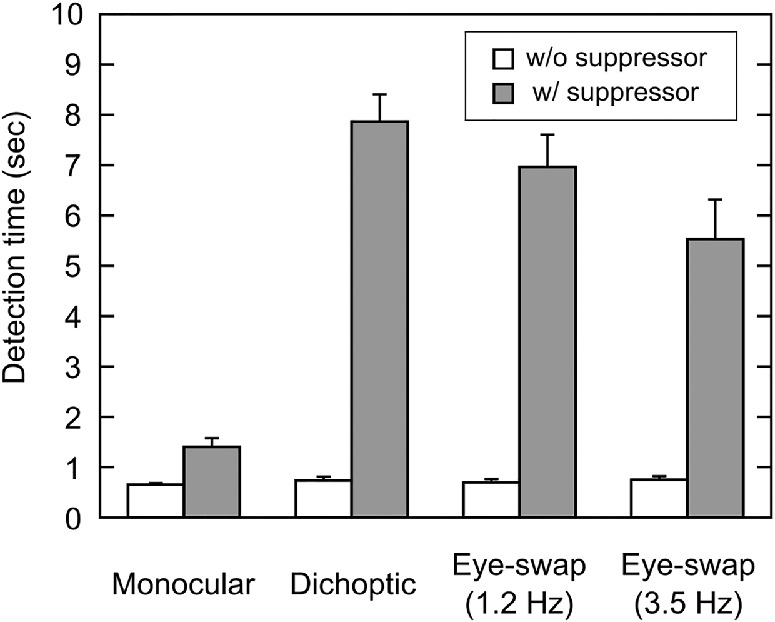
Continuous flash suppression (CFS) refers to a technique to render a monocular stimulus invisible by presenting a dynamic series of high-contrast patterns (such as Mondrian patterns) to the other eye. Despite its popularity as a tool to suppress stimulus from awareness, the suppression mechanisms underlying CFS remain not well understood. To further elucidate the suppression mechanisms, this study investigated the effects of eye swapping on CFS suppression by manipulating the eye of presentation of the suppressor and the target. Results showed that eye swapping of the suppressor and the target significantly reduced the strength of CFS suppression when swapping frequency was higher (3.5 Hz). However, strong suppression persisted at lower swapping frequency (1.2 Hz). Investigation of the time course of suppression revealed that suppression was weaker just after eye swapping but that it quickly regained strength over the monocular presentation period of the suppressor. However, this buildup seemed to not be fast enough to closely follow eye swapping at higher frequency. These findings can be better understood by the contribution of monocular processes to CFS suppression. They imply that interocular suppression caused by competition between monocular processes can mediate phenomenal suppression over multiple eye swaps when swapping frequency is low. The significance of the findings is discussed in relation to binocular rivalry and binocular switch suppression.
连续闪光抑制(CFS)是指通过向另一只眼睛呈现一系列动态的高对比度图案(如蒙德里安图案),使单眼刺激变得不可见的一种技术。尽管它作为一种抑制刺激意识的工具很受欢迎,但CFS背后的抑制机制仍未得到很好的理解。为了进一步阐明抑制机制,本研究通过操纵抑制刺激和目标刺激的呈现眼,研究了眼交换对CFS抑制的影响。结果表明,当交换频率较高(3.5赫兹)时,抑制刺激和目标刺激的眼交换显著降低了CFS抑制的强度。然而,在较低的交换频率(1.2赫兹)下,强烈的抑制仍然存在。对抑制时间过程的研究表明,眼交换后抑制较弱,但在抑制刺激的单眼呈现期间,它很快恢复了强度。然而,这种增强似乎不够快,无法在较高频率下紧密跟随眼交换。通过单眼过程对CFS抑制的贡献,可以更好地理解这些发现。它们意味着当交换频率较低时,单眼过程之间的竞争引起的双眼间抑制可以介导多次眼交换中的现象抑制。将结合双眼竞争和双眼切换抑制来讨论这些发现的意义。