Jerzy Haber Institute of Catalysis and Surface Chemistry, Polish Academy of Sciences, Niezapominajek 8, PL-30239 Krakow, Poland.
Department of Physical Biochemistry, Faculty of Biochemistry, Biophysics and Biotechnology, Jagiellonian University, Krakow, Poland.
J Phys Chem B. 2020 Apr 9;124(14):2961-2972. doi: 10.1021/acs.jpcb.0c01475. Epub 2020 Mar 26.
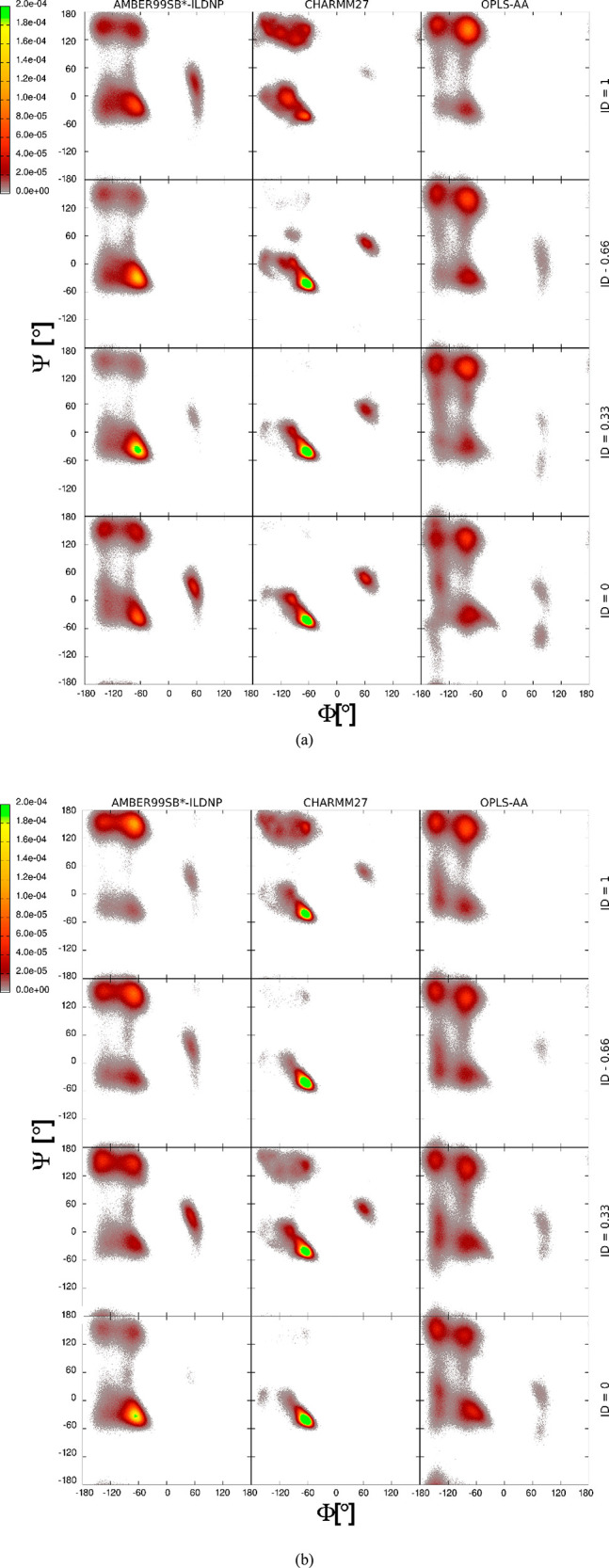
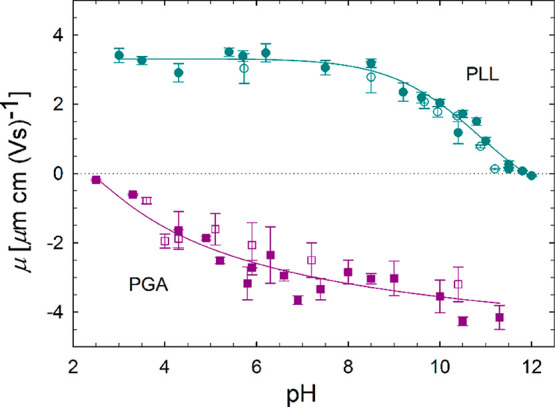
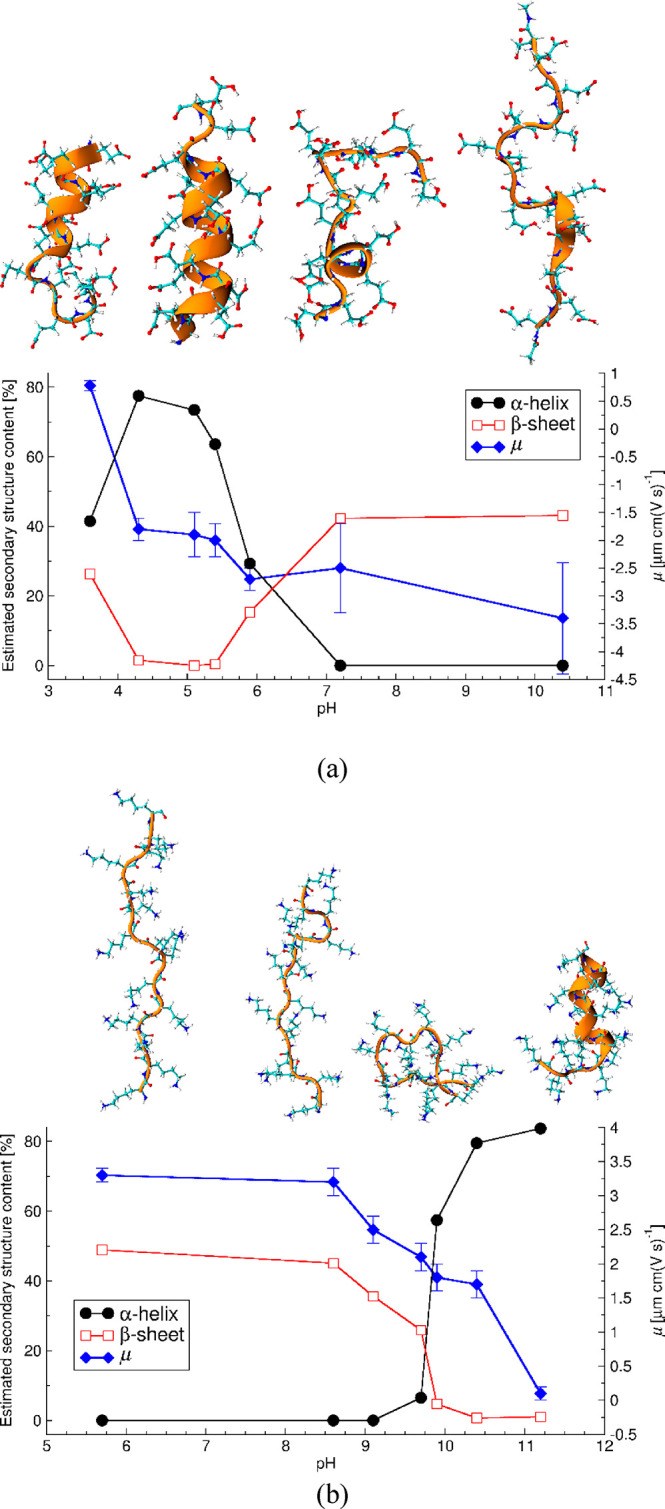
Microsecond-long all-atom molecular dynamics (MD) simulations, circular dichroism, laser Doppler velocimetry, and dynamic light-scattering techniques have been used to investigate pH-induced changes in the secondary structure, charge, and conformation of poly l-lysine (PLL) and poly l-glutamic acid (PGA). The employed combination of the experimental methods reveals for both PLL and PGA a narrow pH range at which they are charged enough to form stable colloidal suspensions, maintaining their α-helix content above 60%; an elevated charge state of the peptides required for colloidal stability promotes the peptide solvation as a random coil. To obtain a more microscopic view on the conformations and to verify the modeling performance, peptide secondary structure and conformations rising in MD simulations are also examined using three different force fields, i.e., OPLS-AA, CHARMM27, and AMBER99SB*-ILDNP. Ramachandran plots reveal that in the examined setup the α-helix content is systematically overestimated in CHARMM27, while OPLS-AA overestimates the β-sheet fraction at lower ionization degrees. At high ionization degrees, the OPLS-AA force-field-predicted secondary structure fractions match the experimentally measured distribution most closely. However, the pH-induced changes in PLL and PGA secondary structure are reasonably captured only by the AMBER99SB*-ILDNP force field, with the exception of the fully charged PGA in which the α-helix content is overestimated. The comparison to simulations results shows that the examined force fields involve significant deviations in their predictions for charged homopolypeptides. The detailed mapping of secondary structure dependency on pH for the polypeptides, especially finding the stable colloidal α-helical regime for both examined peptides, has significant potential for practical applications of the charged homopolypeptides. The findings raise attention especially to the pH fine tuning as an underappreciated control factor in surface modification and self-assembly.
微秒级长全原子分子动力学(MD)模拟、圆二色性、激光多普勒测速法和动态光散射技术已被用于研究聚赖氨酸(PLL)和聚谷氨酸(PGA)的二级结构、电荷和构象在 pH 诱导下的变化。所采用的实验方法组合揭示了 PLL 和 PGA 都有一个狭窄的 pH 范围,在这个范围内它们带足够的电荷形成稳定的胶体悬浮液,保持其α-螺旋含量高于 60%;为了使肽稳定胶体化所需的较高电荷状态促进了肽的溶剂化作用,形成无规卷曲。为了更微观地观察构象,并验证建模性能,还使用三种不同的力场,即 OPLS-AA、CHARMM27 和 AMBER99SB*-ILDNP,检查了 MD 模拟中的肽二级结构和构象。Ramachandran 图表明,在所研究的方案中,CHARMM27 系统地高估了α-螺旋含量,而 OPLS-AA 在较低的离解度下高估了β-折叠部分。在高离解度下,OPLS-AA 力场预测的二级结构分数与实验测量的分布最接近。然而,只有 AMBER99SB*-ILDNP 力场才能合理地捕捉 PLL 和 PGA 二级结构在 pH 诱导下的变化,除了完全带电的 PGA 外,它高估了α-螺旋含量。与模拟结果的比较表明,所研究的力场在预测带电同聚多肽时存在显著的偏差。多肽二级结构对 pH 的依赖性的详细映射,特别是为两种被研究的肽找到稳定的胶体α-螺旋区,对带电同聚多肽的实际应用具有重要的潜在意义。这些发现特别引起了人们对 pH 微调的关注,因为它是表面修饰和自组装中一个被低估的控制因素。