Stemler Jannik, Bruns Caroline, Mellinghoff Sibylle C, Alakel Nael, Akan Hamdi, Ananda-Rajah Michelle, Auberger Jutta, Bojko Peter, Chandrasekar Pranatharthi H, Chayakulkeeree Methee, Cozzi José A, de Kort Elizabeth A, Groll Andreas H, Heath Christopher H, Henze Larissa, Hernandez Jimenez Marcos, Kanj Souha S, Khanna Nina, Koldehoff Michael, Lee Dong-Gun, Mager Alina, Marchesi Francesco, Martino-Bufarull Rodrigo, Nucci Marcio, Oksi Jarmo, Pagano Livio, Phillips Bob, Prattes Juergen, Pyrpasopoulou Athina, Rabitsch Werner, Schalk Enrico, Schmidt-Hieber Martin, Sidharthan Neeraj, Soler-Palacín Pere, Stern Anat, Weinbergerová Barbora, El Zakhem Aline, Cornely Oliver A, Koehler Philipp
Department I of Internal Medicine, Center for Integrated Oncology Aachen Bonn Cologne Duesseldorf (CIO ABCD), Excellence Center for Medical Mycology (ECMM), Faculty of Medicine and University Hospital Cologne, University of Cologne, 50937 Cologne, Germany.
Cologne Excellence Cluster on Cellular Stress Responses in Aging-Associated Diseases (CECAD), University of Cologne, 50931 Cologne, Germany.
J Fungi (Basel). 2020 Mar 13;6(1):36. doi: 10.3390/jof6010036.
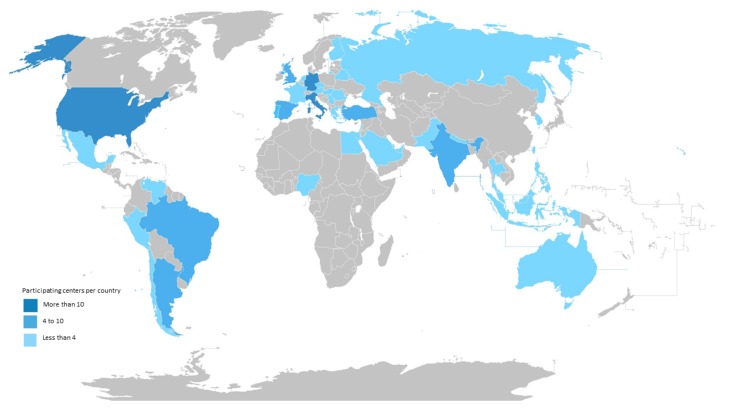
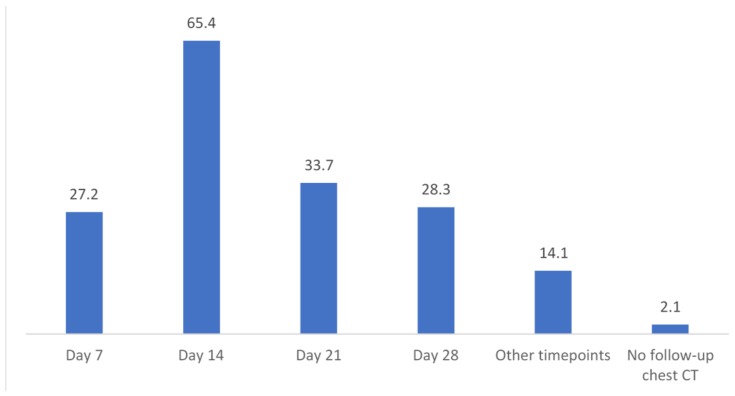
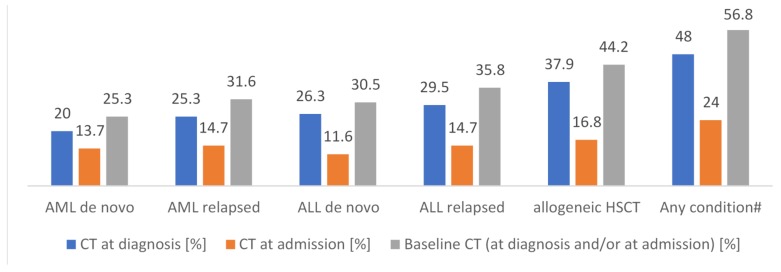
Baseline chest computed tomography (BCT) in high-risk hematology patients allows for the early diagnosis of invasive pulmonary aspergillosis (IPA). The distribution of BCT implementation in hematology departments and impact on outcome is unknown. A web-based questionnaire was designed. International scientific bodies were invited. The estimated numbers of annually treated hematology patients, chest imaging timepoints and techniques, IPA rates, and follow-up imaging were assessed. In total, 142 physicians from 43 countries participated. The specialties included infectious diseases ( = 69; 49%), hematology ( = 68; 48%), and others ( = 41; 29%). BCT was performed in 57% ( = 54) of 92 hospitals. Upon the diagnosis of malignancy or admission, 48% and 24% performed BCT, respectively, and X-ray was performed in 48% and 69%, respectively. BCT was more often used in hematopoietic cell transplantation and in relapsed acute leukemia. European centers performed BCT in 59% and non-European centers in 53%. Median estimated IPA rate was 8% and did not differ between BCT (9%; IQR 5-15%) and non-BCT centers (7%; IQR 5-10%) (p = 0.69). Follow-up computed tomography (CT) for IPA was performed in 98% ( = 90) of centers. In high-risk hematology patients, baseline CT is becoming a standard-of-care. Chest X-ray, while inferior, is still widely used. Randomized, controlled trials are needed to investigate the impact of BCT on patient outcome.
高危血液病患者的基线胸部计算机断层扫描(BCT)有助于侵袭性肺曲霉病(IPA)的早期诊断。血液科BCT的实施情况及其对预后的影响尚不清楚。设计了一份基于网络的调查问卷,并邀请了国际科学机构参与。评估了每年接受治疗的血液病患者数量、胸部成像时间点和技术、IPA发生率以及随访成像情况。共有来自43个国家的142名医生参与。专业包括传染病(69名,49%)、血液学(68名,48%)和其他(41名,29%)。92家医院中有57%(54家)进行了BCT。在诊断为恶性肿瘤或入院时,分别有48%和24%的医院进行了BCT,而进行X线检查的分别为48%和69%。BCT在造血细胞移植和复发急性白血病中使用更为频繁。欧洲中心BCT的实施率为59%,非欧洲中心为53%。估计IPA的中位发生率为8%,BCT中心(9%;四分位间距5 - 15%)和非BCT中心(7%;四分位间距5 - 10%)之间无差异(p = 0.69)。98%(90家)的中心对IPA进行了随访计算机断层扫描(CT)。在高危血液病患者中,基线CT正成为一种标准治疗方法。胸部X线检查虽然效果较差,但仍被广泛使用。需要进行随机对照试验来研究BCT对患者预后的影响。