Massaglia Giulia, Frascella Francesca, Chiadò Alessandro, Sacco Adriano, Marasso Simone Luigi, Cocuzza Matteo, Pirri Candido F, Quaglio Marzia
Department of Applied Science and Technology (DISAT), Politecnico di Torino, Corso Duca degli Abruzzi 24, 10129 Torino, Italy.
Center for Sustainable Future Technologies (CSFT)@Polito, Istituto Italiano di Tecnologia, Environment Park, Building B2 Via Livorno 60, 10144 Torino, Italy.
Nanomaterials (Basel). 2020 Mar 14;10(3):523. doi: 10.3390/nano10030523.
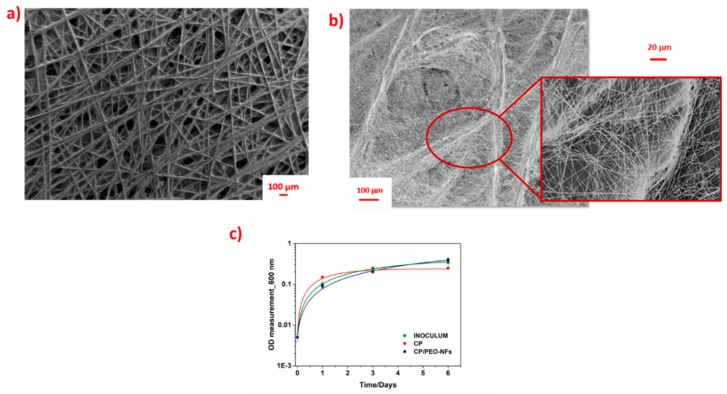
Microbial fuel cells (MFCs) are bio-electrochemical devices able to directly transduce chemical energy, entrapped in an organic mass named fuel, into electrical energy through the metabolic activity of specific bacteria. During the last years, the employment of bio-electrochemical devices to study the wastewater derived from the food industry has attracted great interest from the scientific community. In the present work, we demonstrate the capability of exoelectrogenic bacteria used in MFCs to catalyze the oxidation reaction of honey, employed as a fuel. With the main aim to increase the proliferation of microorganisms onto the anode, engineered electrodes are proposed. Polymeric nanofibers, based on polyethylene oxide (PEO-NFs), were directly electrospun onto carbon-based material (carbon paper, CP) to obtain an optimized composite anode. The crucial role played by the CP/PEO-NFs anodes was confirmed by the increased proliferation of microorganisms compared to that reached on bare CP anodes, used as a reference material. A parameter named recovered energy (Erec) was introduced to determine the capability of bacteria to oxidize honey and was compared with the Erec obtained when sodium acetate was used as a fuel. CP/PEO-NFs anodes allowed achieving an Erec three times higher than the one reached with a bare carbon-based anode.
微生物燃料电池(MFCs)是一种生物电化学装置,能够通过特定细菌的代谢活动,将存在于名为燃料的有机物质中的化学能直接转化为电能。在过去几年中,利用生物电化学装置研究食品工业产生的废水引起了科学界的极大兴趣。在本研究中,我们展示了用于MFCs的产电细菌催化用作燃料的蜂蜜氧化反应的能力。为了主要增加微生物在阳极上的增殖,我们提出了工程化电极。基于聚环氧乙烷的聚合物纳米纤维(PEO-NFs)被直接电纺到碳基材料(碳纸,CP)上,以获得优化的复合阳极。与用作参考材料的裸CP阳极相比,微生物增殖增加证实了CP/PEO-NFs阳极所起的关键作用。引入了一个名为回收能量(Erec)的参数来确定细菌氧化蜂蜜的能力,并与使用醋酸钠作为燃料时获得的Erec进行比较。CP/PEO-NFs阳极实现的Erec比裸碳基阳极高出三倍。