Institute of Animal Pathology, Vetsuisse Faculty, University of Bern, 3001 Bern, Switzerland.
Institute of Genetics, Vetsuisse Faculty, University of Bern, 3001 Bern, Switzerland.
Genes (Basel). 2020 Mar 14;11(3):313. doi: 10.3390/genes11030313.
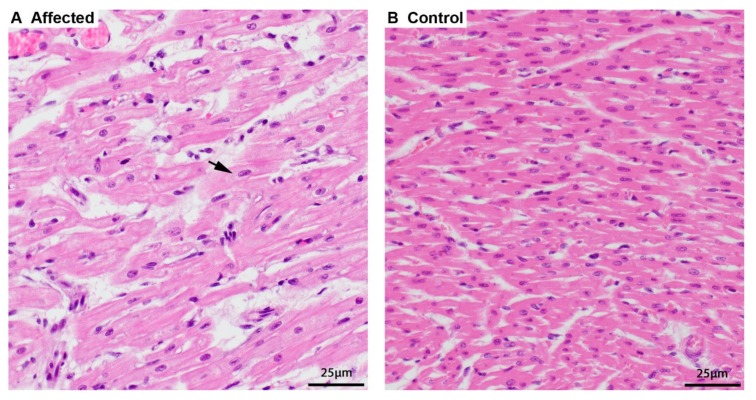
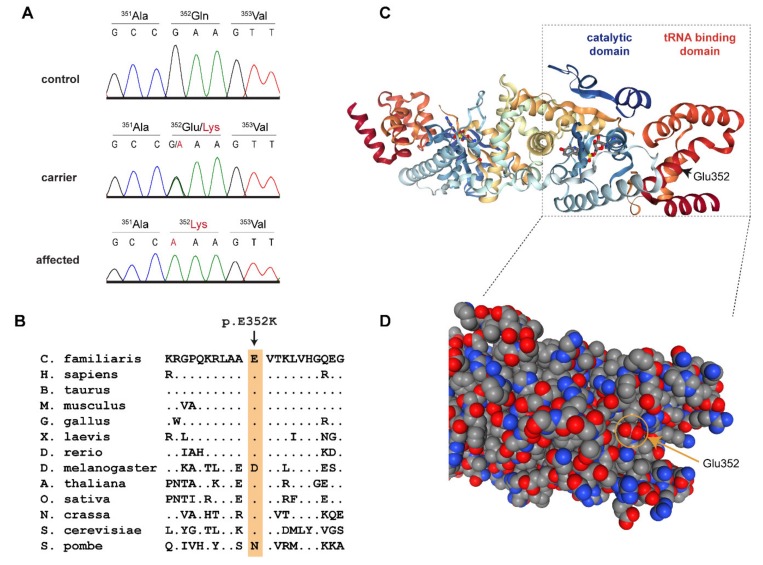
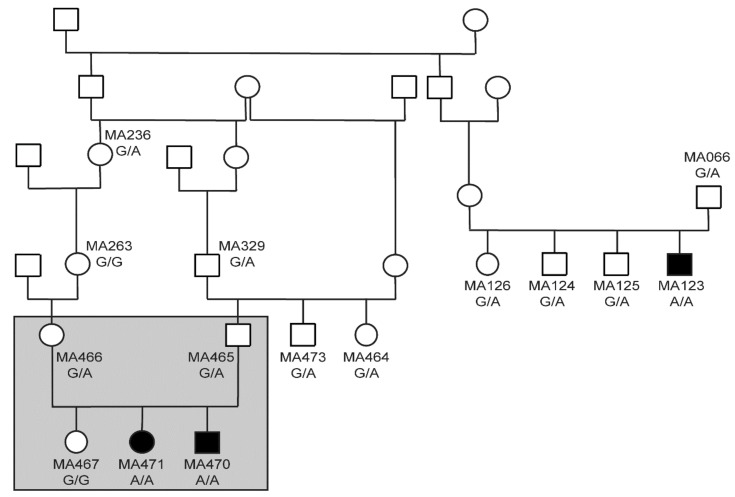
Dog puppy loss by the age of six to eight weeks after normal development is relatively uncommon. Necropsy findings in two spontaneously deceased Belgian Shepherd puppies indicated an abnormal accumulation of material in several organs. A third deceased puppy exhibited mild signs of an inflammation in the central nervous system and an enteritis. The puppies were closely related, raising the suspicion of a genetic cause. Pedigree analysis suggested a monogenic autosomal recessive inheritance. Combined linkage and homozygosity mapping assigned the most likely position of a potential genetic defect to 13 genome segments totaling 82 Mb. The genome of an affected puppy was sequenced and compared to 645 control genomes. Three private protein changing variants were found in the linked and homozygous regions. Targeted genotyping in 96 Belgian Shepherd dogs excluded two of these variants. The remaining variant, :1054G>A or p.Glu352Lys, was perfectly associated with the phenotype in a cohort of 474 Belgian Shepherd dogs encodes the mitochondrial tyrosyl-tRNA synthetase 2 and the predicted amino acid change replaces a negatively charged and evolutionary conserved glutamate at the surface of the tRNA binding domain of YARS2 with a positively charged lysine. Human patients with loss-of-function variants in suffer from myopathy, lactic acidosis, and sideroblastic anemia 2, a disease with clinical similarities to the phenotype of the studied dogs. The carrier frequency was 27.2% in the tested Belgian Shepherd dogs. Our data suggest :1054G>A as the candidate causative variant for the observed juvenile mortality.
6-8 周龄正常发育的幼犬通常不会出现死亡。对两只自然死亡的比利时牧羊犬幼犬进行尸检发现,其多个器官中有异常物质堆积。第三只死亡的幼犬中枢神经系统和肠炎仅有轻度炎症迹象。这些幼犬之间关系密切,这让人怀疑存在遗传原因。系谱分析提示为单基因常染色体隐性遗传。连锁和纯合性作图将潜在遗传缺陷的最可能位置确定在总共 82Mb 的 13 个基因组片段上。受影响幼犬的基因组被测序并与 645 个对照基因组进行比较。在连锁和纯合区域发现了 3 个个体蛋白改变的变异体。在 96 只比利时牧羊犬中的靶向基因分型排除了其中两个变异体。剩下的变异体:1054G>A 或 p.Glu352Lys,与 474 只比利时牧羊犬的表型完全相关,该变异体编码线粒体酪氨酸-tRNA 合成酶 2,预测的氨基酸变化取代了 tRNA 结合域表面带负电荷且进化保守的谷氨酸,而代之以带正电荷的赖氨酸。患有 失活变异的人类患者患有肌病、乳酸酸中毒和铁幼粒细胞性难治性贫血 2,这是一种与所研究犬的表型具有临床相似性的疾病。在测试的比利时牧羊犬中,该变异体的携带率为 27.2%。我们的数据表明:1054G>A 是观察到的幼年死亡率的候选致病变异体。