Liaw Siew Yee, Chew Keng Sheng, Zulkarnain Ahmad, Wong Shirly Siew Ling, Singmamae Nariman, Kaushal Dev Nath, Chan Hiang Chuan
Emergency Medicine and Trauma Department, Sarawak General Hospital, Jalan Hospital, Sarawak, 93586, Malaysia.
Faculty of Medicine, Universiti of Malaya, Jalan Universiti, Kuala Lumpur, 50603, Malaysia.
Int J Emerg Med. 2020 Mar 17;13(1):13. doi: 10.1186/s12245-020-00271-3.
In conjunction with an automated external defibrillator (AED) placement program at various locations within a public university in Malaysia, a series of structured training programs were conducted. The objectives of this study is to (1) evaluate the effectiveness of a structured training program in improving the perception of the importance of AED and cardiopulmonary resuscitation (CPR), (2) evaluate the confidence of the employees in using an AED and performing bystander CPR, (3) identify the fears and concerns of these employees in using AED and performing CPR, and (4) determine the perception of these employees towards the strategy of the AEDs placed at various locations within the university.
In this single-center observational study, a validated questionnaire aimed to assess the university employees' attitude and confidence in handling AED and performing CPR before (pre-test) and immediately after (post-test) the training program was conducted.
A total of 184 participants participated in this study. Using the Wilcoxon signed-rank test, the training programs appeared to have improved the perception that "using AED is important for unresponsive victims" (z = 4.32, p < 0.001) and that "AED practice drills should be performed on a regular basis" (z = - 2.41, p = 0.02) as well as increased the confidence to perform CPR (z = - 8.56, p < 0.001), use AED (z = - 8.93, p < 0.001), identify victims with no signs of life (z = - 7.88, p < 0.001), and the willingness to perform CPR and AED without hesitancy (z = - 8.91, p < 0.001). Fears and concerns on performing CPR and using AED also appeared to have been significantly reduced, and the perception on placement strategies of these AEDs was generally positive.
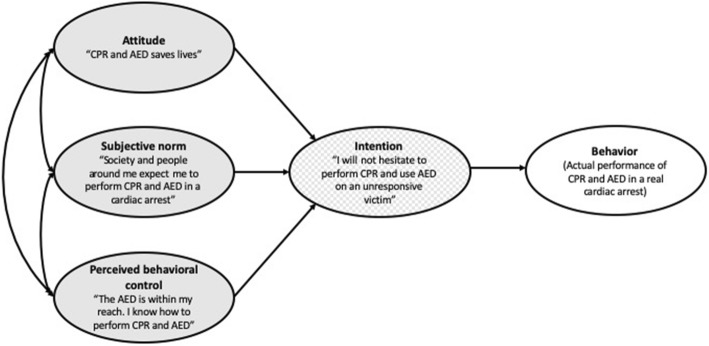
Using the theory of planned behavior as the explanatory framework, training programs appear to be helpful in improving the perception and the confidence of the participants towards performing CPR and using AED through the promotion of positive attitude, positive societal expectation, and a positive sense of empowerment. But whether this positive effect will translate into actual CPR performance and AED application in a real cardiac arrest is yet to be seen.
在马来西亚一所公立大学的多个地点开展自动体外除颤器(AED)放置项目的同时,还进行了一系列结构化培训项目。本研究的目的是:(1)评估结构化培训项目在提高对AED和心肺复苏术(CPR)重要性的认识方面的有效性;(2)评估员工使用AED和进行旁观者心肺复苏的信心;(3)确定这些员工在使用AED和进行心肺复苏时的恐惧和担忧;(4)确定这些员工对大学内各地点放置的AED策略的看法。
在这项单中心观察性研究中,使用一份经过验证的问卷,旨在评估大学员工在培训项目开展前(预测试)和开展后立即(后测试)对处理AED和进行心肺复苏的态度和信心。
共有184名参与者参与了本研究。使用Wilcoxon符号秩检验,培训项目似乎提高了“对无反应受害者使用AED很重要”(z = 4.32,p < 0.001)以及“应定期进行AED实践演练”(z = -2.41,p = 0.02)的认知,同时提高了进行心肺复苏(z = -8.56,p < 0.001)、使用AED(z = -8.93,p < 0.001)、识别无生命迹象受害者(z = -7.88,p < 0.001)以及毫不犹豫地进行心肺复苏和使用AED的意愿(z = -8.91,p < 0.001)。对进行心肺复苏和使用AED的恐惧和担忧也似乎显著减少,并且对这些AED放置策略的看法总体上是积极的。
以计划行为理论作为解释框架,培训项目似乎有助于通过促进积极态度、积极的社会期望和积极的赋权感来提高参与者对进行心肺复苏和使用AED的认知和信心。但这种积极效果是否会转化为实际心脏骤停时的心肺复苏表现和AED应用还有待观察。