• 文献检索
  • 文档翻译
  • 深度研究
  • 学术资讯
  • Suppr Zotero 插件Zotero 插件
  • 邀请有礼
  • 套餐&价格
  • 历史记录
应用&插件
Suppr Zotero 插件Zotero 插件浏览器插件Mac 客户端Windows 客户端微信小程序
定价
高级版会员购买积分包购买API积分包
服务
文献检索文档翻译深度研究API 文档MCP 服务
关于我们
关于 Suppr公司介绍联系我们用户协议隐私条款
关注我们

Suppr 超能文献

核心技术专利:CN118964589B侵权必究
粤ICP备2023148730 号-1Suppr @ 2026

文献检索

告别复杂PubMed语法,用中文像聊天一样搜索,搜遍4000万医学文献。AI智能推荐,让科研检索更轻松。

立即免费搜索

文件翻译

保留排版,准确专业,支持PDF/Word/PPT等文件格式,支持 12+语言互译。

免费翻译文档

深度研究

AI帮你快速写综述,25分钟生成高质量综述,智能提取关键信息,辅助科研写作。

立即免费体验

头颈部癌症患者多学科营养康复治疗效果的随机对照试验(NUTRI-HAB 试验)的原理和设计。

Rationale and design of a randomised controlled trial investigating the effect of multidisciplinary nutritional rehabilitation for patients treated for head and neck cancer (the NUTRI-HAB trial).

机构信息

REHPA, The Danish Knowledge Centre for Rehabilitation and Palliative Care, Department of Clinical Research, University of Southern Denmark, Odense, Denmark; Odense University Hospital, Vestergade 17, Nyborg, DK-5800, Denmark.

Department of Nursing and Nutrition, University College Copenhagen, Sigurdsgade 26, DK-2200, Copenhagen N, Denmark.

出版信息

Nutr J. 2020 Mar 17;19(1):21. doi: 10.1186/s12937-020-00539-7.

DOI:10.1186/s12937-020-00539-7
PMID:32183835
原文链接:https://pmc.ncbi.nlm.nih.gov/articles/PMC7079410/
Abstract

BACKGROUND

Eating problems frequently affect quality of life and physical, psychological and social function in patients treated for head and neck cancer (HNC). Residential rehabilitation programmes may ameliorate these adverse effects but are not indicated for all individuals. Systematic assessment of rehabilitation needs may optimise the use of resources while ensuring referral to rehabilitation for those in need. Yet, evidence lacks on which nutrition screening and assessment tools to use. The trial objectives are: 1) To test the effect of a multidisciplinary residential nutritional rehabilitation programme compared to standard care on the primary outcome body weight and secondary outcomes health-related quality of life, physical function and symptoms of anxiety and depression in patients curatively treated for HNC and 2) To test for correlations between participants' development in outcome scores during their participation in the programme and their baseline scores in Nutritional Risk Screening 2002 (NRS 2002), the Scored Patient-Generated Subjective Global Assessment Short Form (PG-SGA SF), and M. D. Anderson Dysphagia Inventory (MDADI) and to assess sensitivity, specificity and predictive values of the three tools in relation to a clinically relevant improvement in outcome scores.

METHODS

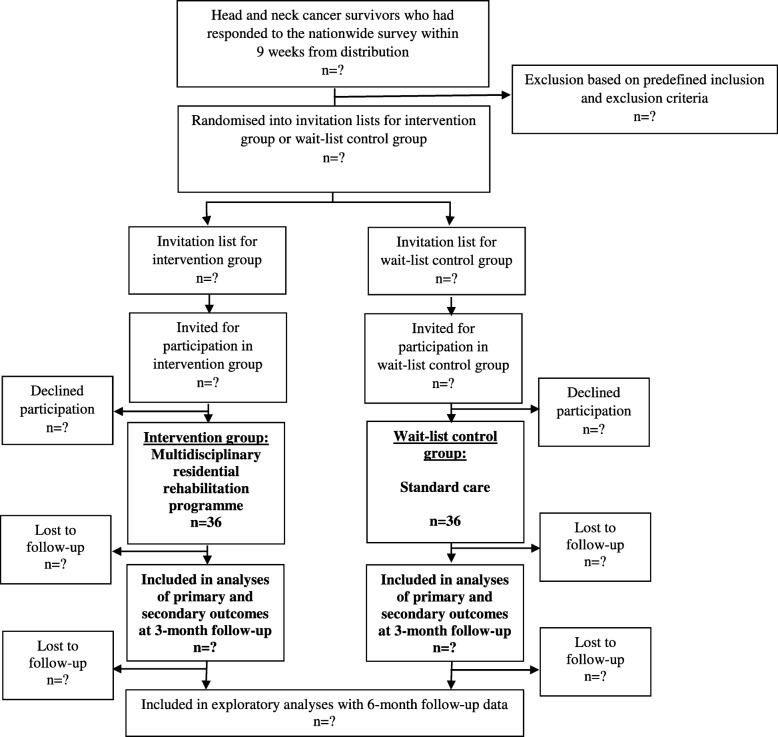
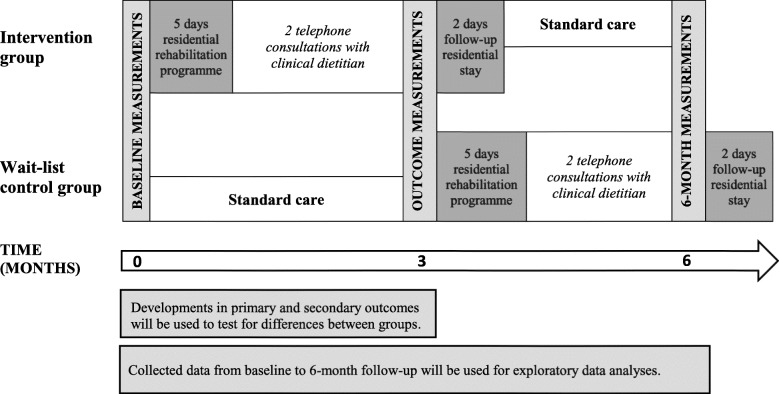
In a randomised controlled trial, 72 patients treated for HNC recruited through a nationwide survey will be randomised to a multidisciplinary residential nutritional rehabilitation programme or to a wait-list control group. Data are collected at baseline, three and six months. Primary outcome is change in body weight, and secondary outcomes include changes in quality of life, physical function and symptoms of anxiety and depression. Potential correlations between intervention effect and baseline scores in NRS 2002, PG-SGA-SF and MDADI will be tested, and sensitivity, specificity and predictive values of the three tools in relation to a clinically relevant improvement in outcome scores will be assessed.

DISCUSSION

This is the first randomised controlled trial to test the effect of a multidisciplinary residential nutritional rehabilitation programme in patients treated for HNC. Recruitment through a nationwide survey gives a unique possibility to describe the trial population and to identify potential selection bias. As the trial will explore the potential of different nutrition screening and assessment tools in the assessment of rehabilitation needs in patients treated for HNC, the trial will create knowledge about how selection and prioritisation of nutritional rehabilitation aimed at patients treated for HNC should be offered. The results may contribute to a better organisation and use of existing resources in benefit of patients treated for HNC.

TRIAL REGISTRATION

The trial is registered by The Danish Data Protection Agency (registration 2012-58-0018, approval number 18/14847) and the Regional Committees on Health Research Ethics for Southern Denmark (journal number 20182000-165). ClinicalTrials.gov Identifier: NCT03909256. Registered April 9, 2019.

摘要

背景

在头颈部癌症(HNC)治疗患者中,饮食问题经常影响生活质量以及身体、心理和社会功能。住院康复计划可能会改善这些不良影响,但并非适用于所有患者。系统的康复需求评估可以优化资源的使用,同时确保有需要的患者得到康复治疗。然而,目前缺乏关于应使用哪种营养筛查和评估工具的证据。本试验的目的是:1)比较多学科住院营养康复计划与标准护理对 HNC 根治性治疗患者的体重主要结局和健康相关生活质量、身体功能以及焦虑和抑郁症状的次要结局的影响,2)检测在参与该计划过程中参与者的结局评分的变化与营养风险筛查 2002 (NRS 2002)、患者自评主观整体评估简短形式(PG-SGA SF)和 MD 安德森吞咽障碍量表(MDADI)的基线评分之间的相关性,并评估这三种工具在与临床相关的结局评分改善方面的灵敏度、特异性和预测值。

方法

在一项随机对照试验中,通过全国性调查招募的 72 例 HNC 治疗患者将被随机分配至多学科住院营养康复计划组或等待名单对照组。数据在基线、3 个月和 6 个月时收集。主要结局为体重变化,次要结局包括生活质量、身体功能和焦虑抑郁症状的变化。将检测干预效果与 NRS 2002、PG-SGA-SF 和 MDADI 的基线评分之间的潜在相关性,并评估这三种工具在与临床相关的结局评分改善方面的灵敏度、特异性和预测值。

讨论

这是首个测试多学科住院营养康复计划在 HNC 治疗患者中的效果的随机对照试验。通过全国性调查招募可以为描述试验人群和确定潜在选择偏倚提供独特的可能性。由于该试验将探索不同营养筛查和评估工具在评估 HNC 治疗患者康复需求方面的潜力,因此该试验将为如何提供针对 HNC 治疗患者的营养康复选择和优先级提供知识。结果可能有助于更好地组织和利用现有资源,使 HNC 治疗患者受益。

试验注册

该试验由丹麦数据保护局(注册号 2012-58-0018,批准号 18/14847)和南丹麦地区伦理委员会(期刊号 20182000-165)注册,并在 ClinicalTrials.gov 上注册(登记号 NCT03909256)。登记日期:2019 年 4 月 9 日。
https://cdn.ncbi.nlm.nih.gov/pmc/blobs/03fe/7079410/e7f3ba8f81c5/12937_2020_539_Fig2_HTML.jpg
https://cdn.ncbi.nlm.nih.gov/pmc/blobs/03fe/7079410/a8ef2a3bb9f4/12937_2020_539_Fig1_HTML.jpg
https://cdn.ncbi.nlm.nih.gov/pmc/blobs/03fe/7079410/e7f3ba8f81c5/12937_2020_539_Fig2_HTML.jpg
https://cdn.ncbi.nlm.nih.gov/pmc/blobs/03fe/7079410/a8ef2a3bb9f4/12937_2020_539_Fig1_HTML.jpg
https://cdn.ncbi.nlm.nih.gov/pmc/blobs/03fe/7079410/e7f3ba8f81c5/12937_2020_539_Fig2_HTML.jpg

相似文献

1
Rationale and design of a randomised controlled trial investigating the effect of multidisciplinary nutritional rehabilitation for patients treated for head and neck cancer (the NUTRI-HAB trial).头颈部癌症患者多学科营养康复治疗效果的随机对照试验(NUTRI-HAB 试验)的原理和设计。
Nutr J. 2020 Mar 17;19(1):21. doi: 10.1186/s12937-020-00539-7.
2
Effects of a Multidisciplinary Residential Nutritional Rehabilitation Program in Head and Neck Cancer Survivors-Results from the NUTRI-HAB Randomized Controlled Trial.多学科住院营养康复方案对头颈部癌症幸存者的影响——来自 NUTRI-HAB 随机对照试验的结果。
Nutrients. 2020 Jul 17;12(7):2117. doi: 10.3390/nu12072117.
3
Diagnostic test accuracy of nutritional tools used to identify undernutrition in patients with colorectal cancer: a systematic review.用于识别结直肠癌患者营养不良的营养评估工具的诊断测试准确性:一项系统综述
JBI Database System Rev Implement Rep. 2015 May 15;13(4):141-87. doi: 10.11124/jbisrir-2015-1673.
4
To eat is to practice-managing eating problems after head and neck cancer.进食是一种实践——管理头颈部癌症后的进食问题。
J Cancer Surviv. 2019 Oct;13(5):792-803. doi: 10.1007/s11764-019-00798-2. Epub 2019 Aug 24.
5
Eating As Treatment (EAT): A Stepped-Wedge, Randomized Controlled Trial of a Health Behavior Change Intervention Provided by Dietitians to Improve Nutrition in Patients With Head and Neck Cancer Undergoing Radiation Therapy (TROG 12.03).饮食作为治疗手段(EAT):营养师提供的健康行为改变干预措施的阶梯式随机对照试验,旨在改善接受放疗的头颈部癌症患者的营养状况(TROG 12.03)。
Int J Radiat Oncol Biol Phys. 2019 Feb 1;103(2):353-362. doi: 10.1016/j.ijrobp.2018.09.027. Epub 2018 Oct 5.
6
Malnutrition in Geriatric Rehabilitation: Prevalence, Patient Outcomes, and Criterion Validity of the Scored Patient-Generated Subjective Global Assessment and the Mini Nutritional Assessment.老年康复中的营养不良:评分患者主观整体评估和微型营养评估的患病率、患者结局和判定有效性。
J Acad Nutr Diet. 2016 May;116(5):785-94. doi: 10.1016/j.jand.2015.06.013. Epub 2015 Jul 26.
7
Therapeutic exercises for affecting post-treatment swallowing in people treated for advanced-stage head and neck cancers.针对晚期头颈癌患者治疗后吞咽功能的治疗性锻炼
Cochrane Database Syst Rev. 2016 Aug 26;2016(8):CD011112. doi: 10.1002/14651858.CD011112.pub2.
8
A comparison of the MNA-SF, MUST, and NRS-2002 nutritional tools in predicting treatment incompletion of concurrent chemoradiotherapy in patients with head and neck cancer.MNA-SF、MUST 和 NRS-2002 营养工具在预测头颈部癌症患者同期放化疗治疗不完成的比较。
Support Care Cancer. 2021 Sep;29(9):5455-5462. doi: 10.1007/s00520-021-06140-w. Epub 2021 Mar 11.
9
Nutrition Status and Health-Related Quality of Life Among Outpatients With Advanced Head and Neck Cancer.营养状况与晚期头颈部癌症门诊患者的健康相关生活质量。
Nutr Clin Pract. 2020 Dec;35(6):1129-1137. doi: 10.1002/ncp.10476. Epub 2020 Mar 5.
10
Study protocol: cost-effectiveness of multidisciplinary nutritional support for undernutrition in older adults in nursing home and home-care: cluster randomized controlled trial.研究方案:养老院和居家护理中老年人营养不良的多学科营养支持的成本效益:整群随机对照试验
Nutr J. 2014 Aug 28;13:86. doi: 10.1186/1475-2891-13-86.

引用本文的文献

1
Dietary advice with or without oral nutritional supplements for disease-related malnutrition in adults.膳食建议,包括或不包括口服营养补充剂,用于治疗成人相关营养不良。
Cochrane Database Syst Rev. 2021 Dec 21;12(12):CD002008. doi: 10.1002/14651858.CD002008.pub5.
2
Effects of a Multidisciplinary Residential Nutritional Rehabilitation Program in Head and Neck Cancer Survivors-Results from the NUTRI-HAB Randomized Controlled Trial.多学科住院营养康复方案对头颈部癌症幸存者的影响——来自 NUTRI-HAB 随机对照试验的结果。
Nutrients. 2020 Jul 17;12(7):2117. doi: 10.3390/nu12072117.

本文引用的文献

1
Nutritional experiences in head and neck cancer patients.头颈部癌症患者的营养体验。
Eur J Cancer Care (Engl). 2019 Nov;28(6):e13168. doi: 10.1111/ecc.13168. Epub 2019 Sep 30.
2
Nutrition and swallowing therapy strategies for patients with head and neck cancer.头颈部癌症患者的营养和吞咽治疗策略。
Nutrition. 2020 Jan;69:110548. doi: 10.1016/j.nut.2019.06.028. Epub 2019 Jul 2.
3
To eat is to practice-managing eating problems after head and neck cancer.进食是一种实践——管理头颈部癌症后的进食问题。
J Cancer Surviv. 2019 Oct;13(5):792-803. doi: 10.1007/s11764-019-00798-2. Epub 2019 Aug 24.
4
Clinical and sociodemographic factors that affect the quality of life of survivors of head and neck cancer.影响头颈部癌症幸存者生活质量的临床和社会人口学因素。
Support Care Cancer. 2020 Apr;28(4):1941-1950. doi: 10.1007/s00520-019-05008-4. Epub 2019 Aug 2.
5
Swallowing disorders after treatment for head and neck cancer.头颈部癌治疗后的吞咽障碍。
Radiol Oncol. 2019 Jun 1;53(2):225-230. doi: 10.2478/raon-2019-0028.
6
Big data analysis of associations between patient reported outcomes, observer reported toxicities, and overall quality of life in head and neck cancer patients treated with radiation therapy.头颈部癌症患者接受放射治疗后,患者报告结局、观察者报告毒性与总体生活质量之间关联的大数据分析。
Radiother Oncol. 2019 Aug;137:167-174. doi: 10.1016/j.radonc.2019.04.030. Epub 2019 May 22.
7
Nutritional Screening Tools Used and Validated for Cancer Patients: A Systematic Review.用于癌症患者的营养筛查工具:系统评价。
Nutr Cancer. 2019;71(6):898-907. doi: 10.1080/01635581.2019.1595045. Epub 2019 Apr 29.
8
Spiritual, religious, and existential concerns of cancer survivors in a secular country with focus on age, gender, and emotional challenges.癌症幸存者在一个世俗国家的精神、宗教和存在主义关注,重点关注年龄、性别和情感挑战。
Support Care Cancer. 2019 Dec;27(12):4713-4721. doi: 10.1007/s00520-019-04775-4. Epub 2019 Apr 8.
9
Yoga for symptom management in oncology: A review of the evidence base and future directions for research.瑜伽在肿瘤症状管理中的应用:对证据基础的回顾及未来研究方向。
Cancer. 2019 Jun 15;125(12):1979-1989. doi: 10.1002/cncr.31979. Epub 2019 Apr 1.
10
Experiences and coping strategies related to food and eating up to two years after the termination of treatment in patients with head and neck cancer.头颈癌患者治疗结束后长达两年内与食物及饮食相关的经历和应对策略。
Eur J Cancer Care (Engl). 2019 Mar;28(2):e12964. doi: 10.1111/ecc.12964. Epub 2018 Nov 16.