Solleveld Michelle M, Schrantee Anouk, Baek Hee Kyung, Bottelier Marco A, Tamminga Hyke G H, Bouziane Cheima, Stoffelsen Reino, Lucassen Paul J, Van Someren Eus J W, Rijsman Roselyne M, Reneman Liesbeth
Department of Radiology and Nuclear Medicine, Amsterdam University Medical Center, University of Amsterdam, Amsterdam, Netherlands.
Brain Plasticity Group, Swammerdam Institute for Life Sciences, University of Amsterdam, Amsterdam, Netherlands.
Front Psychiatry. 2020 Feb 28;11:82. doi: 10.3389/fpsyt.2020.00082. eCollection 2020.
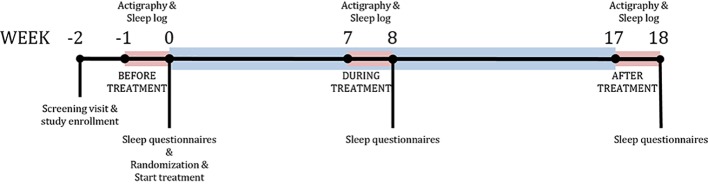
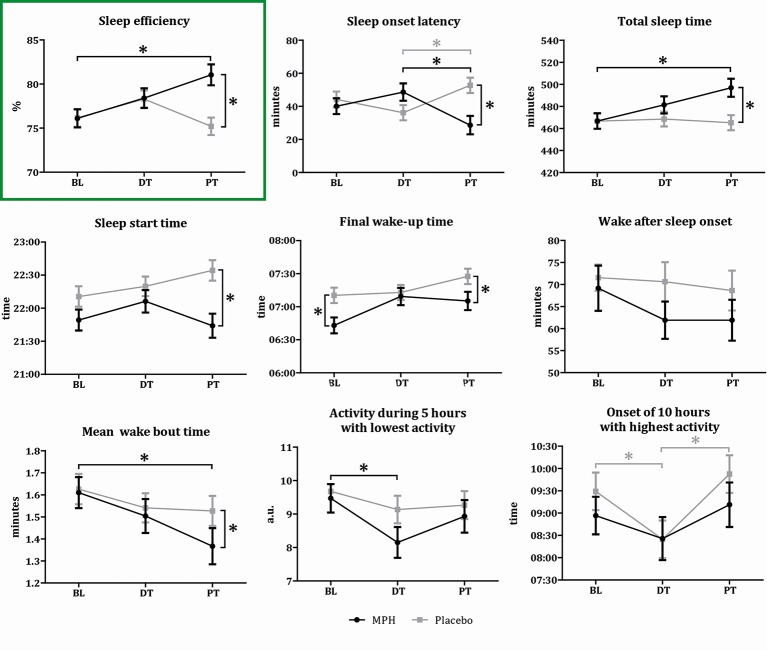
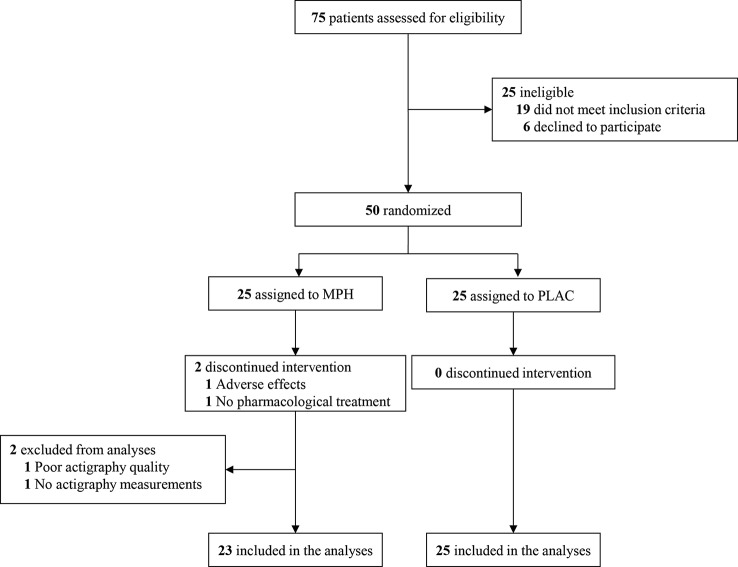
Methylphenidate (MPH) improves behavioral symptoms of attention-deficit/hyperactivity disorder (ADHD). Its effects on sleep, however, are insufficiently known, as trials with MPH in medication-naive children were so far restricted to relatively short trial durations. Here, we assessed effects of prolonged MPH treatment on sleep in medication-naive boys in a 16-weeks double-blind, placebo controlled, multicenter clinical trial with immediate-release MPH (ePOD-MPH trial, NTR3103). Seventy-five boys, aged 10-12 years, were screened for eligibility using ADHD DSM-IV criteria. Sleep was assessed using actigraphy, diaries and questionnaires prior to randomization, in week 8, and 1 week after trial end. Fifty boys (mean age 11.4y, SD 0.9) were randomized to MPH or placebo. Linear mixed model analysis demonstrated a significant time-by-treatment interaction effect (p = 0.007) on sleep efficiency. Post-hoc analyses demonstrated that the two groups did not differ from each other (p = 0.94) during treatment (week 8), but that sleep efficiency was significantly improved in the MPH (p = 0.005), but not placebo group (p = 0.87) 1 week after trial end. The lack of MPH's negative effects on sleep during treatment differ from most previous studies and could be explained by the relatively long trial duration in our study and the medication-naive status of our sample; suggesting that evaluating sleep problems only shortly after treatment onset presents an incomplete picture, because it might not be representative for sleep quality after longer treatment periods. Our findings of improved sleep after trial end could be due to rebound effects or longer-term effects of MPH treatment and therefore require replication.
Central Committee on Research Involving Human Subjects (an independent registry, identifier NL34509.000.10) before enrollment of the first subject and The Netherlands National Trial Register, identifier NTR3103.
哌甲酯(MPH)可改善注意力缺陷多动障碍(ADHD)的行为症状。然而,其对睡眠的影响尚不清楚,因为此前针对未服用过药物的儿童进行的MPH试验时间相对较短。在此,我们在一项为期16周的双盲、安慰剂对照、多中心临床试验中,使用速释MPH评估了长期MPH治疗对未服用过药物的男孩睡眠的影响(ePOD-MPH试验,NTR3103)。使用ADHD DSM-IV标准对75名10至12岁的男孩进行了资格筛查。在随机分组前、第8周以及试验结束后1周,使用活动记录仪、日记和问卷对睡眠进行评估。50名男孩(平均年龄11.4岁,标准差0.9)被随机分为MPH组或安慰剂组。线性混合模型分析显示,治疗时间与睡眠效率之间存在显著的交互作用(p = 0.007)。事后分析表明,两组在治疗期间(第8周)无差异(p = 0.94),但在试验结束后1周,MPH组的睡眠效率显著提高(p = 0.005),而安慰剂组未提高(p = 0.87)。MPH在治疗期间对睡眠无负面影响,这与之前的大多数研究不同,可能是由于我们的研究试验持续时间相对较长以及样本未服用过药物的状态;这表明仅在治疗开始后不久评估睡眠问题是不全面的,因为它可能无法代表更长治疗期后的睡眠质量。我们关于试验结束后睡眠改善的发现可能是由于MPH治疗的反弹效应或长期效应,因此需要重复验证。
在招募第一名受试者之前,已在涉及人类受试者研究中央委员会(一个独立注册机构,标识符NL34509.000.10)以及荷兰国家试验注册中心进行注册,标识符NTR3103。