Department of Endocrinology and Metabolism, Shanghai Key Laboratory of Diabetes Mellitus, Shanghai Clinical Center for Diabetes, Shanghai Jiao Tong University Affiliated Sixth People's Hospital, Shanghai, China.
Shanghai Diabetes Institute, Shanghai Key Laboratory of Diabetes Mellitus, Shanghai Clinical Center for Diabetes, Shanghai Jiao Tong University Affiliated Sixth People's Hospital, Shanghai, China.
Front Endocrinol (Lausanne). 2020 Feb 28;11:68. doi: 10.3389/fendo.2020.00068. eCollection 2020.
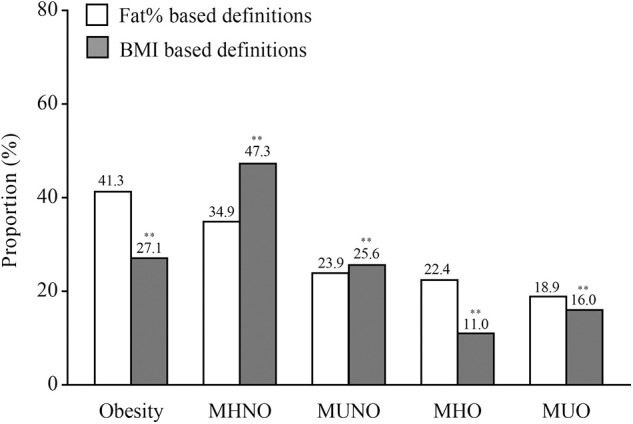
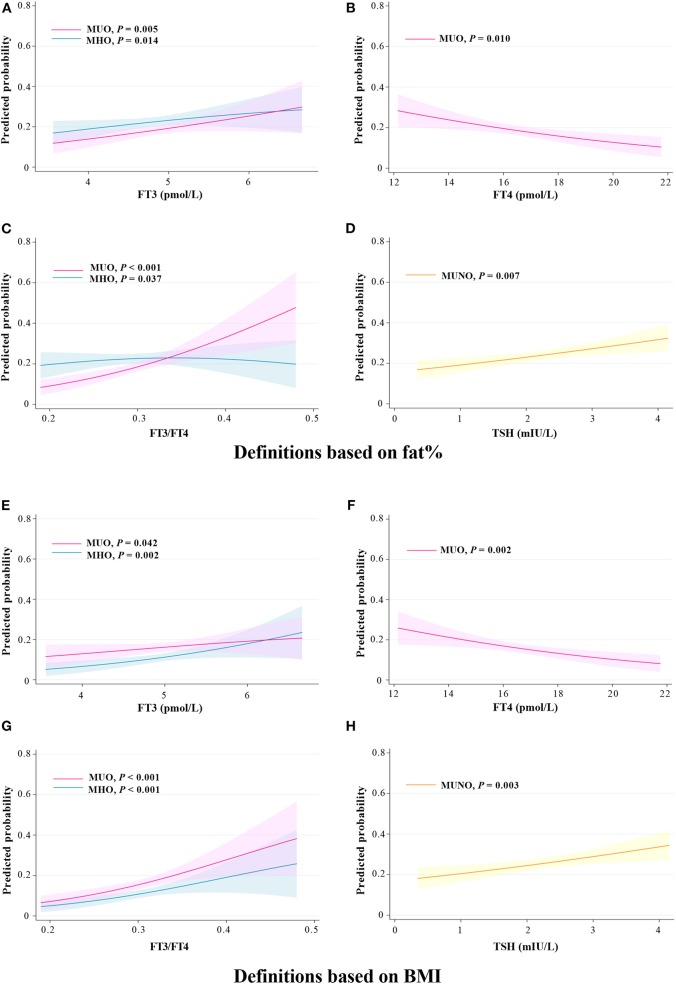
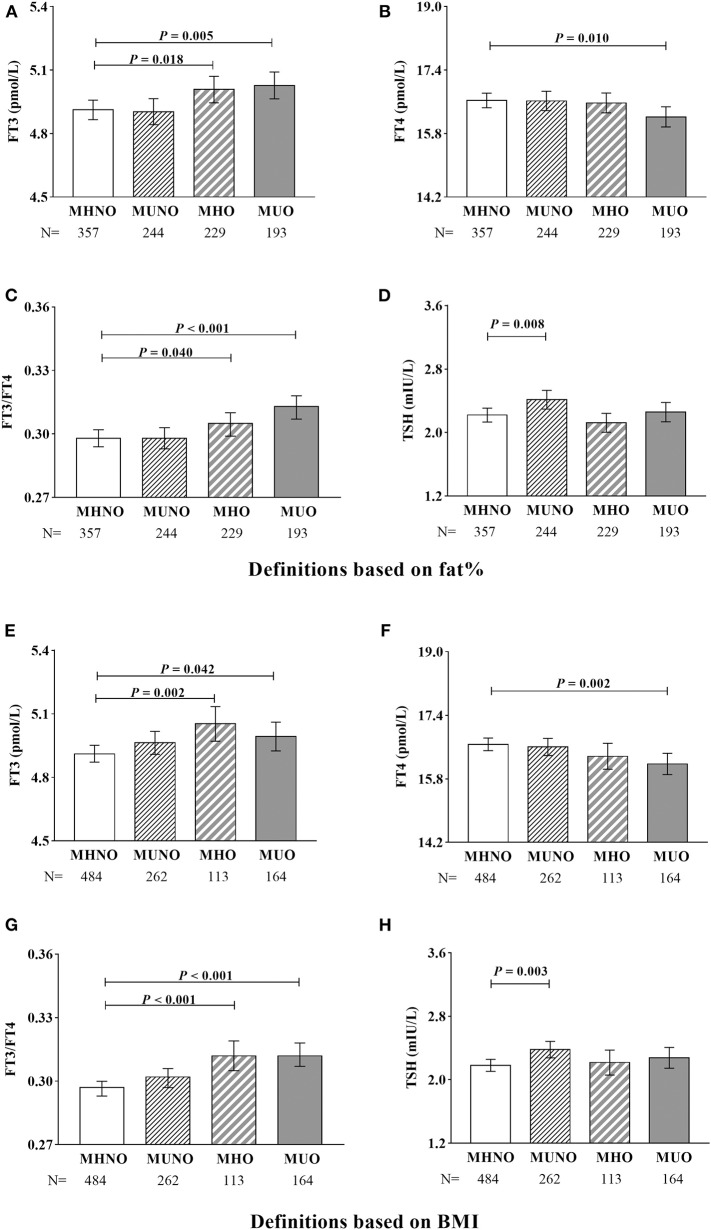
Metabolically healthy obese (MHO) individuals have attracted broad attention. We aimed to investigate the characteristics of serum thyroid hormones in different metabolic phenotypes of obesity. The study included 1,023 community-based euthyroid subjects (age range: 27-81 years), of whom 586 were women. Fat% was detected by a bioelectrical impedance analyzer. Two definitions of obesity were applied as follows: (1) fat% ≥ 25% for men and ≥ 30% for women; (2) body mass index (BMI) ≥ 25 kg/m. According to the diagnostic criteria for metabolic syndrome by the Chinese Diabetes Society, metabolically unhealthy was defined as two or more components of metabolic syndrome, excluding waist circumference. Serum-free triiodothyronine (FT3), free thyroxine (FT4), and thyroid-stimulating hormone (TSH) levels were measured by electrochemiluminescence immunoassay. The proportions of obesity defined by fat% and BMI were 41.3 and 27.1%, respectively. The proportion of metabolically unhealthy was 41.6%. After adjusting for age and gender, regardless of the definitions based on fat% or BMI, FT3 was positively related to both the MHO and the metabolically unhealthy obese (MUO) phenotypes [MHO: odds ratio (OR)s = 1.676 based on fat% and 2.055 based on BMI; MUO: ORs = 1.818 based on fat% and 1.526 based on BMI; all < 0.05]; FT4 was negatively related to the MUO phenotype (ORs = 0.870 based on fat% and 0.849 based on BMI, all < 0.05); FT3/FT4 was also positively related to both the MHO and the MUO phenotypes (MHO: ORs = 1.678 based on fat% and 2.825 based on BMI; MUO: ORs = 2.866 based on fat% and 2.883 based on BMI; all < 0.05); and TSH was positively related to the metabolically unhealthy non-obese phenotype (ORs = 1.329 based on fat% and 1.321 based on BMI, all < 0.01). In euthyroid population, both the MHO and the MUO phenotypes were characterized by increased FT3 and FT3/FT4 levels.
代谢健康型肥胖(MHO)个体受到了广泛关注。我们旨在研究不同肥胖代谢表型中血清甲状腺激素的特征。该研究纳入了 1023 名来自社区的甲状腺功能正常的受试者(年龄范围:27-81 岁),其中 586 名为女性。脂肪百分比通过生物电阻抗分析仪进行检测。采用以下两种肥胖定义:(1)男性脂肪百分比≥25%,女性脂肪百分比≥30%;(2)体重指数(BMI)≥25kg/m。根据中国糖尿病学会的代谢综合征诊断标准,代谢不健康定义为代谢综合征的两个或多个组成部分,不包括腰围。通过电化学发光免疫分析法测量血清游离三碘甲状腺原氨酸(FT3)、游离甲状腺素(FT4)和促甲状腺激素(TSH)水平。脂肪百分比和 BMI 定义的肥胖比例分别为 41.3%和 27.1%。代谢不健康的比例为 41.6%。在调整年龄和性别后,无论基于脂肪百分比还是 BMI 的定义,FT3 均与 MHO 和代谢不健康肥胖(MUO)表型呈正相关[MHO:基于脂肪百分比的比值比(OR)为 1.676,基于 BMI 的 OR 为 2.055;MUO:基于脂肪百分比的 OR 为 1.818,基于 BMI 的 OR 为 1.526;均<0.05];FT4 与 MUO 表型呈负相关(基于脂肪百分比的 OR 为 0.870,基于 BMI 的 OR 为 0.849;均<0.05);FT3/FT4 与 MHO 和 MUO 表型均呈正相关[MHO:基于脂肪百分比的 OR 为 1.678,基于 BMI 的 OR 为 2.825;MUO:基于脂肪百分比的 OR 为 2.866,基于 BMI 的 OR 为 2.883;均<0.05];TSH 与代谢不健康非肥胖表型呈正相关(基于脂肪百分比的 OR 为 1.329,基于 BMI 的 OR 为 1.321;均<0.01)。在甲状腺功能正常的人群中,MHO 和 MUO 表型的特点均为 FT3 和 FT3/FT4 水平升高。