Organ Transplant Center, The First Affiliated Hospital, Sun Yat-sen University, Guangzhou, China.
BGI-Guangzhou Medical Laboratory, BGI-Shenzhen, Guangzhou, China.
Front Immunol. 2020 Feb 28;11:342. doi: 10.3389/fimmu.2020.00342. eCollection 2020.
To evaluate the diagnostic performance of donor-derived plasma cell-free DNA (cfDNA) in discriminating antibody-mediated rejection (ABMR) or donor-specific antibodies (DSA) without histological lesions in kidney allograft recipients.
In this prospective single center observational study, we enrolled kidney allograft recipients between November, 2016 and September, 2017 at the First Affiliated Hospital of Sun Yat-sen University. Kidney allograft recipients with ABMR, DSA but no histological lesions or negative DSA, and stable renal function were included. The plasma cfDNA fraction was measured using a targeted, single nucleotide polymorphism (SNP)-based assay. Pathological diagnosis was made according to the 2015 Banff Kidney Rejection Classification. The area under the ROC curve (AUC-ROC) was determined using the bootstrapping method to estimate median and 95% confidence interval (95% CI). The sensitivity, specificity and Youden index, positive predictive value (PPV), and negative predictive value (NPV) were calculated for specific cfDNA fractions.
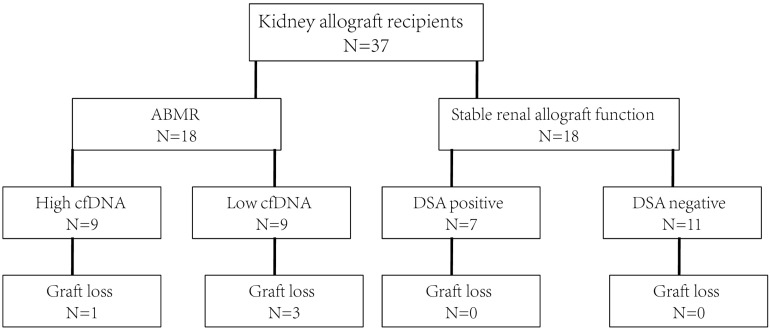
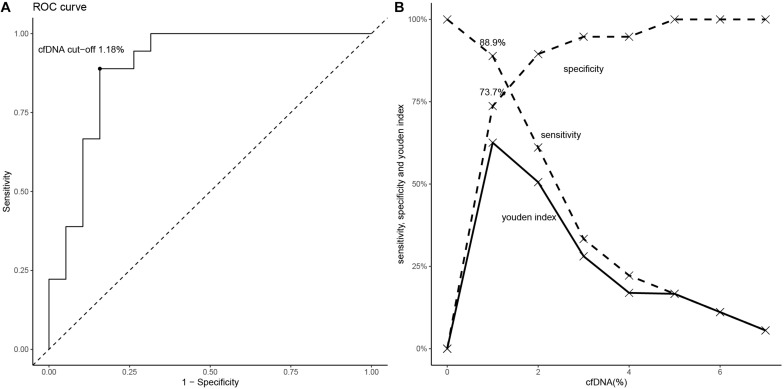
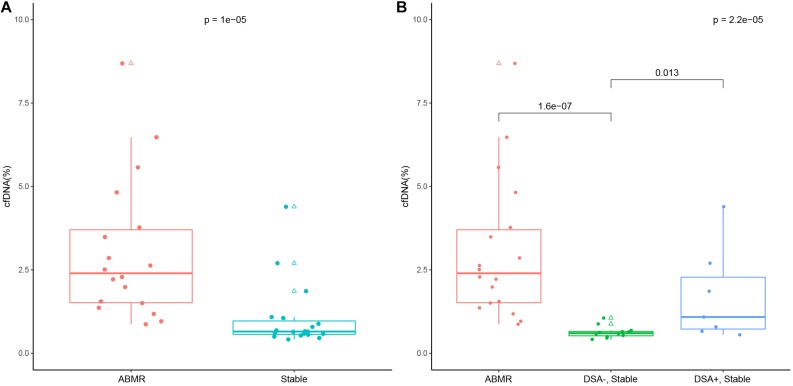
Totally 37 consecutive patients received kidney allografts, including 18 recipients in the ABMR group and 19 recipients in the stable allograft group (7 DSA-positive and 12 DSA-negative). All patients in the ABMR group were DSA positive and 7 patients in the stable group were DSA positive but had no pathologically proven ABMR. The median donor-derived plasma cfDNA fraction was 2.4% (Q1 1.52% -Q3 3.70%) in the ABMR group, and was significantly higher than that of the stable group (0.65%, Q1 0.57% -Q3 0.97%; < 0.001), but comparable with that of the DSA-positive patients in the stable allograft group ( = 0.074). The AUC-ROC of cfDNA was 0.90 (95% CI, 0.79-0.98). When a cfDNA threshold of 1% was chosen, it had a sensitivity of 88.9% and a specificity of 73.7%. The PPV was 76.2% and the NPV was 87.5%.
Donor-derived plasma cfDNA fraction increased in kidney allograft recipients with ABMR. Detection of donor-derived plasma cfDNA fraction may contribute to the discrimination between ABMR and stable renal allograft function and may aid early recognition of earlier stage antibody-mediated injury.
评估供体来源的无细胞血浆 DNA (cfDNA) 在区分无组织学病变的肾移植受者中的抗体介导的排斥反应 (ABMR) 或供体特异性抗体 (DSA) 中的诊断性能。
本前瞻性单中心观察性研究纳入 2016 年 11 月至 2017 年 9 月在中山大学附属第一医院接受肾移植的患者。纳入 ABMR、DSA 但无组织学病变或 DSA 阴性且肾功能稳定的肾移植受者。使用靶向单核苷酸多态性 (SNP) 检测法测量血浆 cfDNA 片段。根据 2015 年 Banff 肾脏排斥分类进行病理诊断。使用自举法确定 ROC 曲线下面积 (AUC-ROC) ,以估计中位数和 95%置信区间 (95%CI) 。计算特定 cfDNA 片段的灵敏度、特异性和 Youden 指数、阳性预测值 (PPV) 和阴性预测值 (NPV) 。
共纳入 37 例连续接受肾移植的患者,其中 ABMR 组 18 例,稳定移植组 19 例(7 例 DSA 阳性,12 例 DSA 阴性)。ABMR 组所有患者均为 DSA 阳性,稳定组 7 例患者 DSA 阳性但无组织学证实的 ABMR。ABMR 组供体来源的血浆 cfDNA 中位数为 2.4%(Q1 1.52% - Q3 3.70%),明显高于稳定组(0.65%,Q1 0.57% - Q3 0.97%;<0.001),但与稳定移植组 DSA 阳性患者相当(=0.074)。cfDNA 的 AUC-ROC 为 0.90(95%CI,0.79-0.98)。当选择 cfDNA 阈值为 1%时,其灵敏度为 88.9%,特异性为 73.7%。PPV 为 76.2%,NPV 为 87.5%。
ABMR 肾移植受者中供体来源的血浆 cfDNA 分数增加。检测供体来源的血浆 cfDNA 分数有助于区分 ABMR 和稳定的肾移植功能,并可能有助于早期识别早期的抗体介导损伤。