
成人原发性肾病综合征的中药注射剂:系统评价与网状Meta分析
Chinese Herbal Injections for Primary Nephrotic Syndrome in Adults: A Systematic Review and Network Meta-Analysis.
作者信息
Han Shisheng, Yao Tianwen, Lu Yanhua, Lu Yan, Xu Yanqiu, Wang Yi
机构信息
Department of Nephrology, Yueyang Hospital of Integrated Traditional Chinese and Western Medicine, Shanghai University of Traditional Chinese Medicine, Shanghai 200437, China.
Department of Internal Medicine, Youyi Street Community Health Service Center of Baoshan District, Shanghai 201900, China.
出版信息
Evid Based Complement Alternat Med. 2020 Feb 24;2020:1047489. doi: 10.1155/2020/1047489. eCollection 2020.
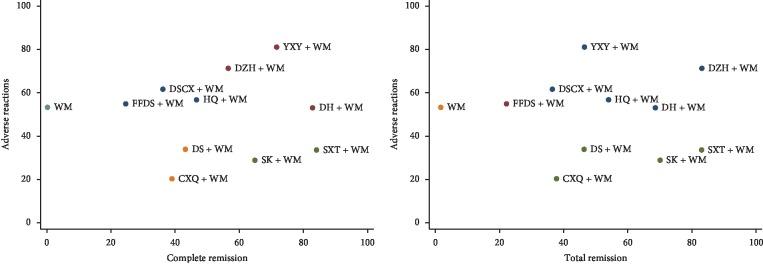
Primary nephrotic syndrome (PNS) is a common renal disease that presents with heavy proteinuria and hypoalbuminemia. Despite notable advances in its treatment, some patients show poor responses and clinical outcomes when treated with conventional Western medicine (WM). Chinese herbal injections (CHIs) have been reported to have beneficial effects for PNS. The aim of the present study was to comprehensively determine the efficacy and safety of CHIs for PNS in adults using a network meta-analysis approach. PubMed, Embase, the Cochrane library, and four Chinese databases were systematically searched to identify randomized controlled trials (RCTs) using CHIs for treatment of PNS published before June 1, 2019. Quality assessment of the identified RCTs was performed according to the Cochrane Handbook. Pooled odds ratios (OR) or mean differences (MD) with corresponding 95% confidence intervals (CI) were calculated for discrete or continuous variables, respectively. The primary outcome was complete/total remission and secondary outcomes were serum albumin and urinary protein excretion. The surface under the cumulative ranking curve (SUCRA) value and cluster analyses were used to rank treatment by probability. Eighty-five studies involving 11 CHIs and 5801 subjects were included. Compared with WM alone, CHI plus WM showed an improved complete/total remission rate as well as higher serum albumin and lower 24-hour urinary protein excretion, except in the following: Yinxingye injection plus WM did not improve the total remission rate, and Dengzhanhua or Xueshuantong injection plus WM did not lower the 24-hour urinary protein excretion. Either Danhong (DH) or Dengzhanhua (DZH) injection plus WM was the preferable treatment for PNS based on SUCRA and cluster analyses of clinical remission and adverse events. However, considering that literature in this area is limited, these results need further validation. CHIs administered as adjuvants to WM showed favourable outcomes for PNS. DH + WM and DZH + WM might be the potential optimal therapies for PNS.
原发性肾病综合征(PNS)是一种常见的肾脏疾病,表现为大量蛋白尿和低白蛋白血症。尽管其治疗取得了显著进展,但一些患者在接受传统西医(WM)治疗时反应不佳且临床结局较差。据报道,中药注射剂(CHIs)对PNS有有益作用。本研究的目的是使用网络荟萃分析方法全面确定CHIs对成人PNS的疗效和安全性。系统检索了PubMed、Embase、Cochrane图书馆和四个中文数据库,以识别2019年6月1日前发表的使用CHIs治疗PNS的随机对照试验(RCTs)。根据Cochrane手册对纳入的RCTs进行质量评估。分别针对离散变量或连续变量计算合并比值比(OR)或平均差(MD)以及相应的95%置信区间(CI)。主要结局为完全/总体缓解,次要结局为血清白蛋白和尿蛋白排泄。使用累积排序曲线下面积(SUCRA)值和聚类分析按概率对治疗进行排序。纳入了85项研究,涉及11种CHIs和5801名受试者。与单纯西医治疗相比,CHIs联合西医治疗显示完全/总体缓解率提高,血清白蛋白升高,24小时尿蛋白排泄降低,但以下情况除外:银杏叶注射液联合西医治疗未提高总体缓解率,灯盏花或血栓通注射液联合西医治疗未降低24小时尿蛋白排泄。基于临床缓解和不良事件的SUCRA和聚类分析,丹红(DH)或灯盏花(DZH)注射液联合西医治疗是PNS的优选治疗方法。然而,考虑到该领域的文献有限,这些结果需要进一步验证。CHIs作为西医治疗的辅助药物对PNS显示出良好的结局。DH + WM和DZH + WM可能是PNS的潜在最佳治疗方法。


 Zotero 插件