Tariel Juliette, Plénet Sandrine, Luquet Émilien
Univ Lyon, Université Claude Bernard Lyon 1, CNRS, ENTPE, UMR 5023 LEHNA Villeurbanne France.
Ecol Evol. 2020 Feb 14;10(5):2367-2376. doi: 10.1002/ece3.6046. eCollection 2020 Mar.
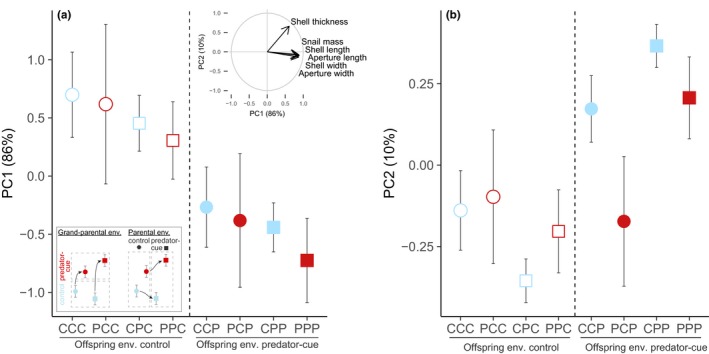
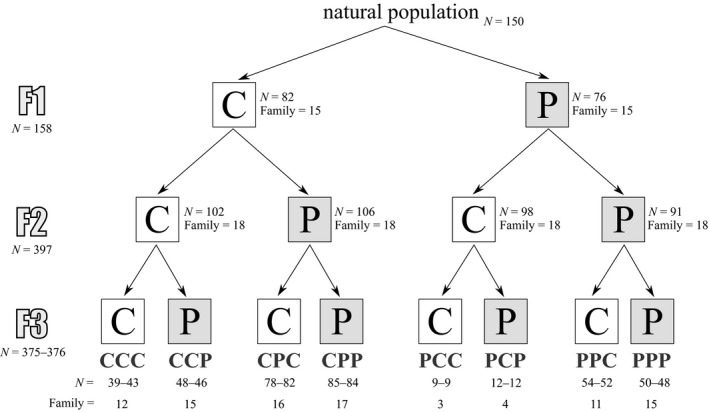
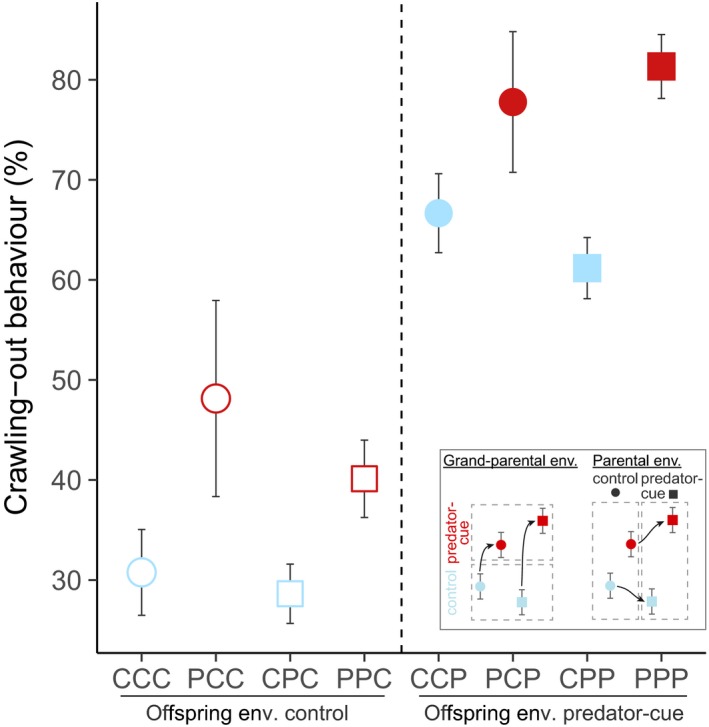
Phenotypic plasticity can occur across generations (transgenerational plasticity) when environments experienced by the previous generations influenced offspring phenotype. The evolutionary importance of transgenerational plasticity, especially regarding within-generational plasticity, is a currently hot topic in the plasticity framework. How long an environmental effect can persist across generations and whether multigenerational effects are cumulative are primordial-for the evolutionary significance of transgenerational plasticity-but still unresolved questions. In this study, we investigated how the grand-parental, parental and offspring exposures to predation cues shape the predator-induced defences of offspring in the snail. We expected that the offspring phenotypes result from a three-way interaction among grand-parental, parental and offspring environments. We exposed three generations of snails without and with predator cues according to a full factorial design and measured offspring inducible defences. We found that both grand-parental and parental exposures to predator cues impacted offspring antipredator defences, but their effects were not cumulative and depended on the defences considered. We also highlighted that the grand-parental environment did alter reaction norms of offspring shell thickness, demonstrating an interaction between the grand-parental transgenerational plasticity and the within-generational plasticity. We concluded that the effects of multigenerational exposure to predator cues resulted on complex offspring phenotypic patterns which are difficult to relate to adaptive antipredator advantages.
当亲代所经历的环境影响子代的表型时,表型可塑性可以跨代发生(跨代可塑性)。跨代可塑性的进化重要性,尤其是相对于代内可塑性而言,是可塑性框架中当前的一个热门话题。一种环境效应能在几代间持续多久,以及多代效应是否具有累积性,这对于跨代可塑性的进化意义至关重要,但仍是尚未解决的问题。在本研究中,我们调查了祖代、亲代和子代暴露于捕食线索如何塑造蜗牛子代的捕食者诱导防御。我们预期子代表型是祖代、亲代和子代环境之间三方相互作用的结果。我们根据全因子设计,让三代蜗牛分别处于有无捕食者线索的环境中,并测量子代的诱导防御。我们发现,祖代和亲代暴露于捕食线索均会影响子代的反捕食防御,但其影响并非累积性的,且取决于所考虑的防御类型。我们还强调,祖代环境确实改变了子代壳厚度的反应规范,这表明祖代跨代可塑性与代内可塑性之间存在相互作用。我们得出结论,多代暴露于捕食线索的影响导致了复杂的子代表型模式,而这些模式难以与适应性反捕食优势联系起来。