Department of Gynecology, The Affiliated Hospital of Qingdao University, Qingdao, China.
School of Nursing, Weifang University of Science and Technology, Shouguang, China.
J Immunol Res. 2020 Feb 26;2020:4683798. doi: 10.1155/2020/4683798. eCollection 2020.
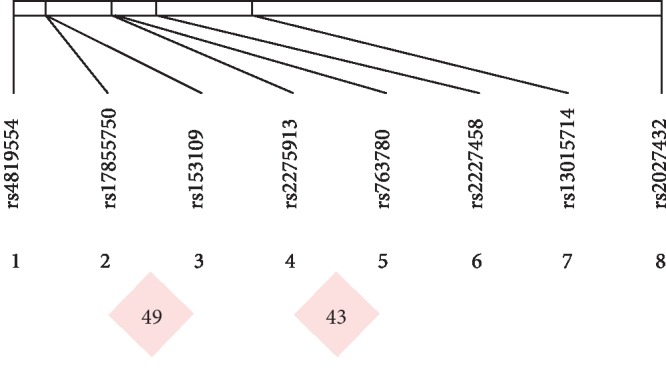
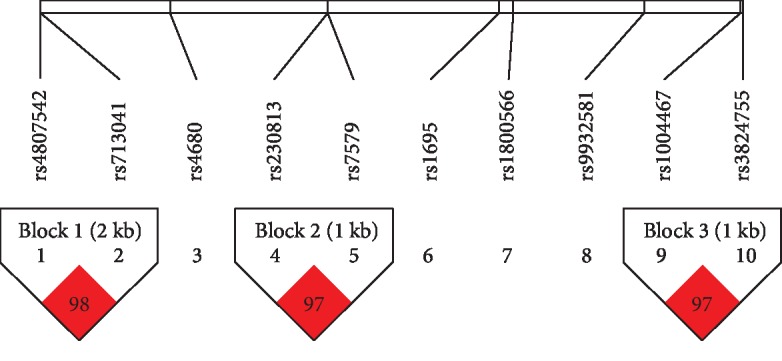
Unbalanced inflammatory reactions and oxidative stress are inseparably interconnected, and both may play crucial roles in the pathophysiological mechanisms of preeclampsia (PE). In the published previous studies, we have genotyped for SNPs that related to inflammation (rs2227485, rs153109, rs17855750, rs2027432, rs2275913, rs763780, rs4819554, and rs13015714) and oxidative stress (rs1695, rs4680, rs1800566, rs4807542, rs713041, rs7579, rs230813, rs1004467, rs3824755, and rs9932581) to investigate whether these polymorphisms were associated with susceptibility to PE in a Chinese Han population. In this present study, we collected these data of experimental and clinical from above studies for haplotype analysis of inflammation-related SNPs in 631 PE patients and 720 normal pregnancy and oxidative stress-related SNPs in 342 PE patients and 457 normal pregnancies for susceptibility to PE. The data of genotype distribution and allele frequency comparisons after correction for multiple comparisons (P/8 or P/10) showed 2 among the 8 candidate inflammation-related SNPs have significant differences (rs2027432 genotype = 407.377, < 0.001, < 0.00625). Moreover, the minor alleles of rs2027432 T (minor allele = 450.923, < 0.001, < 0.00625; OR = 21.439, 95%CI = 15.181-30.278) and rs4819554 G (minor allele = 163.465, < 0.001, < 0.00625; OR = 5.814, 95%CI = 4.380-7.719) were confirmed as risk allele of PE, respectively. Our analysis revealed rs2027432 (TT) of NLRP3 and rs4819554 (GG) of IL-17RA are risk factors for PE. However, no significant difference was found at the oxidative stress-related SNPs. In the candidate loci for oxidative stress, we also identified 3 SNP matches (rs4807542 and rs713041, rs230813 and rs75799, rs1004467 and rs3824755) that had high linkage disequilibrium (LD) with each other and were selected as a block ( = 0.98, = 0.97, = 0.97, > 0.9), and the GT and GC haplotypes of rs4807542 and rs713041 in showed significant differences between the PE and control groups ( = 5.143, = 0.0233, < 0.05; = 6.373, = 0.0116, < 0.05). So, we inferred that polymorphisms of NLRP3 rs2027432 and IL-17RA rs4819554, which are related to inflammation, and the rs713041 variant of , which is related to oxidative stress, were associated with susceptibility to PE. The GT and GC haplotypes of rs4807542 and rs713041 in may increase the risk of PE in the Chinese Han population.
不平衡的炎症反应和氧化应激是不可分割地相互关联的,两者都可能在子痫前期(PE)的病理生理机制中起关键作用。在已发表的先前研究中,我们对与炎症(rs2227485、rs153109、rs17855750、rs2027432、rs2275913、rs763780、rs4819554 和 rs13015714)和氧化应激(rs1695、rs4680、rs1800566、rs4807542、rs713041、rs7579、rs230813、rs1004467、rs3824755 和 rs9932581)相关的 SNP 进行了基因分型,以研究这些多态性是否与中国汉族人群患 PE 的易感性有关。在本研究中,我们收集了上述研究中的实验和临床数据,对 631 例 PE 患者和 720 例正常妊娠的炎症相关 SNP 进行了单体型分析,对 342 例 PE 患者和 457 例正常妊娠的氧化应激相关 SNP 进行了易感性分析。经过多重比较校正(P/8 或 P/10)后,基因型分布和等位基因频率比较的数据显示,8 个候选炎症相关 SNP 中有 2 个存在显著差异(rs2027432 基因型=407.377, < 0.001, < 0.00625)。此外,rs2027432 T (次要等位基因=450.923, < 0.001, < 0.00625;OR=21.439,95%CI=15.181-30.278)和 rs4819554 G (次要等位基因=163.465, < 0.001, < 0.00625;OR=5.814,95%CI=4.380-7.719)被证实分别是 PE 的风险等位基因。我们的分析表明,NLRP3 的 rs2027432(TT)和 IL-17RA 的 rs4819554(GG)是 PE 的危险因素。然而,在氧化应激相关 SNP 中没有发现显著差异。在候选氧化应激基因座中,我们还鉴定出 3 个 SNP 匹配(rs4807542 和 rs713041、rs230813 和 rs75799、rs1004467 和 rs3824755)彼此之间具有高度连锁不平衡(LD),并被选为一个块(D′=0.98,r2=0.97,D′=0.97,r2>0.9),并且 rs4807542 和 rs713041 的 GT 和 GC 单体型在 PE 组和对照组之间存在显著差异(r2=5.143,r2=0.0233,r2<0.05;r2=6.373,r2=0.0116,r2<0.05)。因此,我们推断,与炎症相关的 NLRP3 rs2027432 和 IL-17RA rs4819554 以及与氧化应激相关的 rs713041 多态性与 PE 的易感性有关。rs4807542 和 rs713041 的 GT 和 GC 单体型可能会增加汉族人群患 PE 的风险。