Markatseli Theodora E, Theodoridou Athina, Zakalka Marina, Koukli Eftychia, Triantafyllidou Eva, Tsalavos Sotiris, Andrianakos Alexandros, Drosos Alexandros A
Rheumatology Clinic, Department of Internal Medicine, Medical School, University of Ioannina, Ioannina, Greece.
Academic Clinical Fellow, Rheumatology Unit, D' Internal Medicine Department, Hippokrateion University Hospital, Thessaloniki, Greece.
Mediterr J Rheumatol. 2019 Sep 30;30(3):177-185. doi: 10.31138/mjr.30.3.177. eCollection 2019 Sep.
OBJECTIVE/AIM: One of the most important factors that affect a treatment's performance in rheumatoid arthritis (RA) is adherence to medications. According to literature, there are several reasons for non-adherence in RA patients with some of them being related to a specific patient profile of the study population. In this study, we investigated persistence to intravenous tocilizumab (TCZ) therapy in RA during routine clinical practice in Greece and identified causes for non-adherence.
183 RA patients who mostly attended private practice Rheumatologists and received intravenous TCZ treatment at a schedule of 1 infusion per 4-weeks in the first 6 months were recorded retrospectively.
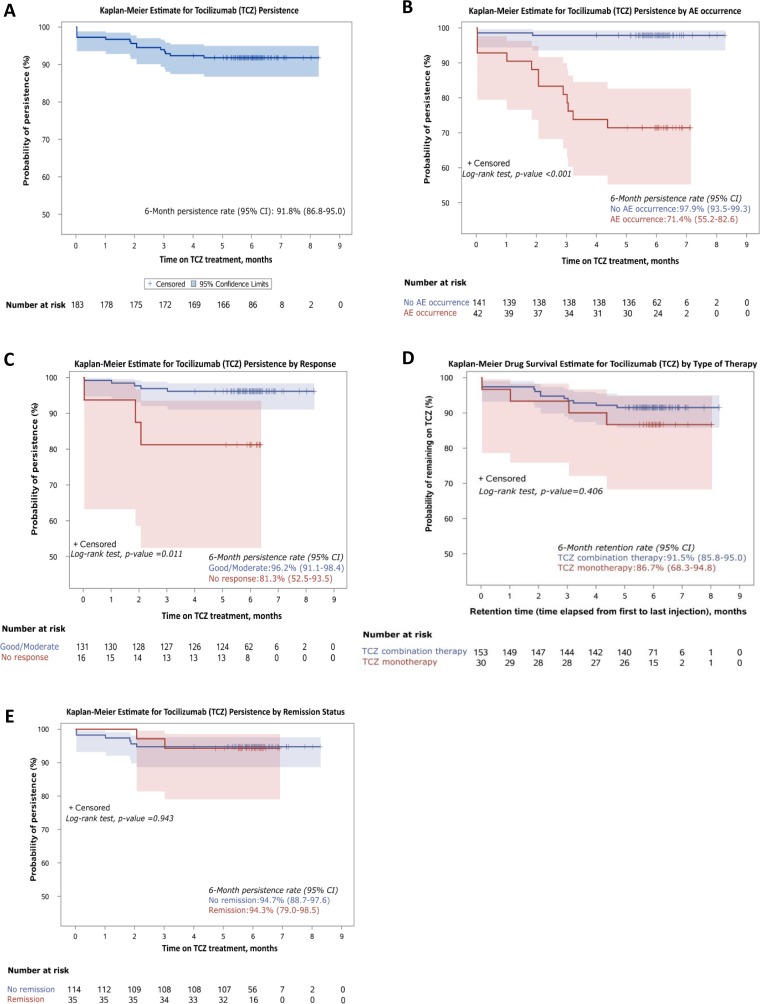
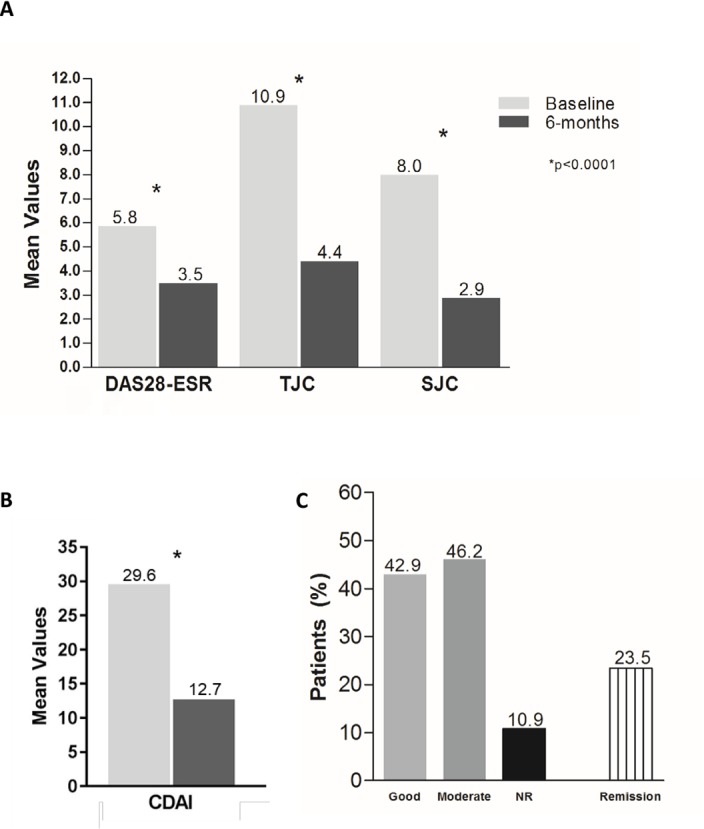
Persistence estimated rate to TCZ therapy was 92.0% for patients that received 6 infusions and 83.4% for patients that received 7 infusions of TCZ. Potential factors that influence persistence to therapy were the occurrence of adverse events and response to the therapy. The main reasons for non-adherence to TCZ therapy were non-medically related with the most common being drug supply issues. The 6-month mean change from baseline in DAS28-ESR after initiation of TCZ therapy was -1.3, and the mean CDAI dropped from 29.6 at baseline to 16.7 at 6 months. Good/Moderate response was achieved by 89.1% of patients and remission by 23.5%. The safety profile was similar to that observed in other TCZ trials with the most common being infections, hematologic manifestations and musculoskeletal disorders.
Overall, persistence to therapy appeared to be high in the rheumatology private practice setting and non-adherence to the TCZ treatment schedule is attributed mainly to non-medical reasons.
影响类风湿关节炎(RA)治疗效果的最重要因素之一是药物依从性。根据文献,RA患者不依从的原因有多种,其中一些与研究人群的特定患者特征有关。在本研究中,我们调查了希腊常规临床实践中RA患者接受静脉注射托珠单抗(TCZ)治疗的持续性,并确定了不依从的原因。
回顾性记录了183例主要就诊于私人执业风湿病学家且在前6个月按每4周1次的计划接受静脉注射TCZ治疗的RA患者。
接受6次输注的患者对TCZ治疗的持续性估计率为92.0%,接受7次输注的患者为83.4%。影响治疗持续性的潜在因素是不良事件的发生和对治疗的反应。不依从TCZ治疗的主要原因与医疗无关,最常见的是药物供应问题。开始TCZ治疗后6个月,DAS28-ESR较基线的平均变化为-1.3,平均CDAI从基线时的29.6降至6个月时的16.7。89.1%的患者达到良好/中度反应,23.5%的患者达到缓解。安全性概况与其他TCZ试验中观察到的相似,最常见的是感染、血液学表现和肌肉骨骼疾病。
总体而言,在风湿病私人执业环境中治疗的持续性似乎较高,不依从TCZ治疗方案主要归因于非医疗原因。