Department of Life Sciences, Imperial College London, London, UK.
Department of Infectious Disease, MRC Centre for Molecular Bacteriology & Infection, Imperial College London, London, UK.
Cell Microbiol. 2020 Apr;22(4):e13184. doi: 10.1111/cmi.13184.
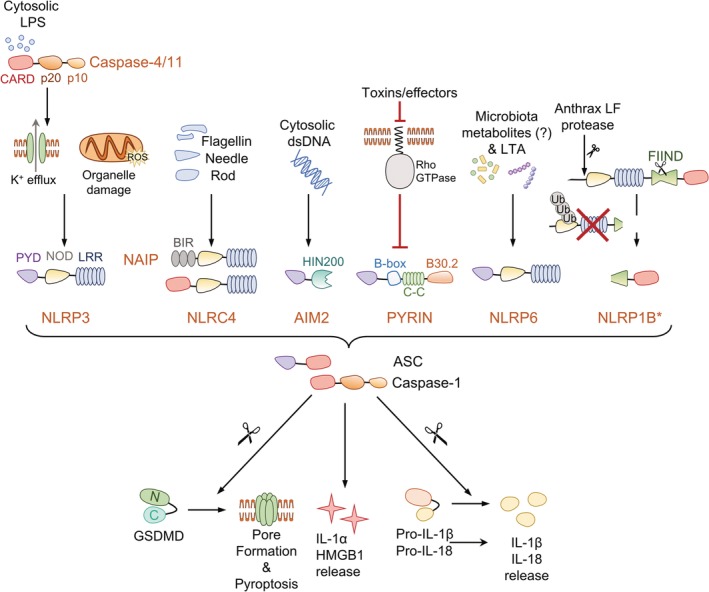
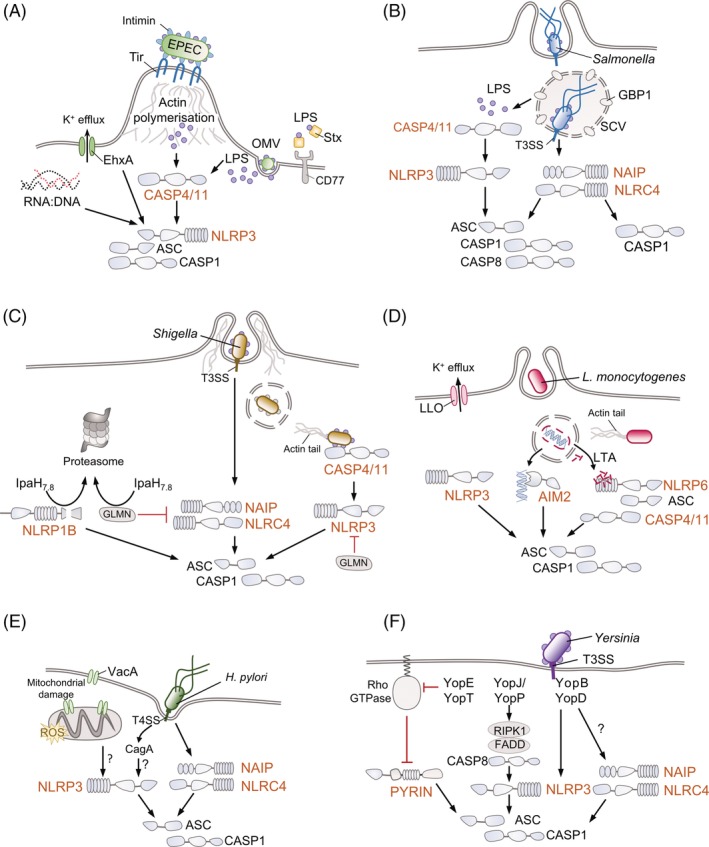
Enteric pathogen-host interactions occur at multiple interfaces, including the intestinal epithelium and deeper organs of the immune system. Microbial ligands and activities are detected by host sensors that elicit a range of immune responses. Membrane-bound toll-like receptors and cytosolic inflammasome pathways are key signal transducers that trigger the production of pro-inflammatory molecules, such as cytokines and chemokines, and regulate cell death in response to infection. In recent years, the inflammasomes have emerged as a key frontier in the tussle between bacterial pathogens and the host. Inflammasomes are complexes that activate caspase-1 and are regulated by related caspases, such as caspase-11, -4, -5 and -8. Importantly, enteric bacterial pathogens can actively engage or evade inflammasome signalling systems. Extracellular, vacuolar and cytosolic bacteria have developed divergent strategies to subvert inflammasomes. While some pathogens take advantage of inflammasome activation (e.g. Listeria monocytogenes, Helicobacter pylori), others (e.g. E. coli, Salmonella, Shigella, Yersinia sp.) deploy a range of virulence factors, mainly type 3 secretion system effectors, that subvert or inhibit inflammasomes. In this review we focus on inflammasome pathways and their immune functions, and discuss how enteric bacterial pathogens interact with them. These studies have not only shed light on inflammasome-mediated immunity, but also the exciting area of mammalian cytosolic immune surveillance.
肠病原体-宿主相互作用发生在多个界面,包括肠道上皮和免疫系统的更深层器官。微生物配体和活动被宿主传感器检测到,这些传感器引发一系列免疫反应。膜结合的 Toll 样受体和细胞质炎性小体途径是关键的信号转导器,可触发促炎分子(如细胞因子和趋化因子)的产生,并调节细胞死亡以响应感染。近年来,炎性小体已成为细菌病原体与宿主之间斗争的一个关键前沿领域。炎性小体是激活 caspase-1 的复合物,并受相关半胱天冬酶(如 caspase-11、-4、-5 和 -8)调节。重要的是,肠道细菌病原体可以主动参与或逃避炎性小体信号系统。细胞外、空泡和细胞质细菌已经开发出不同的策略来颠覆炎性小体。虽然一些病原体利用炎性小体的激活(例如李斯特菌、幽门螺杆菌),但其他病原体(例如大肠杆菌、沙门氏菌、志贺氏菌、耶尔森氏菌)则利用多种毒力因子,主要是 III 型分泌系统效应物,来颠覆或抑制炎性小体。在这篇综述中,我们重点介绍了炎性小体途径及其免疫功能,并讨论了肠道细菌病原体如何与它们相互作用。这些研究不仅揭示了炎性小体介导的免疫,还揭示了哺乳动物细胞质免疫监视的令人兴奋的领域。