El Colegio de la Frontera Sur (ECOSUR), Tapachula, Chiapas, México.
Programa Moscafrut SADER-SENASICA, Metapa de Domínguez, Chiapas, México.
J Insect Sci. 2020 Mar 1;20(2). doi: 10.1093/jisesa/ieaa010.
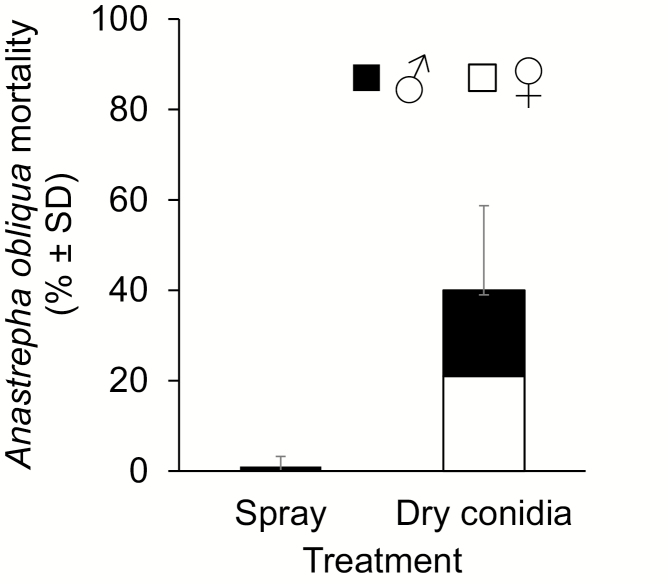
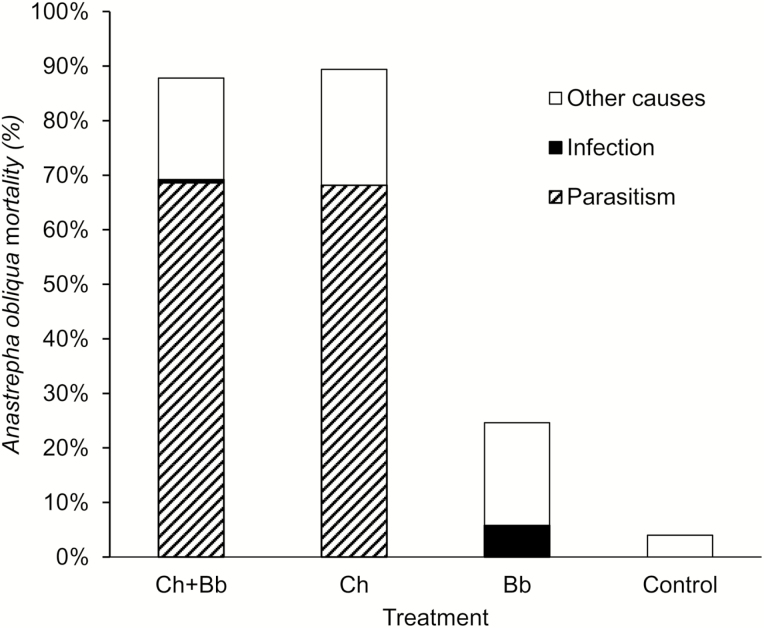
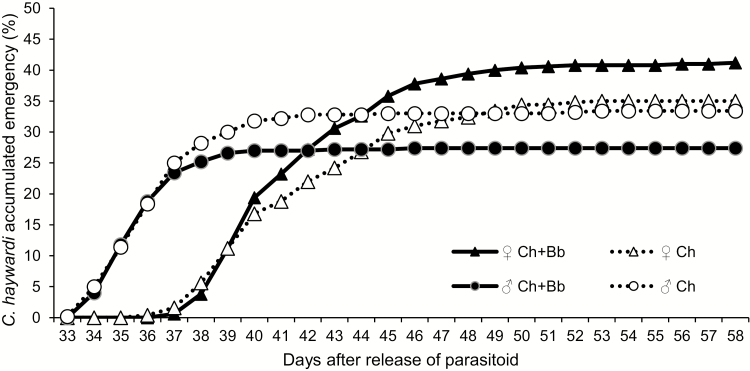
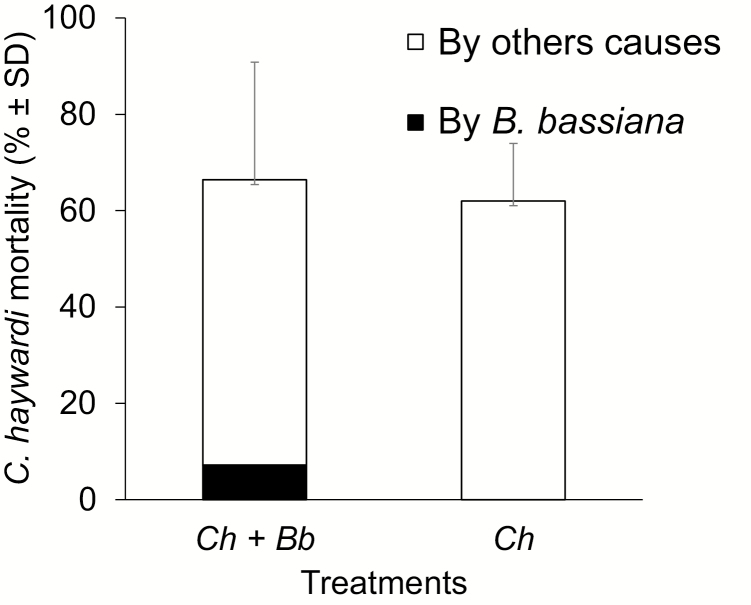
The interaction between the entomopathogenic fungus Beauveria bassiana (Balsamo) and the parasitoid Coptera haywardi (Oglobin), as potential biological control agents for Anastrepha obliqua (Macquart) fruit flies, was evaluated under laboratory and semi-protected field cage conditions. The effects of the parasitoids and fungus were individually and jointly assessed in Plexiglas cages. Application of B. bassiana dry conidia to soil produced 40% mortality in A. obliqua adults. However, mortality was lower (21.2%) on evaluation under field cage conditions. According to the multiple decrement life table analysis, the probability of death of A. obliqua was 88% when C. haywardi parasitoids and B. bassiana conidia were used in conjunction, 89% when only C. haywardi parasitoids were released and 23% when only B. bassiana conidia were applied. These results demonstrate that no synergistic, additive or antagonistic interaction took place with the simultaneous use of these natural enemies, since the presence of B. bassiana had no effect on the C. haywardi parasitism. These results indicate that the parasitoid is a better natural enemy for the control of A. obliqua, and show that, although the two biological control agents can be used simultaneously, their joint application will not produce increased control.
在实验室和半保护野外笼条件下,评估了昆虫病原真菌白僵菌(Balsamo)和寄生蜂 Coptera haywardi(Oglobin)作为潜在的生物防治剂,对安氏寡鬃实蝇(Macquart)实蝇的相互作用。单独和联合评估了寄生蜂和真菌对聚甲基丙烯酸甲酯笼中的影响。将白僵菌干燥分生孢子施用于土壤中,可使安氏寡鬃实蝇成虫的死亡率达到 40%。然而,在野外笼条件下评估时,死亡率较低(21.2%)。根据多次递减生命表分析,当同时使用 C. haywardi 寄生蜂和 B. bassiana 分生孢子时,A. obliqua 的死亡概率为 88%,仅释放 C. haywardi 寄生蜂时为 89%,仅施用 B. bassiana 分生孢子时为 23%。这些结果表明,当同时使用这些天敌时,没有协同、相加或拮抗作用,因为 B. bassiana 的存在对 C. haywardi 的寄生没有影响。这些结果表明,寄生蜂是控制 A. obliqua 的更好的天敌,并且表明,尽管这两种生物防治剂可以同时使用,但它们的联合应用不会产生增加的控制效果。