Du Ran, Joswig Jan-Ole, Hübner René, Zhou Lin, Wei Wei, Hu Yue, Eychmüller Alexander
Physical Chemistry, Technische Universität Dresden, Bergstr. 66b, 01069, Dresden, Germany.
Theoretische Chemie, Fakultät für Chemie und Lebensmittelchemie, Technische Universität Dresden, 01062, Dresden, Germany.
Angew Chem Int Ed Engl. 2020 May 18;59(21):8293-8300. doi: 10.1002/anie.201916484. Epub 2020 Apr 6.
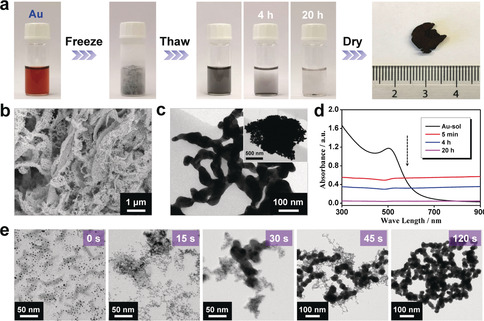
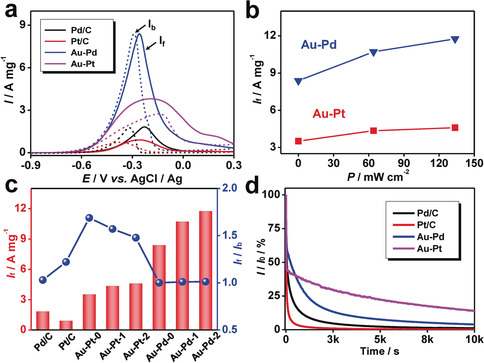
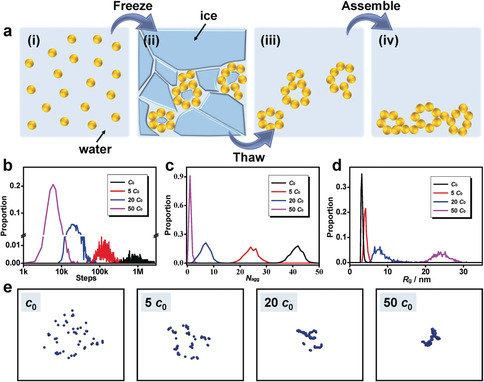
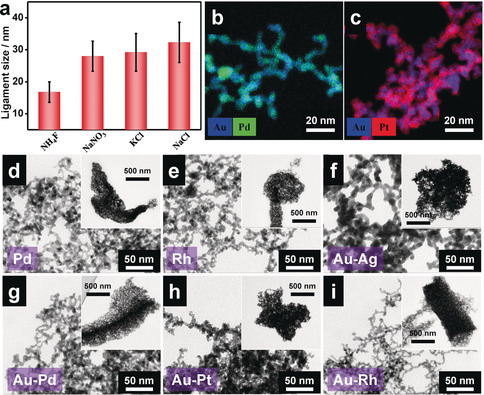
Noble-metal aerogels (NMAs) have drawn increasing attention because of their self-supported conductive networks, high surface areas, and numerous optically/catalytically active sites, enabling their impressive performance in diverse fields. However, the fabrication methods suffer from tedious procedures, long preparation times, unavoidable impurities, and uncontrolled multiscale structures, discouraging their developments. By utilizing the self-healing properties of noble-metal aggregates, the freezing-promoted salting-out behavior, and the ice-templating effect, a freeze-thaw method is crafted that is capable of preparing various hierarchically structured noble-metal gels within one day without extra additives. In light of their cleanliness, the multi-scale structures, and combined catalytic/optical properties, the electrocatalytic and photoelectrocatalytic performance of NMAs are demonstrated, which surpasses that of commercial noble-metal catalysts.
贵金属气凝胶(NMAs)因其自支撑导电网络、高比表面积和众多光学/催化活性位点而受到越来越多的关注,使其在不同领域具有令人印象深刻的性能。然而,其制备方法存在步骤繁琐、制备时间长、不可避免的杂质以及多尺度结构难以控制等问题,阻碍了它们的发展。通过利用贵金属聚集体的自愈特性、冷冻促进的盐析行为和冰模板效应,设计了一种冻融方法,该方法能够在一天内制备各种具有层次结构的贵金属凝胶,无需额外添加物。鉴于其纯净度、多尺度结构以及组合的催化/光学性质,展示了NMAs的电催化和光电催化性能,其性能超过了商业贵金属催化剂。