School of Economics and Statistics, Guangzhou University, Guangzhou 510006, China.
Guangzhou International Institute of Finance and Guangzhou University, Guangzhou 510006, China.
Int J Environ Res Public Health. 2020 Mar 16;17(6):1928. doi: 10.3390/ijerph17061928.
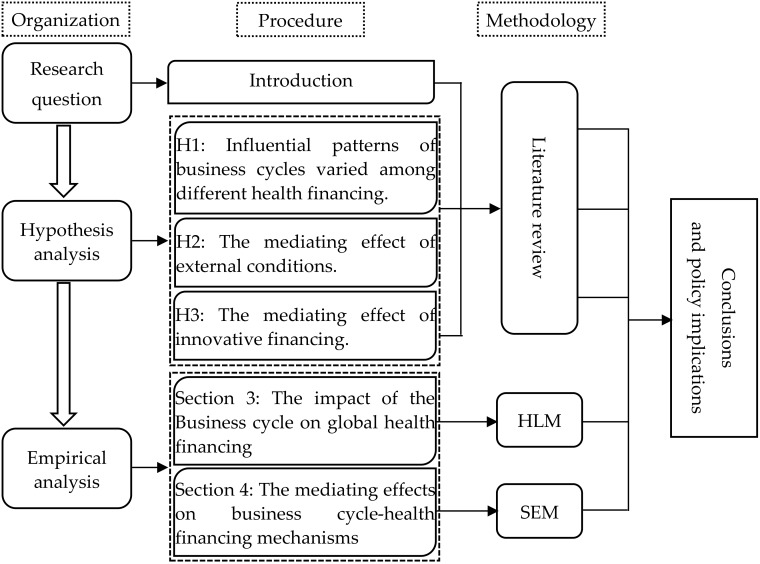
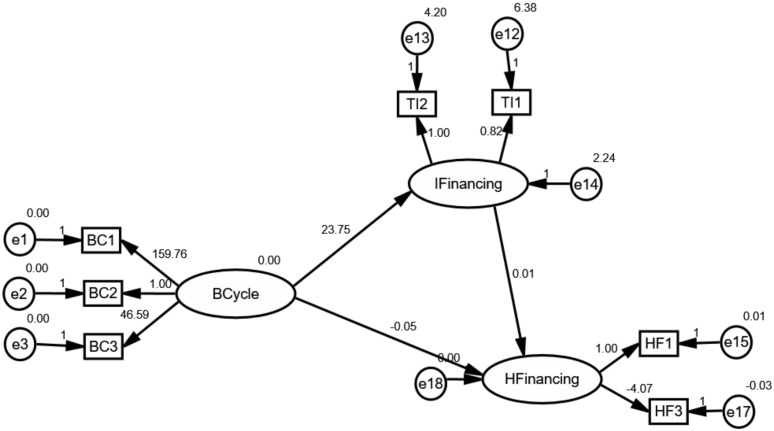
Diverse types of healthcare systems in countries offer opportunities to explore the heterogeneous sources of health financing. This paper widely explores the effect of the business cycle on subsidized, voluntary and out-of-pocket health spending in 34 countries with different types of healthcare systems, by the methodology of hierarchical linear modeling (HLM). We use a panel of annual data during the years from 2000 to 2016. It further examines the business cycle-health financing mechanism by inquiring into the mediating effect of external conditions and innovative health financing, based on the structural equation modeling (SEM). The empirical results reveal that the business cycle harms subsidized spending, whereas its effect on voluntary and protective health spending is positive. Results related to the SEM indicate that the mediating effect of external conditions on the relationship between the business cycle and health financing is negative. However, we find that the business cycle plays a positive effect on health financing through innovative health financing channels. Thus, designing and implementing efforts to shift innovative health financing have substantial effects on the sustainability of healthcare systems.
不同类型的医疗保健系统在各国提供了探索卫生筹资异质性来源的机会。本文采用层次线性建模(HLM)的方法,广泛探讨了34 个具有不同医疗保健系统类型的国家中,商业周期对补贴、自愿和自费卫生支出的影响。我们使用了 2000 年至 2016 年期间的年度面板数据。进一步通过结构方程建模(SEM),探究外部条件和创新卫生筹资的中介效应,考察商业周期-卫生筹资机制。实证结果表明,商业周期对补贴支出有不利影响,而对自愿和保护型卫生支出的影响是积极的。与 SEM 相关的结果表明,外部条件对商业周期与卫生筹资之间关系的中介效应是负面的。然而,我们发现商业周期通过创新卫生筹资渠道对卫生筹资产生积极影响。因此,设计和实施创新卫生筹资的努力对医疗保健系统的可持续性具有重大影响。