Department of Emergency Medicine, National Cheng Kung University Hospital, College of Medicine, National Cheng Kung University, Tainan 70403, Taiwan.
Department of Internal Medicine, National Cheng Kung University Hospital, College of Medicine, National Cheng Kung University, Tainan 70403, Taiwan.
Int J Environ Res Public Health. 2020 Mar 16;17(6):1930. doi: 10.3390/ijerph17061930.
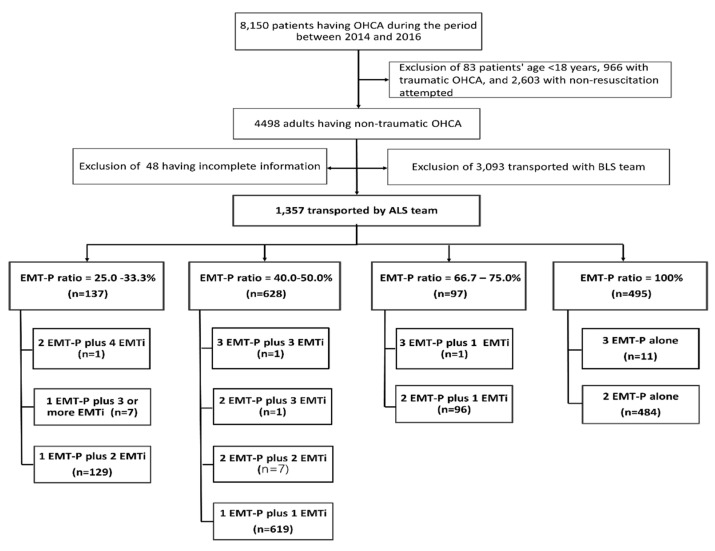
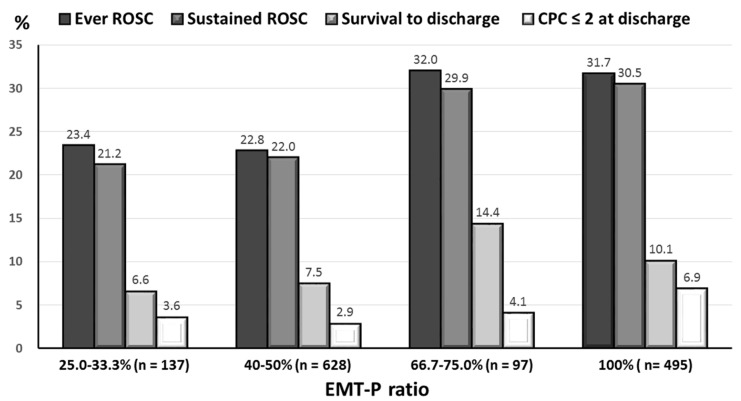
Paramedics can provide advanced life support (ALS) for patients with out-of-hospital cardiac arrest (OHCA). However, the impact of emergency medical technician (EMT) configuration on their outcomes remains debated. A three-year cohort study consisted of non-traumatic OHCA adults transported by ALS teams was retrospectively conducted in Tainan City using an Utstein-style population database. The EMT-paramedic (EMT-P) ratio was defined as the EMT-P proportion out of all on-scene EMTs. Among the 1357 eligible cases, the median (interquartile range) number of on-scene EMTs and the EMT-P ratio were 2 (2-2) persons and 50% (50%-100%), respectively. The multivariate analysis identified five independent predictors of sustained return of spontaneous circulation (ROSC): younger adults, witnessed cardiac arrest, prehospital ROSC, prehospital defibrillation, and comorbid diabetes mellitus. After adjustment, every 10% increase in the EMT-P ratio was on average associated with an 8% increased chance (adjusted odds ratio [aOR], 1.08; p < 0.01) of sustained ROSC and a 12% increase change (aOR, 1.12; p = 0.048) of favorable neurologic status at discharge. However, increased number of on-scene EMTs was not linked to better outcomes. For nontraumatic OHCA adults, an increase in the on-scene EMT-P ratio resulted in a higher proportion of improved patient outcomes.
医护人员可为院外心脏骤停(OHCA)患者提供高级生命支持(ALS)。然而,急救医疗技术员(EMT)配置对其结果的影响仍存在争议。一项使用 Utstein 式人群数据库的回顾性三年队列研究,纳入了由 ALS 小组转运的非创伤性 OHCA 成年人。 EMT-医师(EMT-P)比例定义为现场 EMT 中 EMT-P 的比例。在 1357 例合格病例中,中位数(四分位距)现场 EMT 人数和 EMT-P 比例分别为 2(2-2)人和 50%(50%-100%)。多变量分析确定了持续自主循环恢复(ROSC)的五个独立预测因素:年轻人、目击心脏骤停、院前 ROSC、院前除颤和合并糖尿病。调整后, EMT-P 比例每增加 10%,持续 ROSC 的机会平均增加 8%(调整后的优势比 [aOR],1.08;p < 0.01),出院时神经功能状态良好的几率增加 12%(aOR,1.12;p = 0.048)。然而,现场 EMT 人数的增加与更好的结果无关。对于非创伤性 OHCA 成年人,现场 EMT-P 比例的增加导致患者预后改善的比例更高。