School of Forest Resources, University of Maine, 5755 Nutting Hall, Orono, ME 04469, USA.
Department of Chemical and Biomedical Engineering, University of Maine, Orono, ME 04469, USA.
Molecules. 2020 Mar 16;25(6):1344. doi: 10.3390/molecules25061344.
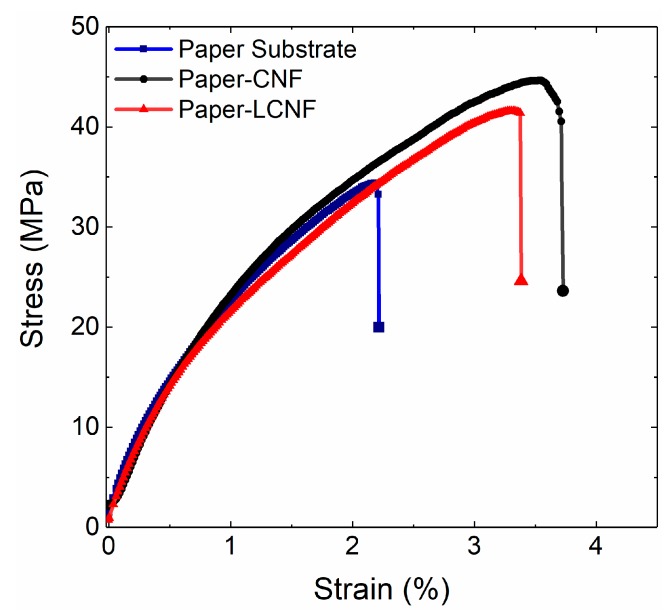
Environmental and health concerns are driving the need for new materials in food packaging to replace poly- or perfluorinated compounds, aluminum layers, and petroleum-based polymers. Cellulose nanofibrils (CNF) have been shown by a number of groups to form excellent barrier layers to oxygen and grease. However, the influence of lignin-containing cellulose nanofibrils (LCNF) on film barrier properties has not been well reported. Herein, thin films (16 g/m) from LCNF and CNF were formed on paper substrates through a filtration technique that should mimic the addition of material at the wet end of a paper machine. Surface, barrier and mechanical attributes of these samples were characterized. The analysis on the surface free energy and water contact angle pointed to the positive role of lignin distribution in inducing a certain degree of water repellency. The observed oxygen transmission rate (OTR) and water vapor permeability (WVP) values of LCNF-coated samples were nearly similar to those with CNF. However, the presence of lignin improved the oil proof performance; these layered designs exhibited an excellent resistance to grease (kit No. 12). The attained papers with LCNF coat were formed into bowl-like containers using metal molds and a facile oven drying protocol to evaluate their resistance to oil penetration over a longer period. The results confirmed the capability of LCNF layer in holding commercially available cooking oils with no evidence of leakage for over five months. Also, an improvement in the tensile strength and elongation at break was observed in the studied papers. Overall, the proposed packaging material possesses viable architecture and can be considered as a fully wood-based alternative for the current fluorocarbon systems.
环境和健康问题促使人们需要用新材料来替代食品包装中的聚或全氟化合物、铝层和石油基聚合物。许多研究小组已经证明,纤维素纳米纤维(CNF)可以形成出色的氧气和油脂阻隔层。然而,含木质素的纤维素纳米纤维(LCNF)对薄膜阻隔性能的影响尚未得到很好的报道。在此,通过过滤技术在纸基材上形成了 LCNF 和 CNF 的薄膜(16 g/m),该技术应模拟在造纸机湿端添加材料的情况。对这些样品的表面、阻隔和机械性能进行了表征。表面自由能和水接触角的分析表明木质素分布在诱导一定程度的疏水性方面发挥了积极作用。观察到的 LCNF 涂层样品的氧气传输率(OTR)和水蒸气透过率(WVP)值与 CNF 相近。然而,木质素的存在提高了防油性能;这些层状设计对油脂(12 号套件)具有极好的抵抗力。用 LCNF 涂层的纸张使用金属模具和简单的烤箱干燥方案形成碗状容器,以评估它们在较长时间内抵抗油渗透的能力。结果证实了 LCNF 层能够容纳市售烹饪油而不会有泄漏的能力,超过五个月没有证据表明有泄漏。此外,研究中的纸张的拉伸强度和断裂伸长率也有所提高。总的来说,所提出的包装材料具有可行的结构,可以被认为是当前含氟碳系统的全木质替代品。