Department of Urology, Medical College of People's Liberation Army, Chinese People's Liberation Army General Hospital, No. 28 Fuxing Road, Haidian District, Beijing, 100853, China.
Department of Urology, Rehabilitation School of Capital Medical University, China Rehabilitation Research Center, No. 10 Jiaomen North Road, Fengtai District, Beijing, 100068, China.
BMC Urol. 2020 Mar 18;20(1):29. doi: 10.1186/s12894-020-00601-w.
The robot-assisted radical prostatectomy (RARP) has been widely applied in recent years; however, only a few studies are reported about long-term urinary continence after surgery. The present study aimed to examine the outcomes of continence rates (CRs) and determine the risk and protective factors of urinary continence in patients with prostate cancer (PCa) undergoing RARP.
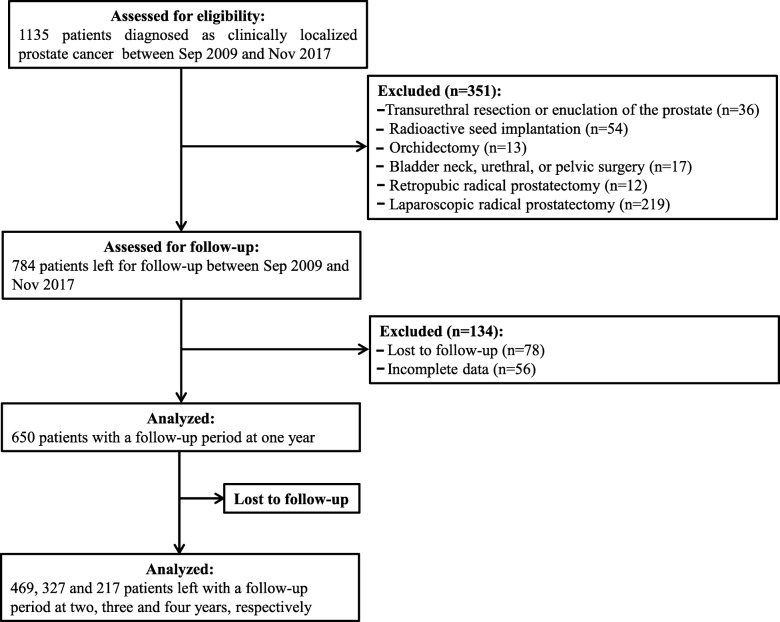
This retrospective study included 650 patients treated with RARP with perioperative data and at least one year of follow-up from September 2009 to November 2017. Also, the preoperative, intraoperative, and postoperative parameters of the patients were analyzed. Continence was defined as no pad use. Early and late continence was defined as the return of urinary continence within 3 months and beyond 12 months post-surgery, respectively. CRs were examined from 1 to 48 months postoperatively. Logistic regression analysis evaluated the association between the predictive factors and urinary continence in the early and late stages.
No significant difference was detected in the CR from 12 to 48 months postoperatively (P = 0.766). Logistic regression analysis proved that pelvic lymph node dissection (PLND) was a significant risk factor of urinary continence at 1 month. Nerve-sparing (NS) was a significant protective factor of urinary continence at 1, 3, and 6 months. Advanced age was an independent risk factor of urinary continence at 6, 12, and 24 months. Other variables were not statistically significant predictors of urinary continence.
The current results demonstrated that CR gradually improved with time within 1 year and stabilized 1 year after the surgery. PLND, NS, and age were significant determinants of continence in the early and late stages, respectively. These parameters could be used for preoperative identification of patients at high risk and counseling about postoperative expectations for urinary continence.
机器人辅助根治性前列腺切除术(RARP)近年来得到了广泛应用,但术后长期尿控情况的报道较少。本研究旨在探讨控尿率(CR)的结果,并确定接受 RARP 的前列腺癌(PCa)患者尿控的风险和保护因素。
本回顾性研究纳入了 2009 年 9 月至 2017 年 11 月期间接受 RARP 治疗的 650 例患者,均具有围手术期数据和至少 1 年的随访。同时,分析了患者的术前、术中及术后参数。控尿定义为无尿垫使用。早期和晚期控尿分别定义为术后 3 个月内和 12 个月后恢复尿控。术后 1 至 48 个月检查 CR。Logistic 回归分析评估了预测因素与早期和晚期尿控之间的关系。
术后 12 至 48 个月的 CR 无显著差异(P=0.766)。Logistic 回归分析证实,盆腔淋巴结清扫术(PLND)是术后 1 个月尿控的显著危险因素。神经保留(NS)是术后 1、3 和 6 个月尿控的显著保护因素。高龄是术后 6、12 和 24 个月尿控的独立危险因素。其他变量与尿控无统计学显著相关性。
目前的结果表明,CR 在 1 年内逐渐随时间改善,术后 1 年稳定。PLND、NS 和年龄分别是早期和晚期控尿的重要决定因素。这些参数可用于术前识别高危患者,并对术后尿控的期望进行咨询。