Joint Research Unit, bioMerieux, Centre Hospitalier Lyon Sud, Hospice Civils de Lyon, 165 Chemin du Grand Revoyet, 69310, Pierre-Benite, France.
EA 7426 Pathophysiology of Injury-Induced Immunosuppression, University of Lyon1-Hospices Civils de Lyon-bioMérieux, Hôspital Edouard Herriot, 5 Place d'Arsonval, 69437, Lyon Cedex 3, France.
Crit Care. 2020 Mar 18;24(1):96. doi: 10.1186/s13054-020-2788-8.
Sepsis is defined as a life-threatening organ dysfunction caused by a dysregulated host response to infection. Numerous studies have explored the complex and dynamic transcriptome modulations observed in sepsis patients, but a large fraction of the transcriptome remains unexplored. This fraction could provide information to better understand sepsis pathophysiology. Multiple levels of interaction between human endogenous retroviruses (HERV) and the immune response have led us to hypothesize that sepsis is associated with HERV transcription and that HERVs may contribute to a signature among septic patients allowing stratification and personalized management.
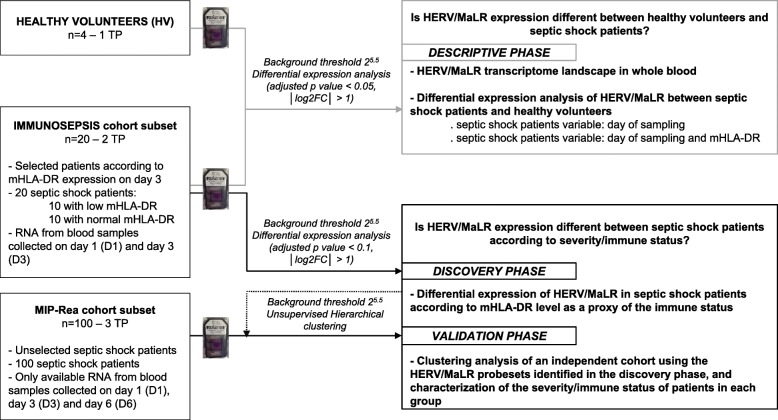
We used a high-density microarray and RT-qPCR to evaluate the HERV and Mammalian Apparent Long Terminal Repeat retrotransposons (MaLR) transcriptome in a pilot study that included 20 selected septic shock patients, stratified on mHLA-DR expression, with samples collected on day 1 and day 3 after inclusion. We validated the results in an unselected, independent cohort that included 100 septic shock patients on day 3 after inclusion. We compared septic shock patients, according to their immune status, to describe the transcriptional HERV/MaLR and conventional gene expression. For differential expression analyses, moderated t tests were performed and Wilcoxon signed-rank tests were used to analyze RT-qPCR results.
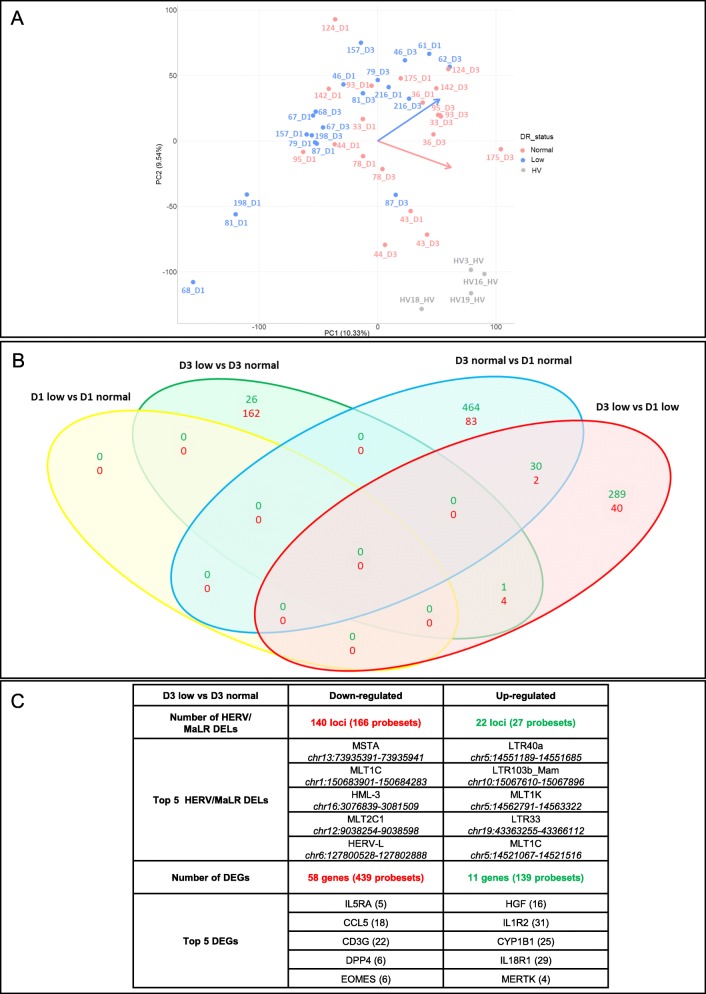
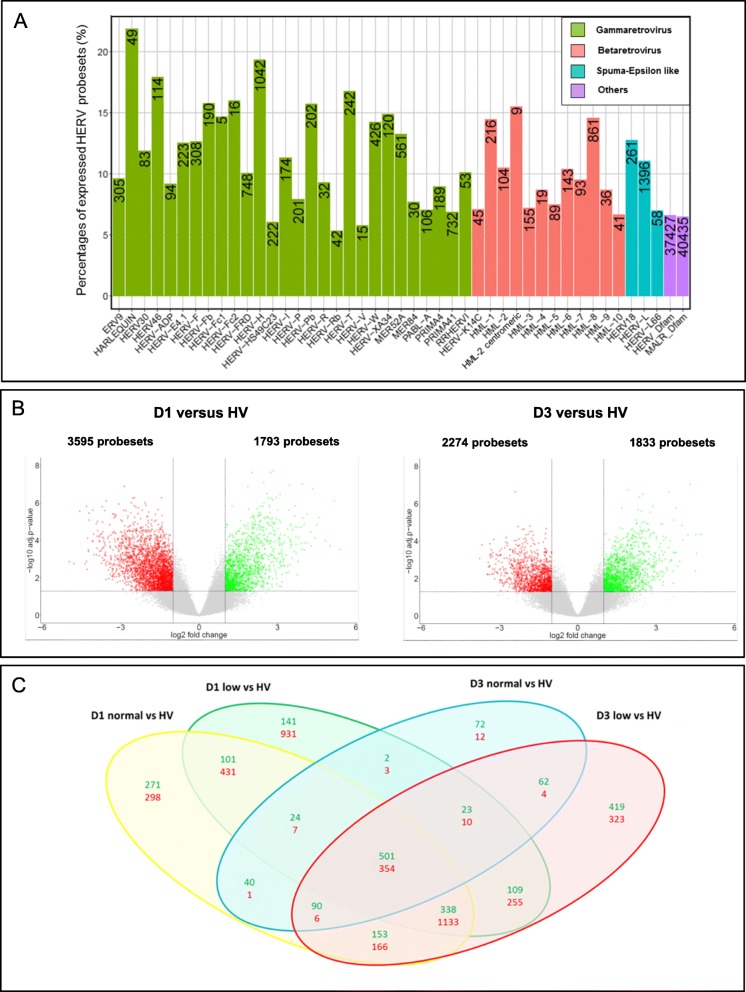
We showed that 6.9% of the HERV/MaLR repertoire was transcribed in the whole blood, and septic shock was associated with an early modulation of a few thousand of these loci, in comparison to healthy volunteers. We provided evidence that a subset of HERV/MaLR and conventional genes were differentially expressed in septic shock patients, according to their immune status, using monocyte HLA-DR (mHLA-DR) expression as a proxy. A group of 193 differentially expressed HERV/MaLR probesets, tested in an independent septic shock cohort, identified two groups of patients with different immune status and severity features.
We demonstrated that a large, unexplored part of our genome, which codes for HERV/MaLR, may be linked to the host immune response. The identified set of HERV/MaLR probesets should be evaluated on a large scale to assess the relevance of these loci in the stratification of septic shock patients. This may help to address the heterogeneity of these patients.
败血症是一种危及生命的器官功能障碍,由宿主对感染的失调反应引起。许多研究已经探索了败血症患者观察到的复杂和动态转录组调节,但很大一部分转录组仍未被探索。这部分可能提供更好地了解败血症病理生理学的信息。人类内源性逆转录病毒 (HERV) 与免疫反应之间的多个层次的相互作用使我们假设败血症与 HERV 转录有关,并且 HERV 可能有助于败血症患者的特征,从而实现分层和个性化管理。
我们使用高密度微阵列和 RT-qPCR 来评估 20 名选定的败血症休克患者的 HERV 和哺乳动物表观长末端重复逆转录转座子 (MaLR) 转录组,这些患者根据 mHLA-DR 表达进行分层,样本分别在纳入后的第 1 天和第 3 天采集。我们在一个未选择的独立队列中验证了结果,该队列包括 100 名纳入后第 3 天的败血症休克患者。我们根据免疫状态比较了败血症休克患者,以描述转录 HERV/MaLR 和常规基因表达。对于差异表达分析,进行了 moderated t 检验,并使用 Wilcoxon 符号秩检验分析 RT-qPCR 结果。
我们表明,在全血中转录了 HERV/MaLR 库的 6.9%,与健康志愿者相比,败血症休克与这些基因座的数千个早期调节有关。我们提供了证据,表明根据单核细胞 HLA-DR(mHLA-DR)表达作为代表,败血症休克患者的 HERV/MaLR 和常规基因的亚组根据其免疫状态存在差异表达。在一个独立的败血症休克队列中测试的 193 个差异表达的 HERV/MaLR 探针集,鉴定了两组具有不同免疫状态和严重程度特征的患者。
我们证明了我们基因组中一个很大的、未被探索的部分,即编码 HERV/MaLR 的部分,可能与宿主免疫反应有关。所鉴定的 HERV/MaLR 探针集应进行大规模评估,以评估这些基因座在败血症休克患者分层中的相关性。这可能有助于解决这些患者的异质性。