Department of Medical Immnunology, Graduate School of Medicine, Chiba University, Chiba, Japan.
Department of General Thoracic Surgery, Graduate School of Medicine, Chiba University, Chiba, Japan.
J Immunother Cancer. 2020 Mar;8(1). doi: 10.1136/jitc-2019-000316.
Invariant natural killer T (iNKT) cells produce copious amounts of cytokines in response to specific glycolipid antigens such as α-galactosylceramide (αGalCer) presented by CD1d-expressing antigen-presenting cells (APCs), thus orchestrating other immune cells to fight tumors. Because of their ability to induce strong antitumor responses activated by αGalCer, iNKT cells have been studied for their application in cancer immunotherapy. In our previous phase I/II trial in non-small cell lung cancer (NSCLC) patients who had completed the standard treatment, we showed a relatively long median survival time without severe treatment-related adverse events. Based on these results, we performed a phase II trial to evaluate clinical responses, safety profiles and immune responses as a second-line treatment for advanced NSCLC.
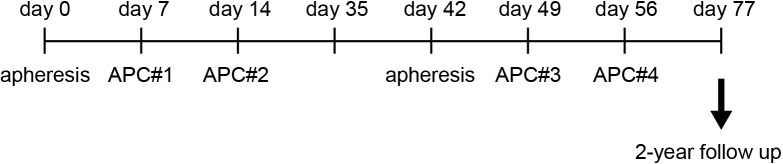
Patients with advanced or recurrent NSCLC refractory to first-line chemotherapy were eligible. αGalCer-pulsed APCs were intravenously administered four times. Overall survival time was evaluated as the primary endpoint. The safety profile and immune responses after APC injection were also monitored. This study was an open label, single-arm, phase II clinical trial performed at Chiba University Hospital, Japan.
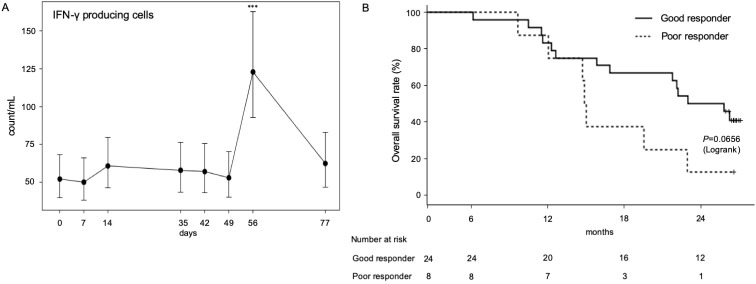
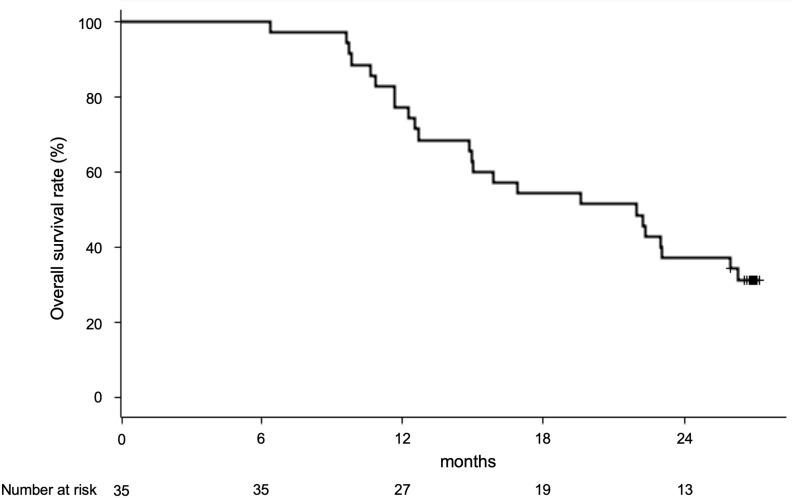
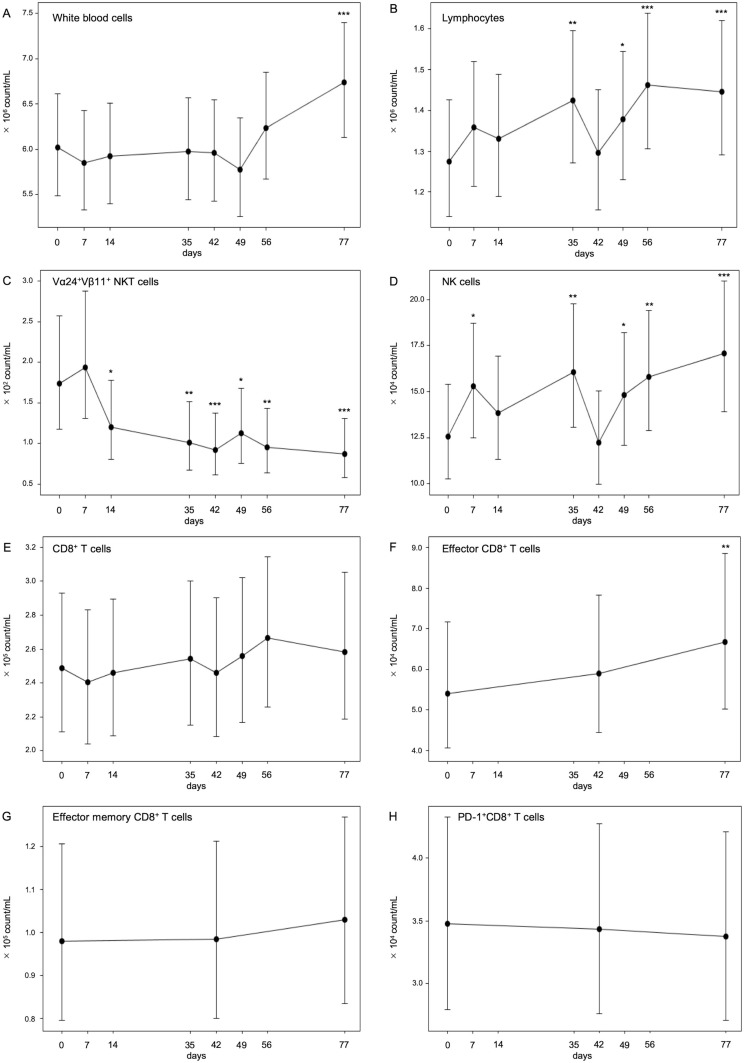
Thirty-five patients were enrolled in this study, of which 32 (91.4%) completed the trial. No severe adverse events related to the treatment were observed. The estimated median survival time of the 35 cases was 21.9 months (95% CI, 14.8 to 26.0). One case (2.9%) showed a partial response, 14 cases (40.0%) remained as stable disease, and 19 cases (54.3%) were evaluated as progressive disease. The geometric mean number of iNKT cells in all cases was significantly decreased and the mean numbers of natural killer (NK) cells, interferon-γ-producing cells in response to αGalCer, and effector CD8+ T cells were significantly increased after the administration of αGalCer-pulsed APCs.
The intravenous administration of αGalCer-pulsed APCs was well-tolerated and was accompanied by prolonged overall survival. These results are encouraging and warrant further evaluation in a randomized phase III trial to demonstrate the survival benefit of this immunotherapy.
UMIN000007321.
不变自然杀伤 T(iNKT)细胞在响应特定糖脂抗原(如由 CD1d 表达的抗原呈递细胞 (APC) 呈递的α-半乳糖基神经酰胺 (αGalCer))时会产生大量细胞因子,从而协调其他免疫细胞对抗肿瘤。由于它们能够诱导由αGalCer 激活的强烈抗肿瘤反应,因此 iNKT 细胞已被研究用于癌症免疫治疗。在我们之前针对已完成标准治疗的非小细胞肺癌 (NSCLC) 患者的 I/II 期试验中,我们显示出相对较长的中位生存时间,且无严重与治疗相关的不良事件。基于这些结果,我们进行了 II 期试验,以评估临床反应、安全性概况和免疫反应作为晚期 NSCLC 的二线治疗。
符合条件的患者为晚期或复发性 NSCLC 对一线化疗耐药。静脉内给予αGalCer 脉冲 APC 四次。总生存时间是评估的主要终点。还监测 APC 注射后的安全性概况和免疫反应。这项研究是在日本千叶大学医院进行的一项开放标签、单臂、II 期临床试验。
35 名患者入组本研究,其中 32 名(91.4%)完成了试验。未观察到与治疗相关的严重不良事件。35 例的估计中位生存时间为 21.9 个月(95%CI,14.8 至 26.0)。1 例(2.9%)出现部分缓解,14 例(40.0%)疾病稳定,19 例(54.3%)为疾病进展。所有病例的 iNKT 细胞几何均数显著减少,αGalCer 反应的自然杀伤 (NK) 细胞、干扰素-γ 产生细胞和效应 CD8+T 细胞的平均数量显著增加。
αGalCer 脉冲 APC 的静脉给药耐受良好,并伴有总生存时间延长。这些结果令人鼓舞,需要在随机 III 期试验中进一步评估,以证明这种免疫疗法的生存获益。
UMIN000007321。