Amsterdam UMC, Department of Psychiatry, Amsterdam Institute for Addiction Research, University of Amsterdam, Amsterdam, 1100 DD, Netherlands.
Department of Clinical Psychology, University of Amsterdam, Amsterdam, 1018 WS, The Netherlands.
Sci Rep. 2020 Mar 18;10(1):4949. doi: 10.1038/s41598-020-61892-5.
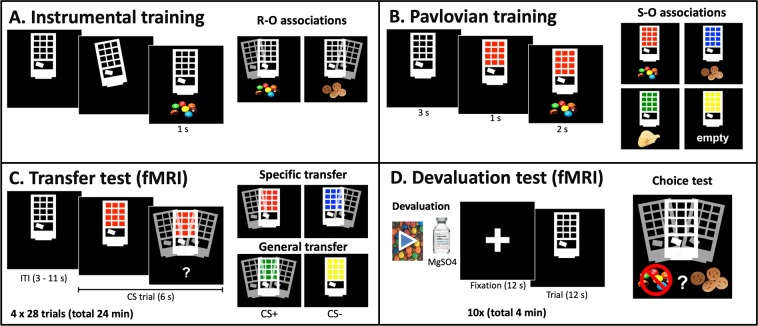
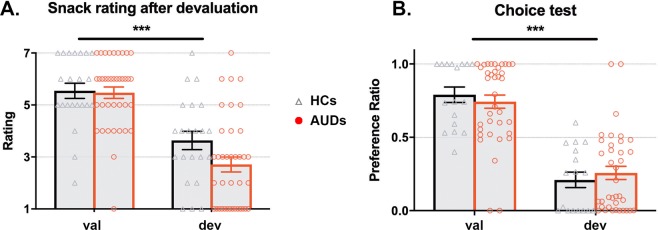
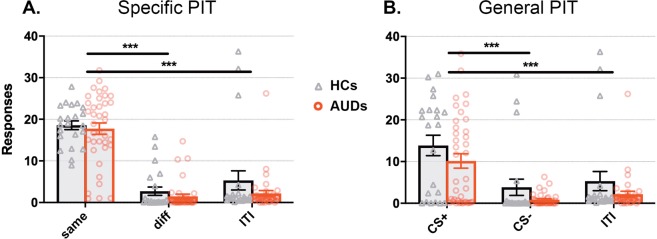
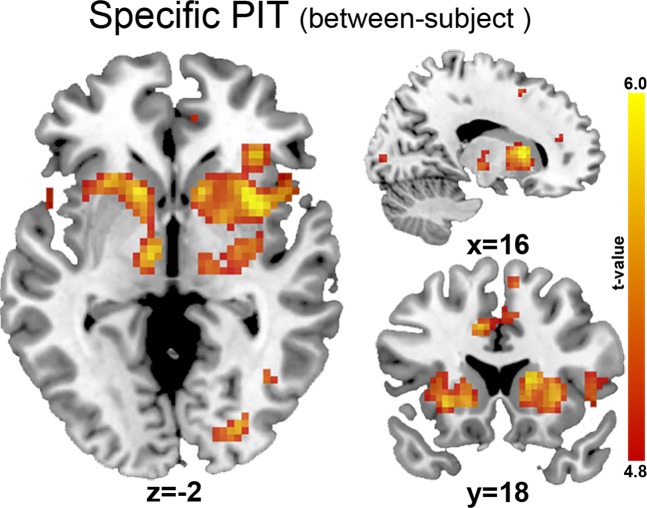
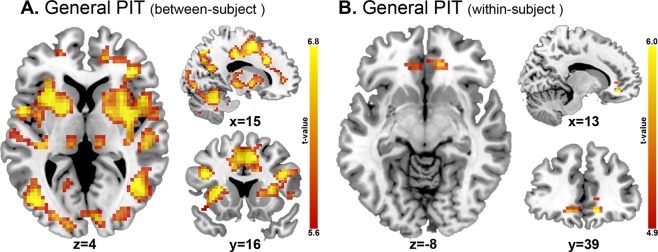
Deficits in instrumental, goal-directed control, combined with the influence of drug-associated Pavlovian-conditioned stimuli, are thought to influence the development and maintenance of addiction. However, direct evidence has mainly come from animal studies. We sought to establish whether alcohol use disorder (AUD) is characterized by behavioral or neurobiological deficits in (i) the integration of Pavlovian and instrumental values and (ii) goal-directed control; and (iii) whether duration or severity of AUD is associated with such deficits. The influence of cues predicting food rewards on instrumental action was assessed in a Pavlovian-to-instrumental transfer (PIT) test, measuring both specific and general PIT, and goal-directed behavior in an outcome-devaluation test. Brain activity was measured using functional MRI in 38 abstinent individuals with AUD and 22 matched healthy control individuals (HCs). We found significant specific and general PIT and outcome-devaluation effects across groups indicating goal-directed control, mediated by distinct corticostriatal signals, but no significant differences between individuals with AUD and healthy controls. Bayesian analyses provided substantial-to-strong evidence for the absence of group differences for these effects, or any relationship with duration or severity of AUD. These results suggest intact ability to integrate action-outcome associations on specific and general PIT and goal-directed learning in AUD during abstinence.
工具性、目标导向控制的缺陷,加上药物相关的巴甫洛夫条件刺激的影响,被认为会影响成瘾的发展和维持。然而,直接证据主要来自动物研究。我们试图确定酒精使用障碍(AUD)是否存在(i)整合巴甫洛夫和工具价值,以及(ii)目标导向控制的行为或神经生物学缺陷;以及(iii)AUD 的持续时间或严重程度是否与这些缺陷相关。在评估预测食物奖励的线索对工具性动作的影响时,我们在巴甫洛夫到工具性转移(PIT)测试中进行了测试,测量了特定和一般的 PIT,以及在结果贬值测试中的目标导向行为。在 38 名戒断的 AUD 个体和 22 名匹配的健康对照个体(HCs)中,我们使用功能磁共振成像测量了大脑活动。我们发现,两组个体都表现出显著的特定和一般 PIT 以及结果贬值效应,表明存在目标导向控制,这是由不同的皮质纹状体信号介导的,但 AUD 个体和健康对照组之间没有显著差异。贝叶斯分析提供了实质性到强证据,表明这些效应或与 AUD 的持续时间或严重程度之间没有群体差异。这些结果表明,在戒断期间,AUD 个体能够在特定和一般的 PIT 以及目标导向学习中整合动作-结果关联,且能力未受损。