ICAR-Indian Institute of Soil and Water Conservation, 218, Kaulagarh Road, Dehradun, 248 195, India.
International Bamboo and Rattan Organization, Addis Ababa, Ethiopia.
Sci Rep. 2020 Mar 18;10(1):4966. doi: 10.1038/s41598-020-61418-z.
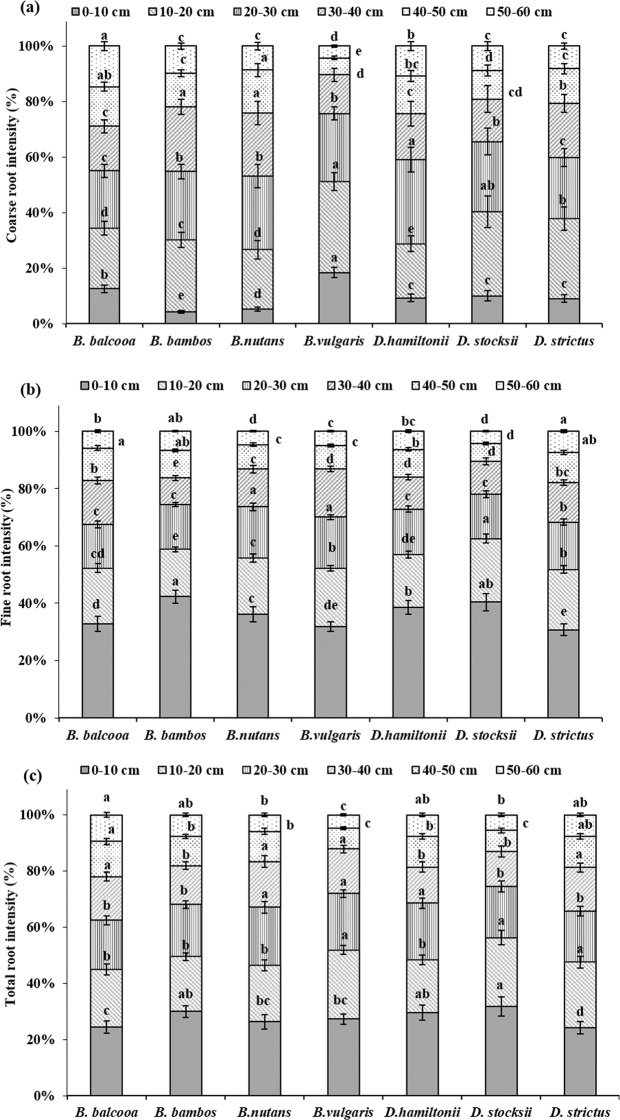
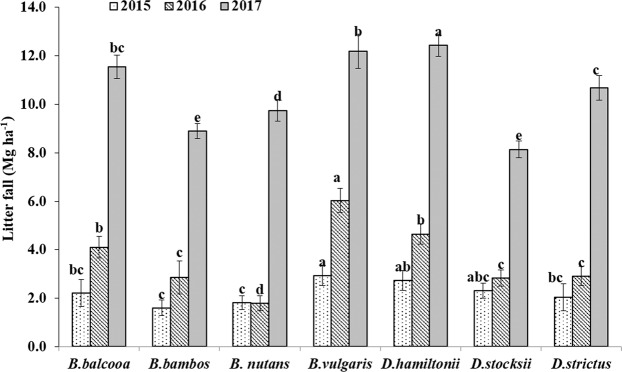
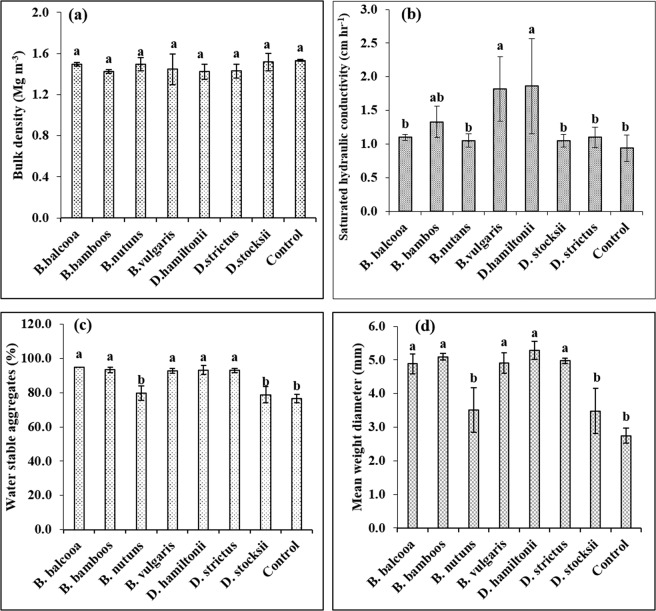
Due to extensive root system, connected rhizome bamboos are considered suitable for improving soil properties within a short period, though most of the claims are anecdotal and need to be supported with quantified data. The study evaluates seven bamboo species viz., Bambusa balcooa, Bambusa bambos, Bambusa vulgaris, Bambusa nutans, Dendrocalamus hamiltonii, Dendrocalamus stocksii and Dendrocalamus strictus for their rooting pattern and impact on soil health properties. Coarse and fine root intensity was maximum in B. vulgaris. Coarse root biomass ranged from 0.6 kg m in B. nutans to 2.0 kg m in B. vulgaris and B. bambos. Fine root biomass ranged from 1.1 kg m in B. nutans to 4.5 kg m in D. hamiltonii. Contribution of fine roots in terms of intensity and biomass was much higher than coarse roots. Fine root biomass showed declining trend with increase in soil depth in all the species. During sixth year, the litter fall ranged from 8.1 Mg ha in D. stocksii to 12.4 Mg ha in D. hamiltonii. Among soil physical properties significant improvement were recorded in hydraulic conductivity, water stable aggregates and mean weight diameter. Soil pH, organic carbon and available phosphorus under different species did not reveal any significant changes, while significant reduction was observed in total nitrogen and potassium. Significant positive correlation was observed between WSA and iron content. Soil microbial population and enzyme activities were higher in control plot. Considering root distribution, biomass, soil hydraulic conductivity and water stable aggregates, B. bambos, B. vulgaris and D. hamiltonii are recommended for rehabilitation of degraded lands prone to soil erosion.
由于根系发达,连生竹被认为适合在短时间内改善土壤特性,尽管大多数说法都是传闻,需要用量化数据来支持。本研究评估了 7 种竹种,即大油竹、麻竹、慈竹、吊丝球竹、巨龙竹、硬头黄竹和版纳甜龙竹,研究其根系分布模式及其对土壤健康属性的影响。粗根和细根强度在慈竹中最大。粗根生物量在吊丝球竹中最低,为 0.6 kg·m,在慈竹和麻竹中最高,为 2.0 kg·m。细根生物量在吊丝球竹中最低,为 1.1 kg·m,在巨龙竹中最高,为 4.5 kg·m。细根在强度和生物量方面的贡献都远高于粗根。在所有物种中,细根生物量随着土壤深度的增加而呈下降趋势。在第六年,凋落物量在硬头黄竹中最低,为 8.1 Mg·ha,在巨龙竹中最高,为 12.4 Mg·ha。在土壤物理性质方面,水力传导率、水稳性团聚体和平均质量直径都有显著改善。不同物种下的土壤 pH、有机碳和有效磷没有显示出任何显著变化,而全氮和钾则显著减少。水稳性团聚体与铁含量呈显著正相关。对照区的土壤微生物种群和酶活性较高。考虑到根系分布、生物量、土壤水力传导率和水稳性团聚体,建议在容易发生土壤侵蚀的退化土地上种植麻竹、慈竹和巨龙竹进行土地复垦。