Kim Daniel W, Buzurovic Ivan M, Mahal Brandon V, Hwang William, Oladeru Oluwadamilola T, O'Farrell Desmond A, Harris Thomas C, Margalit Danielle N, Lam Miranda, Devlin Phillip M
Department of Radiation Oncology, Massachusetts General Hospital, Harvard Medical School, Boston, MA, United States.
Department of Radiation Oncology, Brigham and Women's Hospital, Dana-Farber Cancer Institute, Harvard Medical School, Boston, MA, United States.
J Contemp Brachytherapy. 2020 Feb;12(1):48-52. doi: 10.5114/jcb.2020.92408. Epub 2020 Feb 28.
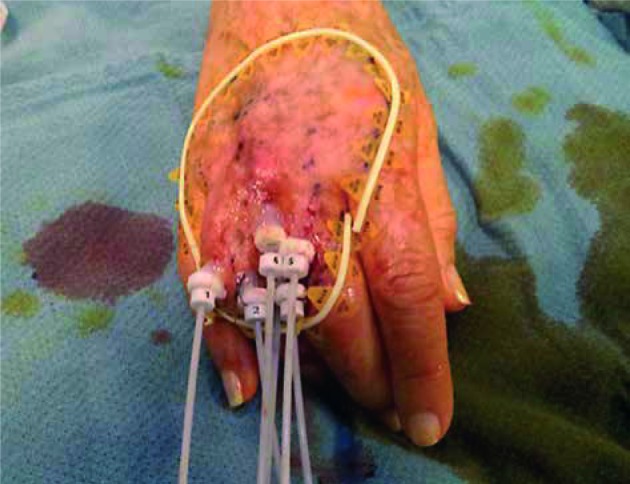
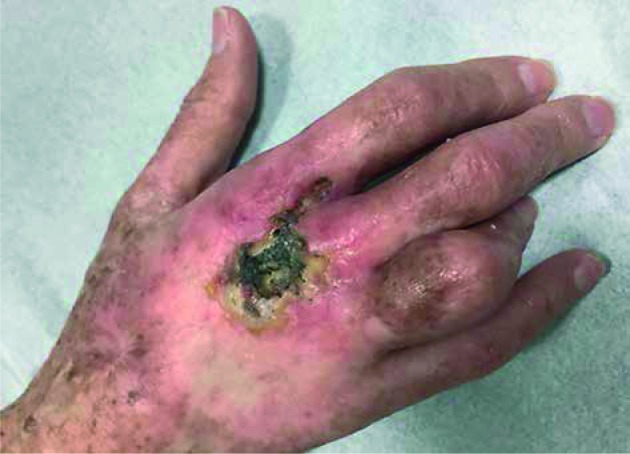
We present a case report of treatment using interstitial and surface high-dose-rate (HDR) brachytherapy for cutaneous squamous cell carcinoma (SCC) involving the interspace of the third and fourth digits. The patient refused two-ray amputation and the lesion was not amenable for external beam radiation therapy (EBRT). This is the first report detailing combined interstitial and surface HDR brachytherapy for a hand SCC.
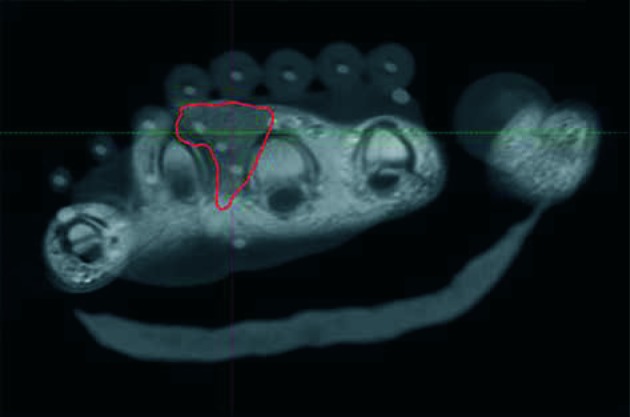
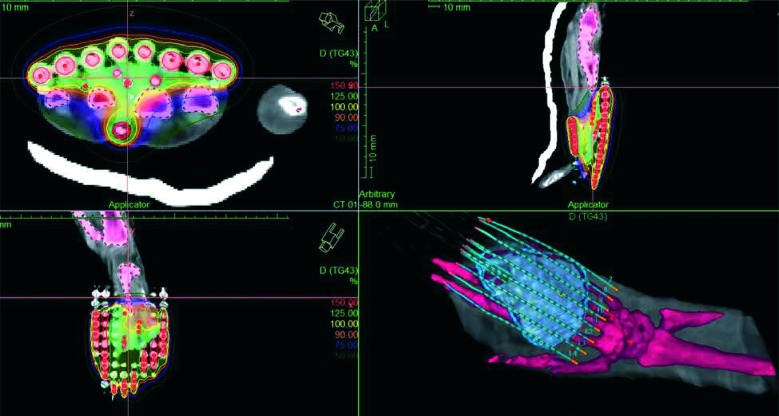
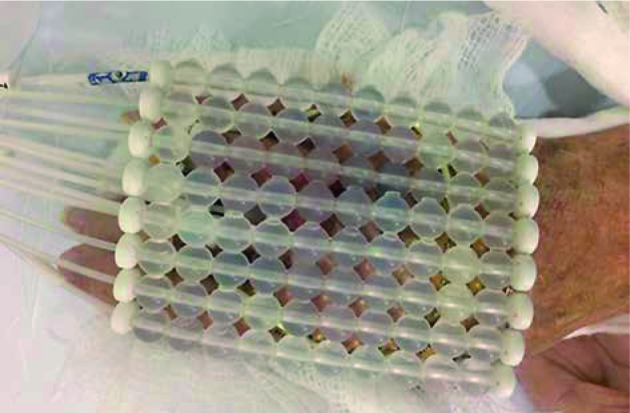
The patient received 4050 cGy in 9 fractions, twice daily using 6 interstitial catheters and 8 Freiburg flap catheters. The clinical target was defined by MRI and ultrasound as a dorsal mass to the interspace between the heads of the third and fourth metacarpals measuring approximately 7 mm transverse × 5 mm volar-dorsal × 16 mm proximal-distal.
The treatment resulted in radiographic and clinical tumor control. The patient retained functional use of her hand. However, there were both acute and late treatment-related side effects. Acutely, inpatient admission for pain control with a nerve block was needed. Long-term toxicity was notable for grade 2 skin necrosis treated with hyperbaric oxygen.
The first interstitial and surface HDR brachytherapy for cutaneous squamous cell carcinoma of a finger interspace for hand function preservation is presented. The initial experience revealed that brachytherapy was tolerated but with notable acute and late side effects. Treatment did result in tumor shrinkage with organ preservation and function of two rays. A larger cohort of patients will be required for additional conclusions related to long-term clinical benefits in patients who refuse ray amputation.
我们报告一例采用组织间和体表高剂量率(HDR)近距离放射治疗累及第三和第四指间隙的皮肤鳞状细胞癌(SCC)的病例。患者拒绝双手截肢,且该病变不适于外照射放疗(EBRT)。这是首例详细描述联合组织间和体表HDR近距离放射治疗手部SCC的报告。
患者分9次接受4050 cGy照射,每天2次,使用6根组织间导管和8根弗赖堡皮瓣导管。通过MRI和超声将临床靶区定义为第三和第四掌骨头间隙背侧的肿物,横径约7 mm×掌背径5 mm×近端至远端径16 mm。
治疗实现了影像学和临床肿瘤控制。患者手部保留了功能。然而,存在急性和晚期与治疗相关的副作用。急性期,需要住院通过神经阻滞控制疼痛。长期毒性表现为2级皮肤坏死,采用高压氧治疗。
首次报告采用组织间和体表HDR近距离放射治疗手指间隙皮肤鳞状细胞癌以保留手部功能。初步经验显示近距离放射治疗可耐受,但有明显的急性和晚期副作用。治疗确实使肿瘤缩小,保留了手部组织和双指功能。对于拒绝手指截肢的患者,需要更多患者队列以得出与长期临床获益相关的更多结论。