Samelis Panagiotis V, Papagrigorakis Eftychios, Konstantinou Apostolos-Lykourgos, Lalos Harris, Koulouvaris Panagiotis
Orthopaedics, Children's General Hospital Panagiotis & Aglaia Kyriakou, Athens, GRC.
Orthopaedics, Katholisches Krankenhaus Dortmund-West - St. Lukas Klinikum, Düsseldorf, DEU.
Cureus. 2020 Feb 5;12(2):e6883. doi: 10.7759/cureus.6883.
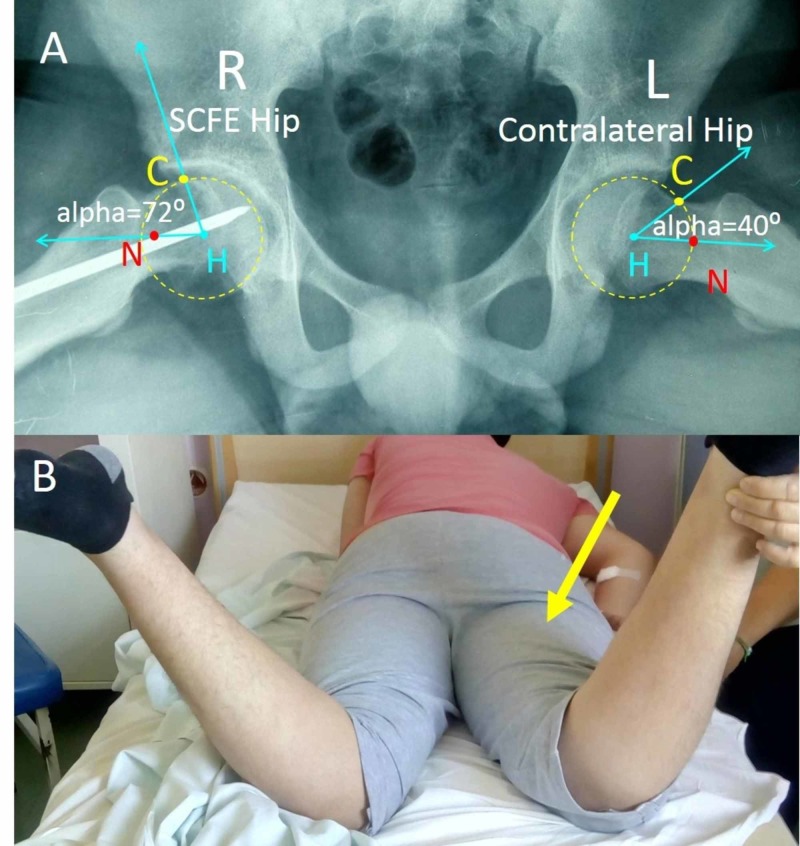
Slipped capital femoral epiphysis (SCFE) is a frequent cause of nontraumatic painful hip of the adolescence. It is the result of the separation of the proximal femoral growth cartilage at the level of the hypertrophic cell zone. The femoral neck metaphysis rotates externally and migrates proximally relative to the femoral head epiphysis, which is stably seated in the acetabulum; early diagnosis and in situ stabilization grants the best long term results. Numerous factors affect treatment outcomes. Not all implants have the same effect on the slipped physis. Application of the traditionally used implants, such as non-threaded pins and cannulated screws, is questioned. Modern implants are available, which stabilize the slip without accelerating physis fusion. This allows femoral head and neck growth and remodeling to limit the post-slip sequellae on hip anatomy and function. Femoroacetabular impingement (FAI) complicates almost all slips. It causes progressive labral and articular cartilage damage and leads to early hip osteoarthritis and total hip replacement, approximately ten years earlier compared to the general population. Avascular necrosis of the femoral head is a dramatic complication, seen almost exclusively in unstable slips. It develops within months after the slip and leads to immediate articular joint degeneration and the need for total hip replacement. Another serious complication of SCFE is chondrolysis, which is a rapid progressive articular cartilage degeneration leading to a narrow joint space and restriction of hip motion. Implant-related complications, such as migration and loosening, may lead to the progression of the slip. Though bilateral disease is quite frequent, there is no consensus about the need for preventive surgery on the healthy contralateral hip. Diagnosis of SCFE is frequently missed or delayed, leading to slips of higher severity. Silent slippage of the capital femoral epiphysis is highly suspected as an underlying cause of cam-type FAI and early-onset hip osteoarthritis. There is controversy, whether asymptomatic implants should be removed. Novel surgical techniques, such as the modified Dunn procedure and hip arthroscopy, seem to be effective modalities for the prevention of FAI in SCFE.
股骨头骨骺滑脱(SCFE)是青少年非创伤性髋关节疼痛的常见原因。它是股骨近端生长软骨在肥大细胞区水平分离的结果。股骨颈干骺端相对于稳定位于髋臼内的股骨头骨骺向外旋转并向近端移位;早期诊断和原位稳定可获得最佳的长期效果。许多因素会影响治疗结果。并非所有植入物对滑脱的骺板都有相同的效果。传统使用的植入物,如非螺纹针和空心螺钉的应用受到质疑。现在有了现代植入物,它们可以稳定滑脱而不加速骺板融合。这使得股骨头和颈能够生长和重塑,以限制滑脱后对髋关节解剖结构和功能的后遗症。股骨髋臼撞击症(FAI)几乎使所有滑脱情况变得复杂。它会导致渐进性的盂唇和关节软骨损伤,并导致早期髋关节骨关节炎和全髋关节置换,与普通人群相比大约提前十年。股骨头缺血性坏死是一种严重的并发症,几乎仅见于不稳定的滑脱。它在滑脱后数月内发生,导致关节立即退变并需要进行全髋关节置换。SCFE的另一个严重并发症是软骨溶解,这是一种快速进展的关节软骨退变,导致关节间隙变窄和髋关节活动受限。与植入物相关的并发症,如移位和松动,可能导致滑脱进展。虽然双侧疾病相当常见,但对于是否需要对健康的对侧髋关节进行预防性手术尚无共识。SCFE的诊断经常被漏诊或延误,导致滑脱程度更高。股骨头骨骺的隐匿性滑脱被高度怀疑是凸轮型FAI和早发性髋关节骨关节炎的潜在原因。对于无症状的植入物是否应取出存在争议。新型手术技术,如改良的邓恩手术和髋关节镜检查,似乎是预防SCFE中FAI的有效方法。