Department of Neurosurgery, The Second Affiliated Hospital, School of Medicine, Zhejiang University, Hangzhou, Zhejiang, China.
Center for Neuroscience Research, Loma Linda University School of Medicine, Loma Linda, CA, USA.
Biomed Res Int. 2020 Feb 28;2020:9707238. doi: 10.1155/2020/9707238. eCollection 2020.
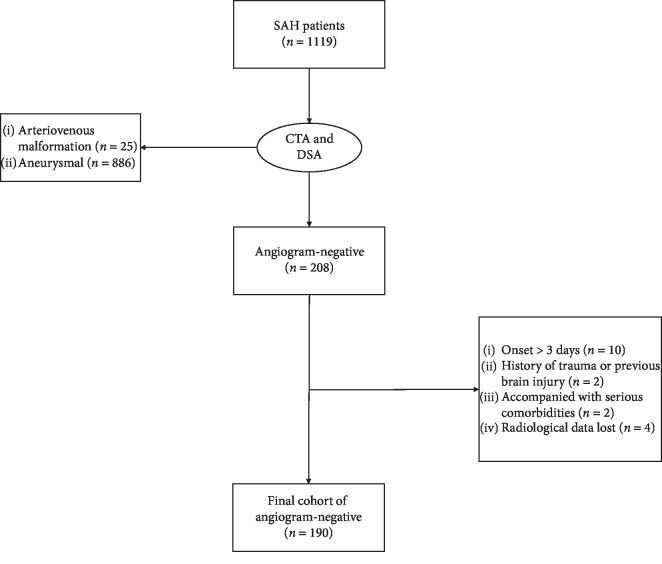
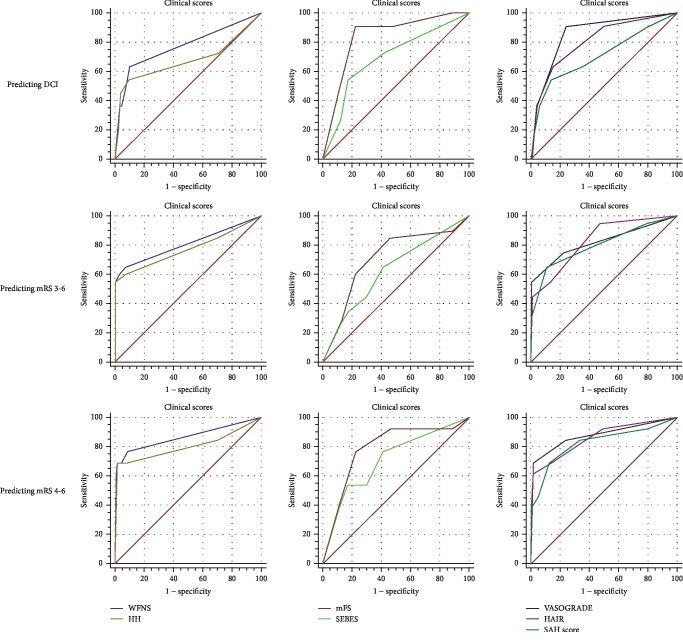
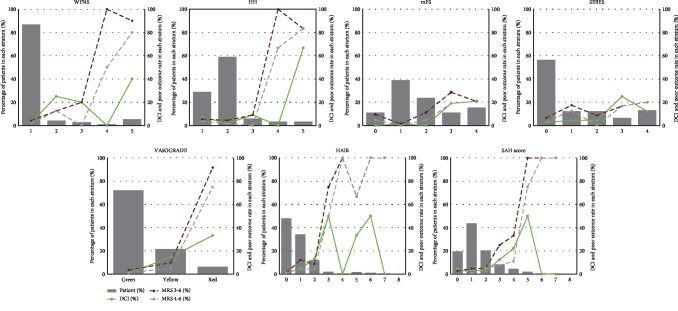
Numerous grading scales have been proposed to predict the outcome of aneurysmal subarachnoid hemorrhage (SAH); however, these have not been validated in angiogram-negative SAH patients. In this study, we aim to validate and compare the aneurysmal SAH grading scales in angiogram-negative SAH patients. There were 190 angiogram-negative SAH patients analyzed from January 2014 to December 2015. The outcomes were measured by delayed cerebral ischemia (DCI) and poor outcome (defined as modified Rankin Scale (mRS) 3-6 or 4-6). The predictive performance of the grading scales was assessed via evaluation of distribution, trend, association, and discrimination. In regard to the distribution, none of the patients were categorized as HAIR 8 and SAH score 8. Both grading scales indicated a significant trend between scores and outcome ( < 0.05), and association with the outcome (OR > 1). The modified Fisher Scale (mFS), World Federation of Neurosurgical Societies scale (WFNS), and combined scores VASOGRADE and HAIR showed good predictive accuracy (area under the curve (AUC) > 0.750) for DCI. The predictive accuracy in each scale performed well in predicting poor outcome, with the exception of mFS and the Subarachnoid hemorrhage Early Brain Edema Score (SEBES). However, the mFS performed with increased accuracy when predicting mRS 4-6. The VASOGRADE, HAIR, and WFNS may be valuable prognostic tools for predicting both DCI and poor outcome. The mFS can be applicable for predicting DCI and mRS 4-6. The SAH score and the Hunt-Hess were also optimal for predicting poor outcome. The predictive performance of SEBES was relatively poor compared to the other scales.
已经提出了许多评分量表来预测颅内动脉瘤性蛛网膜下腔出血(SAH)的结局;然而,这些在血管造影阴性的 SAH 患者中尚未得到验证。在这项研究中,我们旨在验证和比较血管造影阴性的 SAH 患者的动脉瘤性 SAH 评分量表。分析了 2014 年 1 月至 2015 年 12 月期间的 190 例血管造影阴性的 SAH 患者。结果通过迟发性脑缺血(DCI)和不良结局(定义为改良 Rankin 量表(mRS)3-6 或 4-6)来衡量。通过评估分布、趋势、关联和区分度来评估评分量表的预测性能。关于分布,没有患者被归类为 HAIR 8 和 SAH 评分 8。两种评分量表均表明评分与结局之间存在显著趋势(<0.05),与结局相关(OR>1)。改良Fisher 评分(mFS)、世界神经外科学会联合会(WFNS)量表和联合评分 VASOGRADE 和 HAIR 对 DCI 具有良好的预测准确性(曲线下面积(AUC)>0.750)。在预测不良结局方面,每个量表的预测准确性均表现良好,除了 mFS 和蛛网膜下腔出血早期脑水肿评分(SEBES)。然而,mFS 在预测 mRS 4-6 时具有更高的准确性。VASOGRADE、HAIR 和 WFNS 可能是预测 DCI 和不良结局的有价值的预后工具。mFS 可用于预测 DCI 和 mRS 4-6。SAH 评分和 Hunt-Hess 评分也最适合预测不良结局。与其他量表相比,SEBES 的预测性能相对较差。