Tian Ninzi, Wu Dong, Tang Ming, Sun Huichuan, Ji Yuan, Huang Cheng, Chen Lingli, Chen Gang, Zeng Mengsu
Department of Radiology, Zhongshan Hospital of Fudan University, 180 Fenglin Rd, Xuhui District, Shanghai 200032, China.
Shanghai Institute of Medical Imaging, Shanghai Medical College, Fudan University, Shanghai 200032, China.
Open Med (Wars). 2020 Mar 8;15:167-174. doi: 10.1515/med-2020-0024. eCollection 2020.
Monitoring the early treatment effect of sorafenib in advanced hepatocellular carcinoma (HCC) patients is a diagnostic challenge. In a previous study, we reported the potential role of liver computed tomography perfusion (CTP) in the assessment of the response to sorafenib therapy in HCC. The present study aims to investigate whether sorafenib-targeted genes is correlated with CTP parameter, and investigate the potential of sorafenib-targeted genes in early prediction of therapeutic response to sorafenib in advanced HCC.
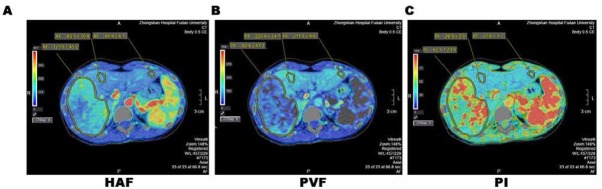
A total of 21 HCC patients were enrolled. Sorafenib was administered orally at a dose of 400 mg twice daily continuously. Treatment response was assessed using modified response evaluation criteria in solid tumors (mRECIST) criteria. CTP scanning was performed before and after two weeks of sorafenib treatment using a 320-detector row CT scanner. The perfusion parameters of portal vein flow (PVF), hepatic artery flow (HAF), and perfusion index (PI) were acquired by CTP. The expression levels of several sorafenib-targeted genes were assayed using real-time quantitative PCR and western blot analysis. Logistic regression was performed to analyze the relationship between HAF values and RAF1 expression levels.
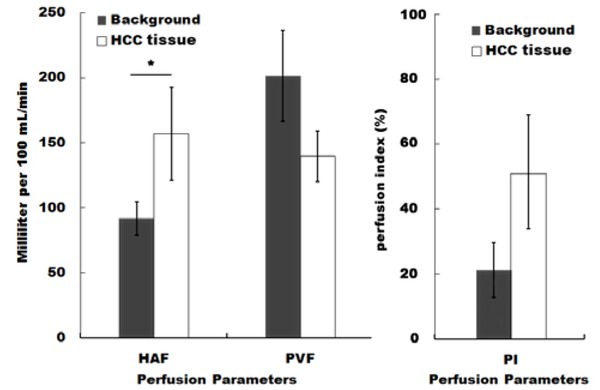
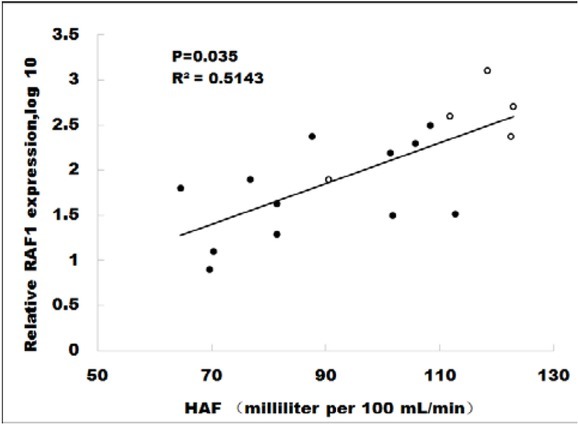
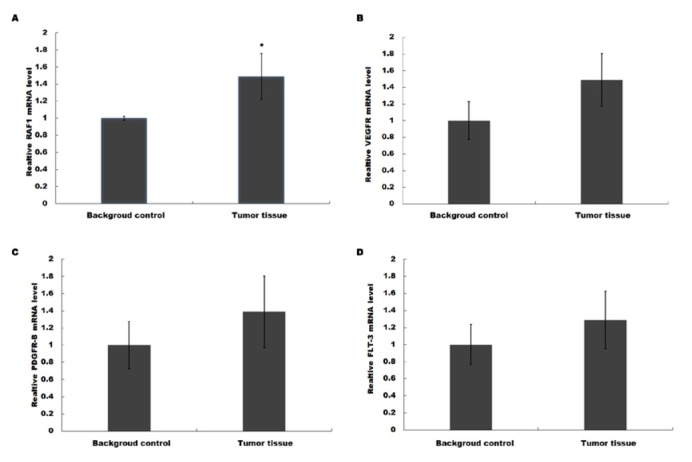
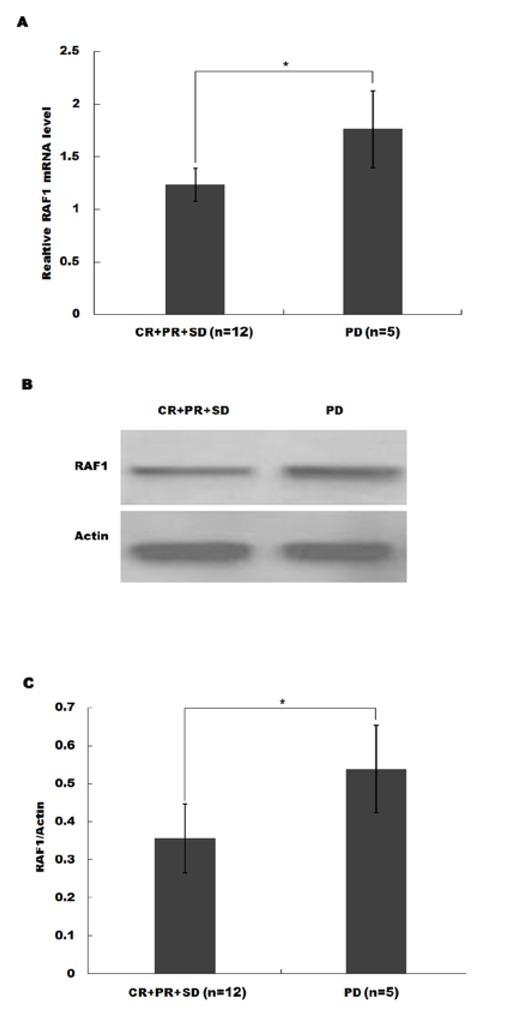
According to mRECIST, the disease control rate (CR+PR+SD) of treatment group was 70.5% after two months of treatment. Compared to background controls, tumor tissues exhibited higher HAF. A sorafenib-targeted gene, RAF1 expression, was increased in tumor tissues especially in the sorafenib-resistant group. The sorafenib-resistant group exhibited a significantly higher RAF1 expression and HAF than the sensitive group. Moreover, the RAF1 expression is positively correlated with the HAF value.
RAF1 expression might predict therapeutic effects of sorafenib in advanced HCC, where RAF1 could potentially serve as a molecular marker for monitoring early therapeutic effects after sorafenib treatment.
监测索拉非尼对晚期肝细胞癌(HCC)患者的早期治疗效果是一项诊断挑战。在先前的一项研究中,我们报道了肝脏计算机断层扫描灌注(CTP)在评估HCC患者对索拉非尼治疗反应中的潜在作用。本研究旨在探讨索拉非尼靶向基因是否与CTP参数相关,并研究索拉非尼靶向基因在晚期HCC患者中早期预测索拉非尼治疗反应的潜力。
共纳入21例HCC患者。索拉非尼以每日两次、每次400mg的剂量持续口服给药。使用实体瘤改良反应评估标准(mRECIST)评估治疗反应。在索拉非尼治疗两周前后,使用320排CT扫描仪进行CTP扫描。通过CTP获取门静脉血流(PVF)、肝动脉血流(HAF)和灌注指数(PI)的灌注参数。使用实时定量PCR和蛋白质印迹分析检测几种索拉非尼靶向基因的表达水平。进行逻辑回归分析以分析HAF值与RAF1表达水平之间的关系。
根据mRECIST,治疗组治疗两个月后的疾病控制率(CR + PR + SD)为70.5%。与背景对照相比,肿瘤组织表现出更高的HAF。一种索拉非尼靶向基因RAF1的表达在肿瘤组织中增加,尤其是在索拉非尼耐药组中。索拉非尼耐药组的RAF1表达和HAF显著高于敏感组。此外,RAF1表达与HAF值呈正相关。
RAF1表达可能预测索拉非尼对晚期HCC的治疗效果,其中RAF1可能作为监测索拉非尼治疗后早期治疗效果的分子标志物。