Herbsman Jodi M, D'Agati Michael, Klein Daniella, O'Donnell Siobhan, Corcoran John R, Folks Tiffany D, Al-Qaqaa Yasir M
Rusk Rehabilitation, NYU Langone Health, New York, N.Y.
Department of Nursing, NYU Langone Health, New York, N.Y.
Pediatr Qual Saf. 2020 Jan 31;5(1):e256. doi: 10.1097/pq9.0000000000000256. eCollection 2020 Jan-Feb.
Mobilizing patients during an intensive care unit admission results in improved clinical and functional outcomes. The goal of this quality improvement project was to increase the percentage of patients in the pediatric intensive care unit (PICU) mobilized early from 62% to 80%. Early mobilization was within 18 hours of admission for nonmechanically ventilated (non-MV) patients and 48 hours for mechanically ventilated (MV) patients.
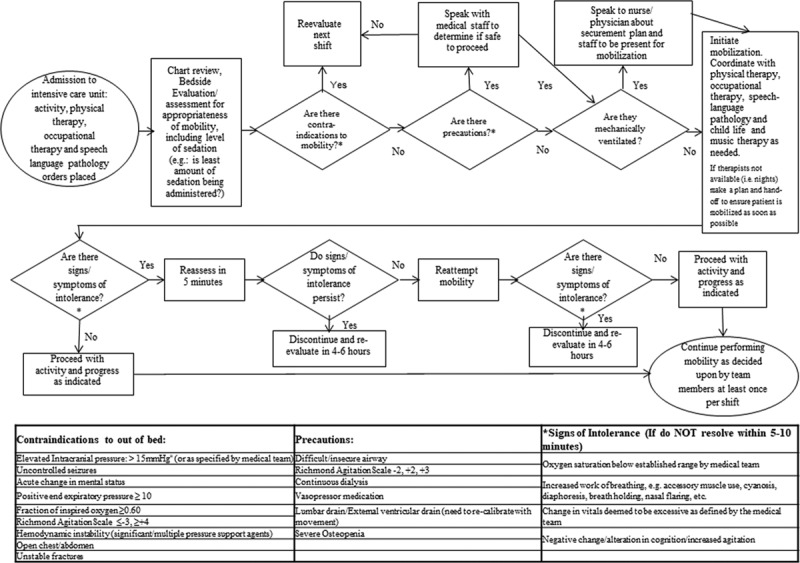
We collected data from September 15, 2015, to December 15, 2016, identified key drivers and barriers, and developed interventions. Interventions included the development of an algorithm to identify patients appropriate for mobilization, management of barriers to mobilization, and education on the benefits of early mobilization. The percentage of PICU patients mobilized early; the percentage of patients with physical therapy, occupational therapy (OT), speech-language pathology (SLP), and activity orders; identified barriers; PICU and hospital length of stay (LOS) and discharge disposition, were compared between the pre- and postintervention groups and the non-MV and MV subgroups. The MV subgroup was too small for statistical testing.
All measures in the combined postintervention group improved and reached significance (<0.05), except for the percentage of SLP orders and discharged home. Percentage mobilized early increased 25%, activity orders 50%, physical therapist orders 14%, OT orders 11%, SLP orders 7%, and discharged home 6%. Hospital LOS decreased by 35%, and PICU LOS decreased by 34%. All measures in the postintervention, non-MV subgroup improved and reached significance (<0.05).
This early mobilization program was associated with statistically significant improvements in the rate of early mobilization, activity and therapy orders, and hospital and PICU LOS.
在重症监护病房住院期间让患者活动可改善临床和功能结局。本质量改进项目的目标是将儿科重症监护病房(PICU)早期活动患者的比例从62%提高到80%。早期活动是指非机械通气(非MV)患者在入院后18小时内,机械通气(MV)患者在入院后48小时内进行活动。
我们收集了2015年9月15日至2016年12月15日的数据,确定了关键驱动因素和障碍,并制定了干预措施。干预措施包括制定一种算法以识别适合活动的患者、管理活动障碍以及开展关于早期活动益处的教育。比较了干预前和干预后组以及非MV和MV亚组中PICU早期活动患者的比例、接受物理治疗、职业治疗(OT)、言语语言病理学(SLP)和活动医嘱的患者比例、识别出的障碍、PICU和医院住院时间(LOS)以及出院处置情况。MV亚组规模太小,无法进行统计检验。
干预后合并组的所有指标均有所改善并达到显著水平(<0.05),但SLP医嘱比例和出院回家的比例除外。早期活动比例增加了25%,活动医嘱增加了50%,物理治疗师医嘱增加了14%,OT医嘱增加了11%,SLP医嘱增加了7%,出院回家的比例增加了6%。医院LOS降低了35%,PICU LOS降低了34%。干预后非MV亚组的所有指标均有所改善并达到显著水平(<0.05)。
这项早期活动计划与早期活动率、活动和治疗医嘱以及医院和PICU LOS的统计学显著改善相关。