Section for Health Promotion, Department of Preventive Gerontology, Center for Gerontology and Social Science, National Center for Geriatrics and Gerontology, Aichi, Japan.
J Cachexia Sarcopenia Muscle. 2020 Oct;11(5):1250-1257. doi: 10.1002/jcsm.12571. Epub 2020 Mar 19.
Malnutrition plays an essential role in the mechanism of pathogenesis for sarcopenia. In late life, both food consumption and energy intakes decline. One of key factors for reduced energy intakes is anorexia of ageing. The aim of this study is to examine the association between anorexia of ageing and sarcopenia among community-dwelling elderly Japanese individuals.
This uses population-based, cross-sectional cohort study of elderly Japanese individuals. Anorexia of ageing was assessed via a simplified nutritional appetite questionnaire. Handgrip strength and walking speed were tested, and skeletal muscle mass was assessed using a bio-impedance analysis device. Subjects with sarcopenia were defined as those who met the criteria of the Asian Working Group for Sarcopenia. The association between anorexia of ageing and sarcopenia was then analysed via multiple regression analysis.
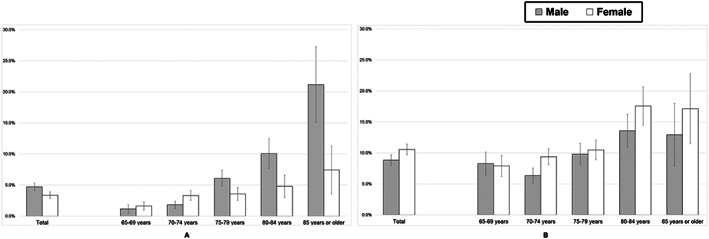
In total, 9,496 elderly Japanese individuals were evaluated (mean age 74.1 ± 5.4 years; male, 47.0%). The prevalence of anorexia of ageing was 9.8% (n = 927) in the present study. The prevalence of sarcopenia in men was 1.1%, 1.8%, 6.1%, 10.1%, and 21.2% and was 1.6%, 3.3%, 3.6%, 4.8%, and 7.4% in women aged 65-69, 70-74, 75-79, 80-84, and 85 years and older, respectively. The prevalence of anorexia also showed an age-dependent increase in both sexes (P < 0.001, respectively). The prevalence of anorexia in men was 8.3%, 6.3%, 9.8%, 13.6%, and 12.9% and was 7.9%, 9.4%, 10.5%, 17.6%, and 17.1% in women aged 65-69, 70-74, 75-79, 80-84, and 85 years and older, respectively. In multivariable logistic regression model adjusted for the covariates except for albumin, anorexia of ageing was independently associated with sarcopenia (OR: 1.45, 95% CI: 1.07 to 1.95; P = 0.015). This significant association remained even after adjusting for all covariates including nutritional status (OR: 1.42, 95% CI: 1.06 to 1.92, P = 0.020).
Anorexia of ageing is associated with sarcopenia among Japanese elderly individuals. Further studies are needed to determine whether a causal association exists between anorexia and sarcopenia.
营养不良在肌肉减少症的发病机制中起着重要作用。在晚年,食物摄入和能量摄入都会下降。能量摄入减少的一个关键因素是与年龄相关的厌食。本研究的目的是检验社区居住的日本老年人中与年龄相关的厌食与肌肉减少症之间的关系。
本研究采用基于人群的、横断面队列研究方法,对日本老年人进行研究。采用简化的营养食欲问卷评估与年龄相关的厌食。测试握力和步行速度,使用生物阻抗分析装置评估骨骼肌质量。将符合亚洲肌肉减少症工作组标准的患者定义为肌肉减少症患者。然后通过多元回归分析分析与年龄相关的厌食与肌肉减少症之间的关系。
共评估了 9496 名日本老年人(平均年龄 74.1±5.4 岁;男性 47.0%)。本研究中与年龄相关的厌食的患病率为 9.8%(n=927)。男性肌肉减少症的患病率分别为 65-69 岁、70-74 岁、75-79 岁、80-84 岁和 85 岁及以上人群的 1.1%、1.8%、6.1%、10.1%和 21.2%,女性分别为 1.6%、3.3%、3.6%、4.8%和 7.4%。在两性中,厌食症的患病率均随年龄的增长而增加(P<0.001,分别)。男性的厌食症患病率分别为 65-69 岁、70-74 岁、75-79 岁、80-84 岁和 85 岁及以上人群的 8.3%、6.3%、9.8%、13.6%和 12.9%,女性分别为 7.9%、9.4%、10.5%、17.6%和 17.1%。在调整白蛋白等协变量的多变量逻辑回归模型中,与年龄相关的厌食症与肌肉减少症独立相关(OR:1.45,95%CI:1.07-1.95;P=0.015)。即使在调整包括营养状况在内的所有协变量后(OR:1.42,95%CI:1.06-1.92,P=0.020),这种显著相关性仍然存在。
与年龄相关的厌食症与日本老年人的肌肉减少症有关。需要进一步研究以确定厌食症与肌肉减少症之间是否存在因果关系。