Ravaioli Matteo, Maroni Lorenzo, Angeletti Andrea, Fallani Guido, De Pace Vanessa, Germinario Giuliana, Odaldi Federica, Corradetti Valeria, Caraceni Paolo, Baldassarre Maurizio, Vasuri Francesco, D'Errico Antonia, Sangiorgi Gabriela, Siniscalchi Antonio, Morelli Maria Cristina, Rossetto Anna, Ranieri Vito Marco, Cescon Matteo, Del Gaudio Massimo, Zanfi Chiara, Bertuzzo Valentina, Comai Giorgia, La Manna Gaetano
Department of Medical and Surgical Sciences, University of Bologna Sant'Orsola-Malpighi Hospital, Bologna, Italy.
Department of Experimental Diagnostic and Specialty Medicine, University of Bologna Sant'Orsola-Malpighi Hospital, Bologna, Italy.
JMIR Res Protoc. 2020 Mar 19;9(3):e13922. doi: 10.2196/13922.
Extended criteria donors (ECD) are widely utilized due to organ shortage, but they may increase the risk of graft dysfunction and poorer outcomes. Hypothermic oxygenated perfusion (HOPE) is a recent organ preservation strategy for marginal kidney and liver grafts, allowing a redirect from anaerobic metabolism to aerobic metabolism under hypothermic conditions and protecting grafts from oxidative species-related damage. These mechanisms may improve graft function and survival.
With this study, we will evaluate the benefit of end-ischemic HOPE on ECD grafts for livers and kidneys as compared to static cold storage (SCS). The aim of the study is to demonstrate the ability of HOPE to improve graft function and postoperative outcomes of ECD kidney and liver recipients.
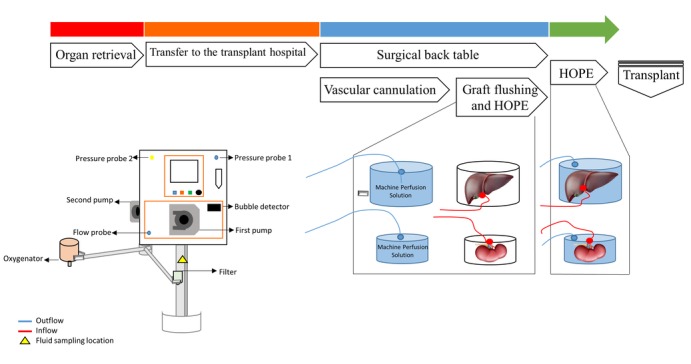
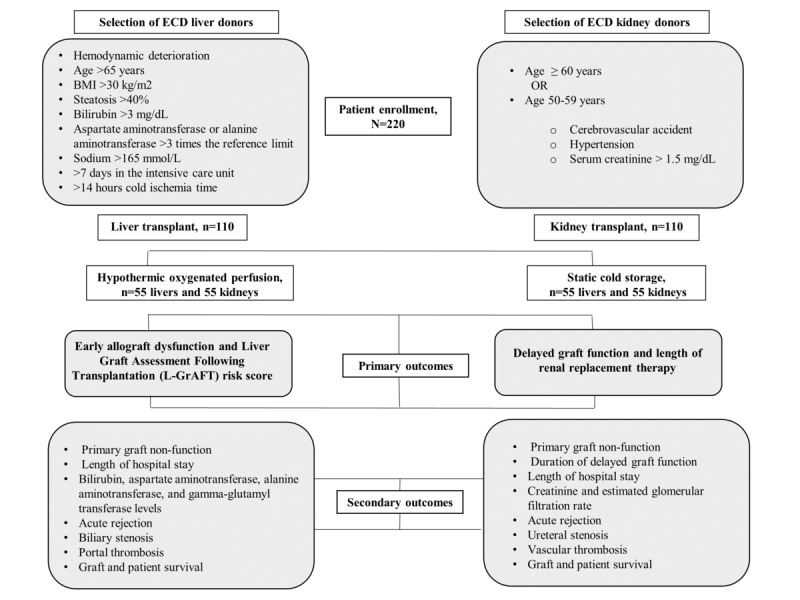
This is an open-label, single-center randomized clinical trial with the aim of comparing HOPE with SCS in ECD kidney and liver transplantation. In the study protocol, which has been approved by the ethics committee, 220 patients (110 liver recipients and 110 kidney recipients) will be enrolled. Livers and kidneys assigned to the HOPE group undergo machine perfusion with cold Belzer solution (4-10°C) and continuous oxygenation (partial pressure of oxygen of 500-600 mm Hg). In the control group, livers and kidneys undergoing SCS are steeped in Celsior solution and stored on ice. Using the same perfusion machine for both liver and kidney grafts, organs are perfused from the start of the back-table procedure until implantation, without increasing the cold ischemia time. For each group, we will evaluate clinical outcomes, graft function tests, histologic findings, perfusate, and the number of allocated organs. Publication of the results is expected to begin in 2021.
Dynamic preservation methods for organs from high-risk donors should improve graft dysfunction after transplantation. To date, we have recruited 108 participants. The study is ongoing, and recruitment of participants will continue until January 2020.
The proposed preservation method should improve ECD graft function and consequently the postoperative patient outcomes.
ClinicalTrials.gov NCT03837197; https://clinicaltrials.gov/ct2/show/NCT03837197 ; Archived by WebCite® at http://www.webcitation.org/76fSutT3R.
INTERNATIONAL REGISTERED REPORT IDENTIFIER (IRRID): DERR1-10.2196/13922.
由于器官短缺,扩大标准供体(ECD)被广泛使用,但它们可能会增加移植物功能障碍的风险和导致较差的预后。低温氧合灌注(HOPE)是一种针对边缘性肾和肝移植物的新型器官保存策略,可在低温条件下使代谢从无氧代谢转向有氧代谢,并保护移植物免受氧化应激相关损伤。这些机制可能会改善移植物功能和存活率。
通过本研究,我们将评估肝和肾ECD移植物缺血末期HOPE相较于静态冷藏(SCS)的益处。本研究的目的是证明HOPE改善ECD肾和肝移植受者移植物功能和术后预后的能力。
这是一项开放标签、单中心随机临床试验,旨在比较ECD肾和肝移植中HOPE与SCS。在已获伦理委员会批准的研究方案中,将招募220名患者(110名肝移植受者和110名肾移植受者)。分配至HOPE组的肝脏和肾脏用冷的Belzer溶液(4 - 10°C)进行机器灌注并持续氧合(氧分压为500 - 600 mmHg)。在对照组中,接受SCS的肝脏和肾脏浸泡在Celsior溶液中并置于冰上保存。使用同一台灌注机对肝和肾移植物进行灌注,从后台操作开始直至植入,不增加冷缺血时间。对于每组,我们将评估临床结局、移植物功能测试、组织学结果、灌注液以及分配器官的数量。预计结果将于2021年开始发表。
针对高风险供体器官的动态保存方法应能改善移植后的移植物功能障碍。截至目前,我们已招募了108名参与者。研究正在进行中,参与者招募将持续至2020年1月。
所提出的保存方法应能改善ECD移植物功能,从而改善术后患者预后。
ClinicalTrials.gov NCT03837197;https://clinicaltrials.gov/ct2/show/NCT03837197;由WebCite®存档于http://www.webcitation.org/76fSutT3R。
国际注册报告识别码(IRRID):DERR1-10.2196/13922。