Hassan Jahidul, Miyajima Ikuo, Ozaki Yukio, Mizunoe Yuki, Sakai Kaori, Zaland Wasimullah
Graduate School of Bioresource and Bioenvironmental Sciences, Faculty of Agriculture, Kyushu University, Fukuoka 819-0395, Japan.
Institute of Tropical Agriculture, Kyushu University, Fukuoka 819-0395, Japan.
Plants (Basel). 2020 Mar 17;9(3):370. doi: 10.3390/plants9030370.
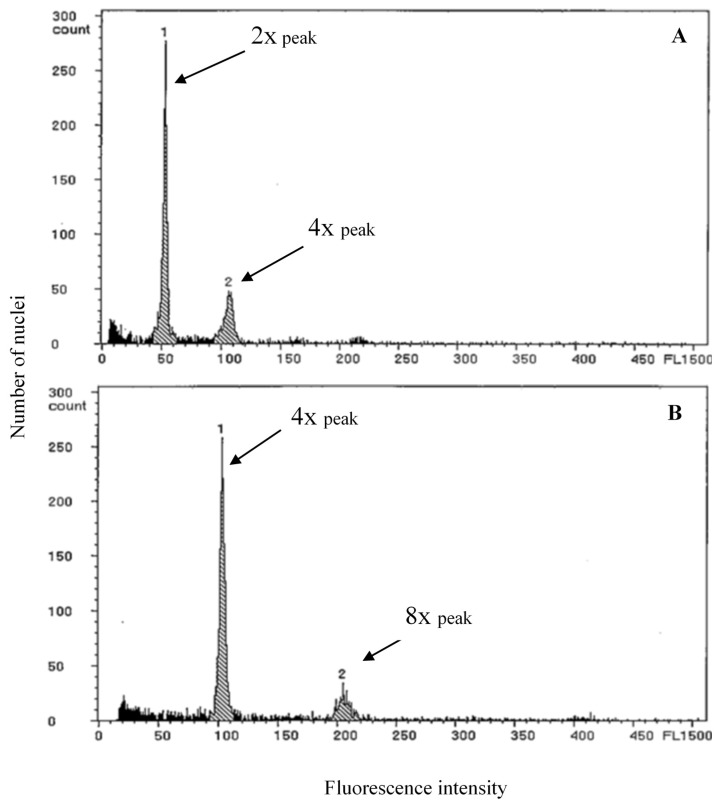
Pointed gourd ( Roxb.) (2n = 2x = 22) is a dioecious cucurbit vegetable and green fruit that is edible after cooking. Consumers prefer to consume seedless or less-seeded fruit because seeds are unpalatable due to their hard coats. Therefore, the cross compatibility between the diploid and induced tetraploid will be helpful for seedless or less-seeded fruit production. Thus, the present study was conducted using mature seeds that were immersed in 0.05%, 0.1%, and 0.5% colchicine for 24, 48, and 72 h to induce tetraploids. These tetraploids were used as parents (male or female) in the inter-ploidy and intra-ploidy crosses. A flow cytometric analysis confirmed the induction of three tetraploids at 0.5% colchicine for 48 and 72 h soaking periods. Among these, two (2) females and one (1) male were differentiated after flower initiation. Crossing between the tetraploid's maternal and diploid paternal parent (4x × 2x), which were revealed to be compatible, resulted in a similar fruit set rate and shape as those of the diploid. In addition, a seed number of 4x × 2x produced fruits that were drastically reduced to 1.8 seeds per fruit, whereas the natural diploid fruits had 26.4 seeds per fruit. These findings suggest that colchicine-induced tetraploid females are important genetic resources for less-seeded fruit production. The genetic stability of tetraploid clones can easily and effectively be maintained by vine cutting for advanced uses.
尖头瓜(Roxb.)(2n = 2x = 22)是一种雌雄异株的葫芦科蔬菜,其绿色果实烹饪后可食用。消费者更喜欢食用无籽或少籽的果实,因为种子外壳坚硬,口感不佳。因此,二倍体与诱导四倍体之间的杂交亲和性将有助于无籽或少籽果实的生产。因此,本研究使用成熟种子,将其浸泡在0.05%、0.1%和0.5%的秋水仙碱溶液中24、48和72小时以诱导四倍体。这些四倍体被用作倍性间和倍性内杂交的亲本(雄性或雌性)。流式细胞仪分析证实,在0.5%秋水仙碱溶液中浸泡48和72小时诱导出了三个四倍体。其中,在开花后区分出了两(2)株雌性和一(1)株雄性。四倍体母本与二倍体父本(4x × 2x)之间的杂交显示具有亲和性,其坐果率和果实形状与二倍体相似。此外,4x × 2x杂交产生的果实种子数大幅减少至每个果实1.8粒种子,而天然二倍体果实每个果实有26.4粒种子。这些结果表明,秋水仙碱诱导的四倍体雌性是少籽果实生产的重要遗传资源。通过扦插可以轻松有效地维持四倍体克隆的遗传稳定性,以供进一步利用。