Honda Shiori, Ishikawa Yuri, Konno Rei, Imai Eiko, Nomiyama Natsumi, Sakurada Kazuki, Koumura Takuya, Kondo Hirohito M, Furukawa Shigeto, Fujii Shinya, Nakatani Masashi
Graduate School of Media and Governance, Keio University, Fujisawa, Japan.
Faculty of Environment and Information Studies, Keio University, Fujisawa, Japan.
Front Psychol. 2020 Mar 3;11:316. doi: 10.3389/fpsyg.2020.00316. eCollection 2020.
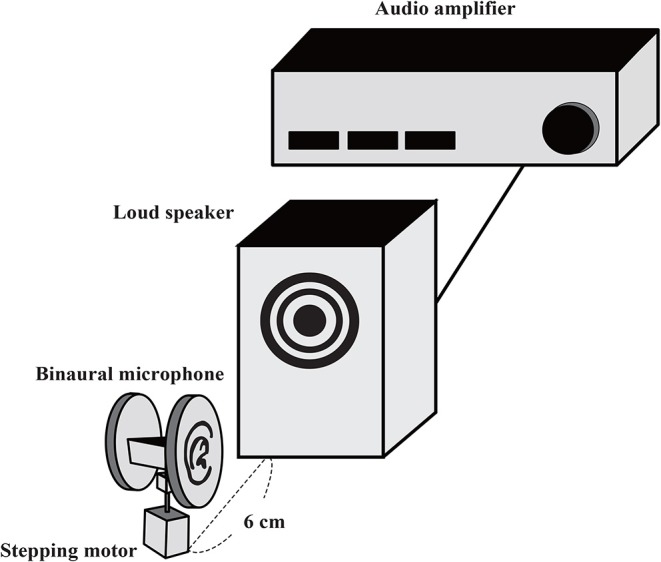
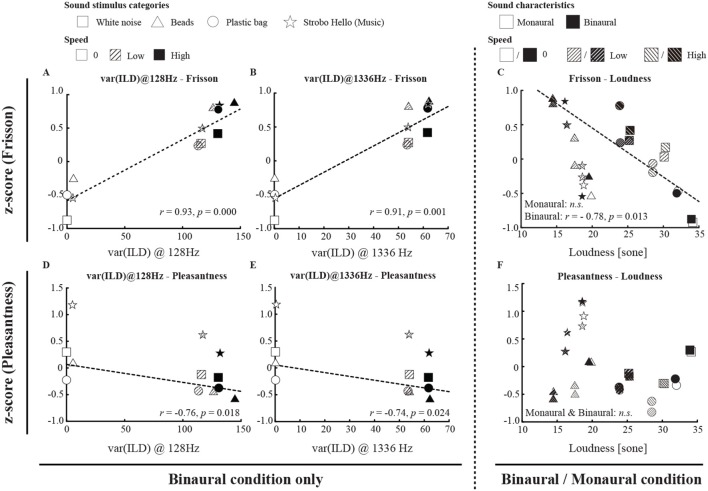
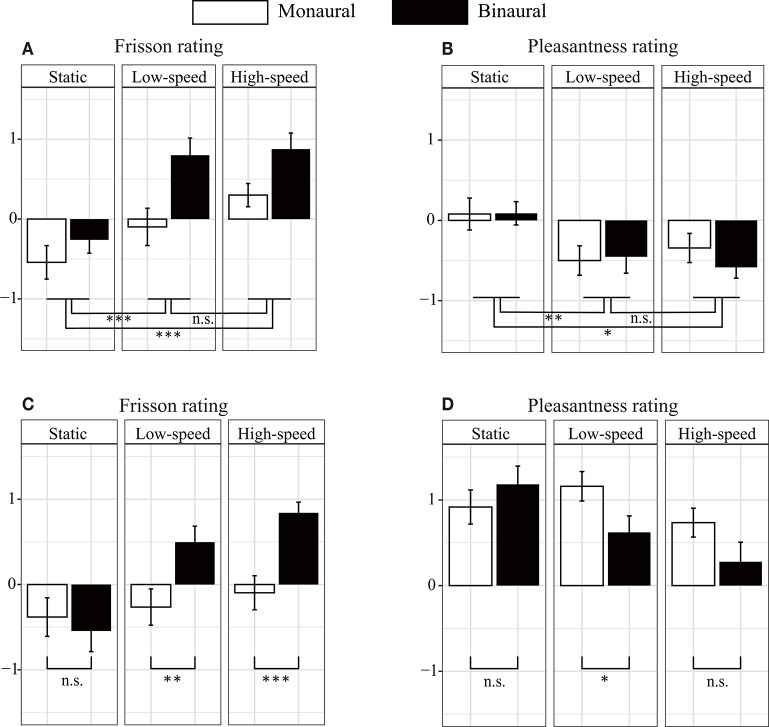
Auditory frisson is the experience of feeling of cold or shivering related to sound in the absence of a physical cold stimulus. Multiple examples of frisson-inducing sounds have been reported, but the mechanism of auditory frisson remains elusive. Typical frisson-inducing sounds may contain a looming effect, in which a sound appears to approach the listener's peripersonal space. Previous studies on sound in peripersonal space have provided objective measurements of sound-inducing effects, but few have investigated the subjective experience of frisson-inducing sounds. Here we explored whether it is possible to produce subjective feelings of frisson by moving a noise sound (white noise, rolling beads noise, or frictional noise produced by rubbing a plastic bag) stimulus around a listener's head. Our results demonstrated that sound-induced frisson can be experienced stronger when auditory stimuli are rotated around the head (binaural moving sounds) than the one without the rotation (monaural static sounds), regardless of the source of the noise sound. Pearson's correlation analysis showed that several acoustic features of auditory stimuli, such as variance of interaural level difference (ILD), loudness, and sharpness, were correlated with the magnitude of subjective frisson. We had also observed that the subjective feelings of frisson by moving a musical sound had increased comparing with a static musical sound.
听觉性颤栗是指在没有物理性冷刺激的情况下,与声音相关的寒冷或颤抖的感觉体验。已经报道了多个引发颤栗的声音例子,但听觉性颤栗的机制仍然难以捉摸。典型的引发颤栗的声音可能包含一种逼近效应,即声音似乎接近听众的个人周边空间。先前关于个人周边空间声音的研究提供了声音诱导效应的客观测量,但很少有研究调查引发颤栗声音的主观体验。在这里,我们探讨了通过在听众头部周围移动噪声刺激(白噪声、滚动珠子的噪声或摩擦塑料袋产生的摩擦噪声)是否有可能产生颤栗的主观感受。我们的结果表明,无论噪声源如何,当听觉刺激围绕头部旋转(双耳移动声音)时,声音诱发的颤栗比不旋转时(单耳静态声音)体验更强。皮尔逊相关分析表明,听觉刺激的几个声学特征,如耳间声级差(ILD)的方差、响度和尖锐度,与主观颤栗的程度相关。我们还观察到,与静态音乐声音相比,移动音乐声音引发的颤栗主观感受有所增加。