Department of Psychology, Center for Brain and Cognition, University of California, San Diego San Diego, CA, USA.
Front Hum Neurosci. 2013 Jun 25;7:296. doi: 10.3389/fnhum.2013.00296. eCollection 2013.
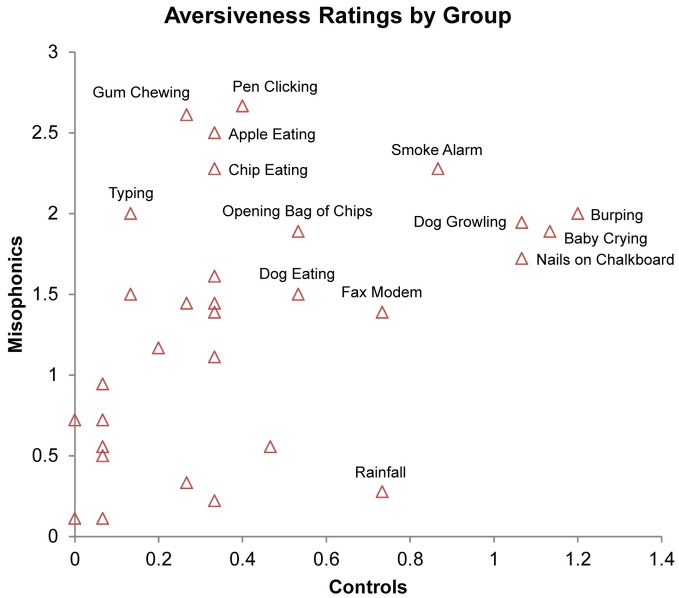
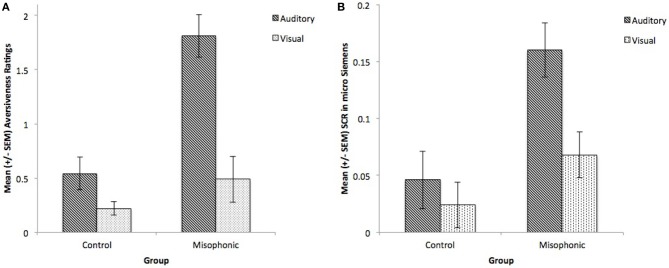
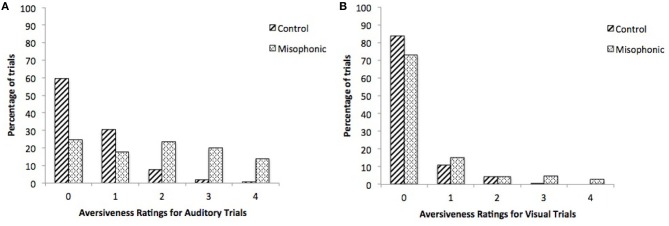
Misophonia is a relatively unexplored chronic condition in which a person experiences autonomic arousal (analogous to an involuntary "fight-or-flight" response) to certain innocuous or repetitive sounds such as chewing, pen clicking, and lip smacking. Misophonics report anxiety, panic, and rage when exposed to trigger sounds, compromising their ability to complete everyday tasks and engage in healthy and normal social interactions. Across two experiments, we measured behavioral and physiological characteristics of the condition. Interviews (Experiment 1) with misophonics showed that the most problematic sounds are generally related to other people's behavior (pen clicking, chewing sounds). Misophonics are however not bothered when they produce these "trigger" sounds themselves, and some report mimicry as a coping strategy. Next, (Experiment 2) we tested the hypothesis that misophonics' subjective experiences evoke an anomalous physiological response to certain auditory stimuli. Misophonic individuals showed heightened ratings and skin conductance responses (SCRs) to auditory, but not visual stimuli, relative to a group of typically developed controls, supporting this general viewpoint and indicating that misophonia is a disorder that produces distinct autonomic effects not seen in typically developed individuals.
恐音症是一种相对未被探索的慢性疾病,患者会对某些无害或重复的声音(如咀嚼、笔尖点击和嘴唇咂嘴声)产生自主唤醒(类似于无意识的“战斗或逃跑”反应)。当接触到引发声音时,恐音症患者会感到焦虑、恐慌和愤怒,从而影响他们完成日常任务和进行健康正常社交互动的能力。在两项实验中,我们测量了这种情况的行为和生理特征。对恐音症患者的访谈(实验 1)表明,最麻烦的声音通常与他人的行为有关(笔尖点击、咀嚼声)。然而,当他们自己发出这些“触发”声音时,恐音症患者并不会感到困扰,有些人会模仿这些声音作为应对策略。接下来,(实验 2)我们测试了这样一种假设,即恐音症患者的主观体验会对某些听觉刺激产生异常的生理反应。与一组典型的对照组相比,恐音症个体对听觉刺激的评分和皮肤电反应(SCR)更高,而对视觉刺激则没有,这支持了这种普遍观点,并表明恐音症是一种会产生独特自主效应的障碍,在典型发育个体中不会出现这些效应。