Cao Hongbao, Baranova Ancha, Yue Weihua, Yu Hao, Zhu Zufu, Zhang Fuquan, Liu Dongbai
Department of Psychiatry, First Hospital/First Clinical Medical College of Shanxi Medical University, Taiyuan, China.
Department of Genomics Research, R&D Solutions, Elsevier Inc., Rockville, MD, United States.
Front Genet. 2020 Mar 4;11:149. doi: 10.3389/fgene.2020.00149. eCollection 2020.
Schizophrenia risk genes are widely investigated, but a systemic analysis of miRNAs contributing to schizophrenia is lacking.
Schizophrenia-associated genetic loci profiles were derived from a genome-wide association study (GWAS) from the Schizophrenia Working Group of the Psychiatric Genomics Consortium (PGC) dataset. Experimentally confirmed relationships between miRNAs and their target genes were retrieved from a miRTarBase. A competitive gene set association analysis for miRNA-target regulations was conducted by the Multi-marker Analysis of GenoMic Annotation (MAGMA) and further validated by literature-based functional pathway analysis using Pathway Studio. The association between the targets of three miRNAs and schizophrenia was further validated using a GWAS of antipsychotic treatment responses.
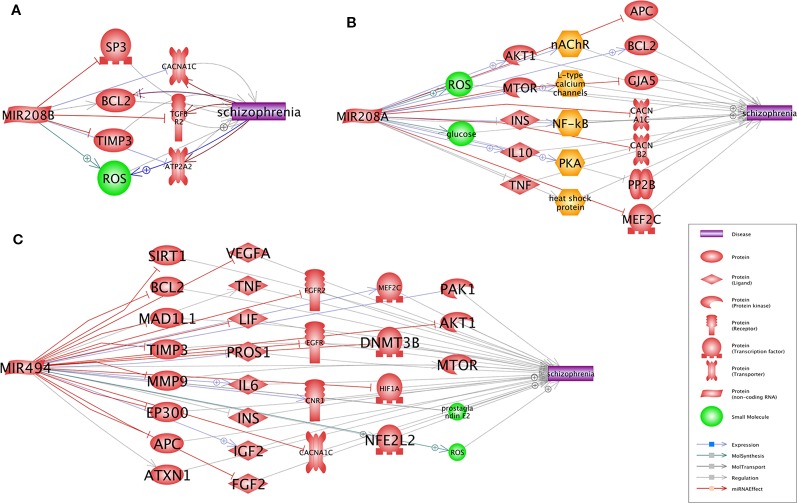
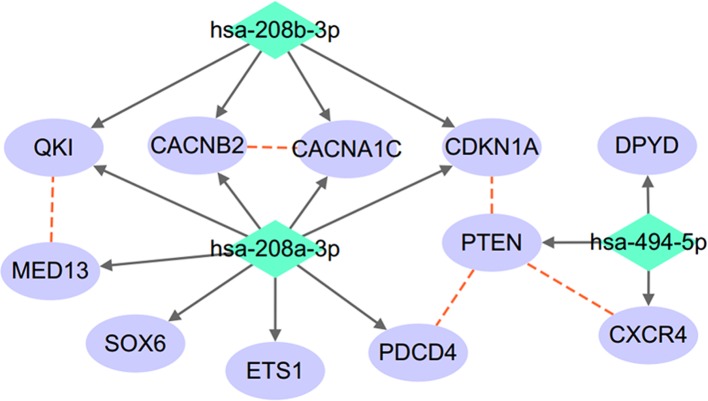
Three novel schizophrenia-risk miRNAs, namely, miR-208b-3p, miR-208a-3p, and miR-494-5p, and their targetomes converged on calcium voltage-gated channel subunit alpha1 C (CACNA1C) and B-cell lymphoma 2 (BCL2), and these are well-known contributors to schizophrenia. Both miR-208a-3p and miR-208b-3p reduced the expression of the RNA-binding protein Quaking (), whose suppression commonly contributes to demyelination of the neurons and to ischemia/reperfusion injury. On the other hand, both QKI and hsa-miR-494-5p were involved in gliomagenesis.
Presented results point at an orchestrating role of miRNAs in the pathophysiology of schizophrenia. The sharing of regulatory networks between schizophrenia and other pathologies may explain higher cardiovascular mortality and lower odds of glioma previously reported in psychiatric patients.
精神分裂症风险基因已得到广泛研究,但对于促成精神分裂症的微小RNA(miRNA)缺乏系统性分析。
精神分裂症相关基因座图谱源自精神病基因组学联盟(PGC)数据集的精神分裂症工作组进行的全基因组关联研究(GWAS)。miRNA与其靶基因之间经实验证实的关系从miRTarBase中检索获得。通过基因组注释多标记分析(MAGMA)对miRNA-靶标调控进行竞争性基因集关联分析,并使用通路工作室基于文献的功能通路分析进一步验证。使用抗精神病药物治疗反应的GWAS进一步验证了三种miRNA的靶标与精神分裂症之间的关联。
三种新型精神分裂症风险miRNA,即miR-208b-3p、miR-208a-3p和miR-494-5p,及其靶标组汇聚于钙电压门控通道亚基α1 C(CACNA1C)和B细胞淋巴瘤2(BCL2),而这些都是精神分裂症的知名促成因素。miR-208a-3p和miR-208b-3p均降低了RNA结合蛋白震颤蛋白(QKI)的表达,其抑制通常会导致神经元脱髓鞘和缺血/再灌注损伤。另一方面,QKI和hsa-miR-494-5p均参与神经胶质瘤的发生。
研究结果表明miRNA在精神分裂症的病理生理学中起协调作用。精神分裂症与其他疾病之间调控网络的共享可能解释了先前报道的精神科患者较高的心血管死亡率和较低的神经胶质瘤发病率。