Department of Diagnostic & Biomedical Sciences, School of Dentistry, The University of Texas Health Science Center at Houston, Houston, TX, USA.
Center for Craniofacial Research, The University of Texas Health Science Center at Houston, Houston, TX, USA.
BMC Med Genomics. 2019 May 23;12(1):70. doi: 10.1186/s12920-019-0535-2.
The etiology of cleft lip with or without cleft palate (CL/P), a common congenital birth defect, is complex and involves the contribution of genetic and environmental factors. Although many candidate genes have been identified, the regulation and interaction of these genes in CL/P remain unclear. In addition, the contribution of microRNAs (miRNAs), non-coding RNAs that regulate the expression of multiple genes, to the etiology of CL/P is largely unknown.
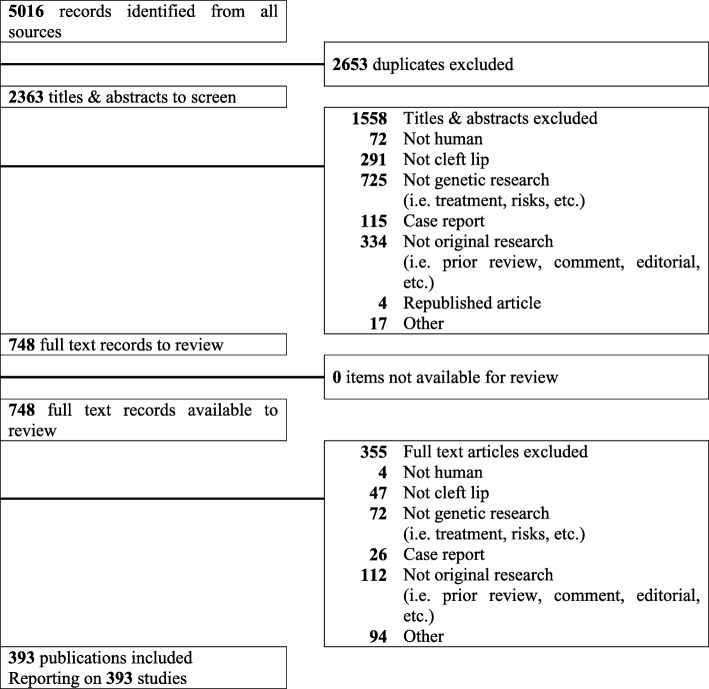
To identify the signatures of causative biological pathways for human CL/P, we conducted a systematic literature review for human CL/P candidate genes and subsequent bioinformatics analyses. Functional enrichment analyses of the candidate CL/P genes were conducted using the pathway databases GO and KEGG. The miRNA-mediated post-transcriptional regulation of the CL/P candidate genes was analyzed with miRanda, PITA, and TargetScan, and miRTarbase. Genotype-phenotype association analysis was conducted using GWAS. The functional significance of the candidate miRNAs was evaluated experimentally in cell proliferation and target gene regulation assays in human lip fibroblasts.
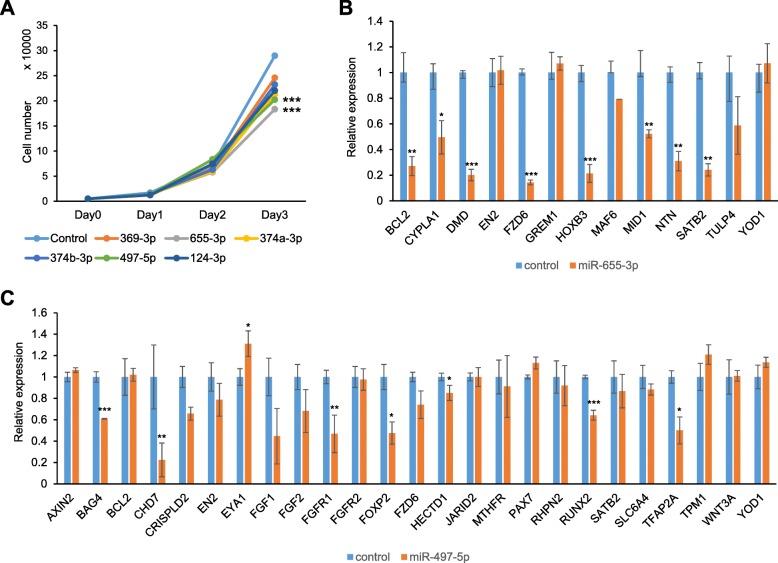
Through an extensive search of the main biomedical databases, we mined 177 genes with mutations or association/linkage reported in individuals with CL/P, and considered them as candidate genes for human CL/P. The genotype-phenotype association study revealed that mutations in 12 genes (ABCA4, ADAM3A, FOXE1, IRF6, MSX2, MTHFR, NTN1, PAX7, TP63, TPM1, VAX1, and WNT9B) were significantly associated with CL/P. In addition, our bioinformatics analysis predicted 16 microRNAs (miRNAs) to be post-transcriptional regulators of CL/P genes. To validate the bioinformatics results, the top six candidate miRNAs (miR-124-3p, miR-369-3p, miR-374a-5p, miR-374b-5p, miR-497-5p, and miR-655-3p) were evaluated by cell proliferation/survival assays and miRNA-gene regulation assays in cultured human lip fibroblasts. We found that miR-497-5p and miR-655-3p significantly suppressed cell proliferation in these cells. Furthermore, the expression of the predicted miRNA-target genes was significantly downregulated by either miR-497-5p or miR-655-3p mimic.
Expression of miR-497-5p and miR-655-3p suppresses cell proliferation through the regulation of human CL/P-candidate genes. This study provides insights into the role of miRNAs in the etiology of CL/P and suggests possible strategies for the diagnosis of CL/P.
唇腭裂(CL/P)是一种常见的先天性出生缺陷,其病因复杂,涉及遗传和环境因素的共同作用。虽然已经鉴定出许多候选基因,但这些基因在 CL/P 中的调控和相互作用仍不清楚。此外,miRNA(miRNAs)等非编码 RNA 对 CL/P 病因的贡献在很大程度上尚不清楚,miRNAs 可调节多个基因的表达。
为了鉴定人类 CL/P 致病生物学途径的特征,我们对人类 CL/P 候选基因进行了系统的文献回顾和随后的生物信息学分析。使用 GO 和 KEGG 途径数据库对候选 CL/P 基因进行功能富集分析。使用 miRanda、PITA 和 TargetScan 以及 miRTarbase 分析了 CL/P 候选基因的 miRNA 介导的转录后调控。使用 GWAS 进行基因型-表型关联分析。在人唇成纤维细胞的细胞增殖和靶基因调控测定中,通过实验评估候选 miRNA 的功能意义。
通过对主要生物医学数据库的广泛搜索,我们挖掘了 177 个在 CL/P 个体中报道有突变或关联/连锁的基因,并将其视为人类 CL/P 的候选基因。基因型-表型关联研究表明,12 个基因(ABCA4、ADAM3A、FOXE1、IRF6、MSX2、MTHFR、NTN1、PAX7、TP63、TPM1、VAX1 和 WNT9B)的突变与 CL/P 显著相关。此外,我们的生物信息学分析预测了 16 个 microRNAs(miRNAs)是 CL/P 基因的转录后调控因子。为了验证生物信息学结果,我们通过细胞增殖/存活测定和培养的人唇成纤维细胞中的 miRNA-基因调控测定评估了前 6 个候选 miRNA(miR-124-3p、miR-369-3p、miR-374a-5p、miR-374b-5p、miR-497-5p 和 miR-655-3p)。我们发现 miR-497-5p 和 miR-655-3p 显著抑制了这些细胞的增殖。此外,miR-497-5p 或 miR-655-3p 模拟物显著下调了预测的 miRNA 靶基因的表达。
miR-497-5p 和 miR-655-3p 的表达通过调节人类 CL/P 候选基因抑制细胞增殖。这项研究提供了 miRNA 在 CL/P 发病机制中的作用的见解,并为 CL/P 的诊断提供了可能的策略。