Department of Neurological Surgery, University of Pittsburgh, Pittsburgh, Pennsylvania.
Department of Otolaryngology, University of Pittsburgh, Pittsburgh, Pennsylvania.
Neurosurgery. 2020 Sep 15;87(4):788-795. doi: 10.1093/neuros/nyaa024.
Despite the impact of Parkinson disease (PD) on speech communication, there is no consensus regarding the effect of lead location on voice-related outcomes in subthalamic nucleus (STN) deep brain stimulation (DBS).
To determine the relationship of stimulation location to changes in cepstral analyses of voice following STN DBS.
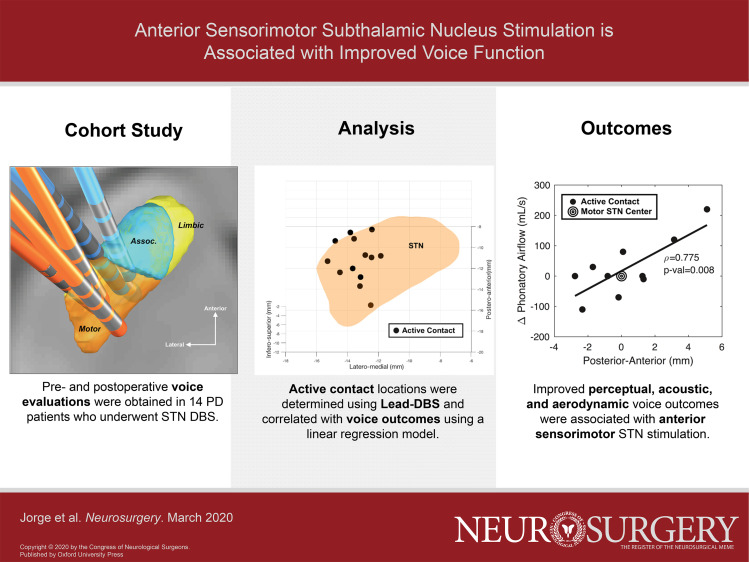
Speech pathology evaluations were obtained from 14 PD subjects, before and after STN DBS, including audio-perceptual voice ratings (overall severity, loudness, hoarseness changes), measured indices of dysphonia (cepstral peak prominence and cepstral spectral index of dysphonia), and phonatory aerodynamics. The contact locations used for active stimulation at the time of postoperative voice evaluations were determined and assessed in relation to voice outcomes.
Voice outcomes remained relatively unchanged on average. Stimulation locations in the anterior portion of the sensorimotor region of the left STN, however, were associated with improvements in voice severity scores, cepstral spectral index of dysphonia, shortness of breath, and phonatory airflow during connected speech. Posterior locations were associated with worsening of these outcomes. Variation in the medial-lateral or dorsal-ventral position on the left, and in any direction on the right, did not correlate with any voice outcome.
Active contact placement within the anterior sensorimotor STN was associated with improved perceptual and acoustic-aerodynamic voice-related outcomes. These findings suggest an STN topography for improving airflow for speech, in turn improving how PD patients' voices sound.
尽管帕金森病(PD)对言语交流有影响,但对于丘脑底核(STN)深部脑刺激(DBS)中刺激部位对与声音相关的结果的影响,尚无共识。
确定 STN-DBS 后刺激部位与语音倒频谱分析变化之间的关系。
对 14 名 PD 患者在 STN-DBS 前后进行了语音病理评估,包括音频感知声音评估(整体严重程度、响度、嘶哑变化)、测量的发声障碍指标(倒频谱峰突出度和发声障碍倒频谱指数)和发声空气动力学。在术后语音评估时确定并评估用于主动刺激的接触位置与语音结果的关系。
平均而言,语音结果相对保持不变。然而,左 STN 感觉运动区前部的刺激位置与声音严重程度评分、发声障碍倒频谱指数、呼吸急促和连接言语时的发声气流改善相关。后部位置与这些结果的恶化相关。左部的前后或背腹位置变化,以及右部的任何方向变化,与任何语音结果均无关。
在 STN 前感觉运动区内的主动接触位置与改善的感知和声学空气动力学相关的声音结果相关。这些发现表明,存在一种改善言语气流的 STN 地形图,从而改善 PD 患者的声音质量。