The Weipers Centre Equine Hospital, Large Animal Clinical Sciences and Public Health, School of Veterinary Medicine, College of Medical, Veterinary and Life Sciences, University of Glasgow, Bearsden Road, Glasgow, UK.
Gambia Horse and Donkey Trust, Sambel Kunda, Central River District, The Gambia.
Parasit Vectors. 2020 Mar 21;13(1):148. doi: 10.1186/s13071-020-04020-6.
Equine trypanosomiasis is a severe and prevalent disease that has the greatest impact globally upon working equids due to its distribution across lower income countries. Morbidity and mortality rates are high; disease management strategies in endemic regions are ineffective and cost prohibitive. Individual variation in disease phenotype in other species suggests host factors could reveal novel treatment and control targets but has not been investigated in equids.
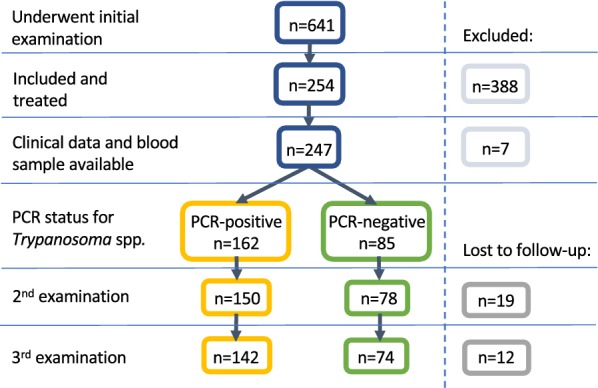
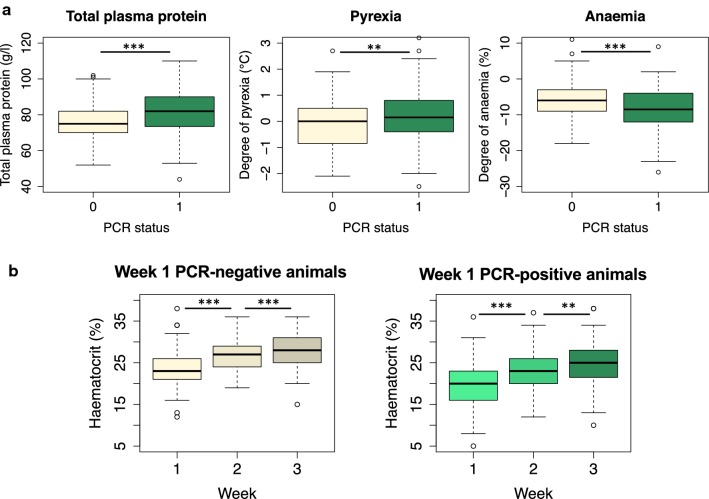
A prospective clinical evaluation of equines presenting for a free veterinary examination was performed in hyperendemic villages in The Gambia. Age, body condition score and body weight were estimated by validated methods, and haematocrit and total protein concentration measured. Animals fulfilling 2 out of 5 clinical inclusion criteria (anaemia, poor body condition, pyrexia, history of abortion, oedema) for a diagnosis of trypanosomiasis received trypanocidal treatment with follow-up at 1 and 2 weeks. Blood samples underwent PCR analysis with specific Trypanosoma spp. primers and results were compared to the subject's clinical and clinicopathological features. A mixed effects generalised linear model was generated to evaluate the association of infection status with degree of pyrexia and anaemia.
Morbidity was high within examined (n = 641) and selected (n = 247) study populations. PCR status was not associated with a defined disease phenotype; there was intra- and inter-species variability. Donkeys were more frequently Trypanosoma spp.-positive (P < 0.001) and febrile (P < 0.001) than horses, but infected horses were more anaemic (P < 0.001), and in poorer body condition (P < 0.001) than donkeys. Sex was correlated to disease phenotype: males were more anaemic (P = 0.03) and febrile (P < 0.001). Haemoparasite co-infections were more common than a single infection.
There was evidence of diversity in trypanosomiasis clinical signs plus variable disease phenotypes within equid subpopulations that warrant further investigation. The complex co-infection profile of field cases requires greater consideration to optimise disease management.
马锥虫病是一种严重且普遍的疾病,由于其在低收入国家的分布,对工作马属动物的影响最大。发病率和死亡率都很高;在流行地区的疾病管理策略无效且成本过高。其他物种疾病表型的个体差异表明宿主因素可能揭示新的治疗和控制靶点,但在马属动物中尚未进行研究。
在冈比亚的高度流行村庄对前来进行免费兽医检查的马属动物进行了前瞻性临床评估。使用经过验证的方法估计年龄、身体状况评分和体重,并测量血球比容和总蛋白浓度。符合锥虫病诊断的 5 项临床纳入标准中的 2 项(贫血、身体状况不佳、发热、流产史、水肿)的动物接受锥虫杀灭治疗,并在 1 周和 2 周时进行随访。血液样本进行聚合酶链反应分析,使用特定的锥虫属引物,结果与动物的临床和临床病理特征进行比较。生成混合效应广义线性模型,以评估感染状态与发热和贫血程度的相关性。
在所检查的(n=641)和选择的(n=247)研究人群中,发病率很高。PCR 状态与特定疾病表型无关;存在种内和种间变异性。驴比马更频繁地呈锥虫属阳性(P<0.001)和发热(P<0.001),但感染马比驴更贫血(P<0.001),身体状况更差(P<0.001)。性别与疾病表型相关:雄性更贫血(P=0.03)和发热(P<0.001)。血液寄生虫的混合感染比单一感染更为常见。
马属动物亚群中存在锥虫病临床症状的多样性和不同的疾病表型,这需要进一步研究。现场病例的复杂混合感染情况需要更多考虑,以优化疾病管理。