SACIDS Foundation for One Health - Africa Centre of Excellence for Infectious Diseases of Human and Animals, Sokoine University of Agriculture, Chuo Kikuu, Tanzania.
Department of Microbiology and Immunology, Muhimbili University of Health and Allied Sciences, Dar es Salaam, Tanzania.
BMJ Glob Health. 2020 Mar 8;5(3):e001955. doi: 10.1136/bmjgh-2019-001955. eCollection 2020.
Ebola virus disease (EVD) is one of the deadliest haemorrhagic fevers affecting humans and non-human primates. Thirty-four outbreaks have been reported in Africa since it was first recognised in 1976. This review analysed 42 years of EVD outbreaks and identified various challenges and opportunities for its control and prevention in Sub-Saharan Africa.
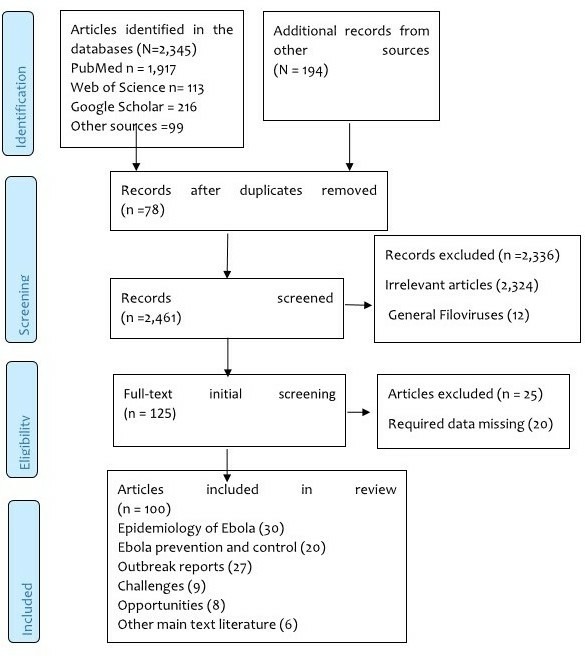
A literature search of relevant articles on EVD was done in PubMed, Web of Science and Google Scholar electronic databases. Articles published from 1976 to 2019 were reviewed to document reports of EVD outbreaks in Sub-Saharan Africa. Data extraction focused on the year of outbreak, geographical spread, virus strain involved, number of cases and deaths, case fatality, and outbreak management. Analyses of trends in case fatality were performed by calculating ORs between times.
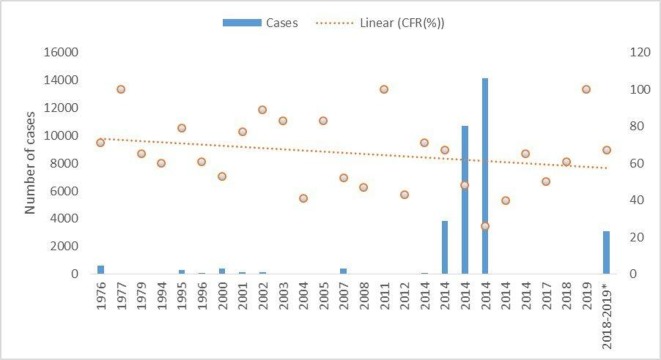
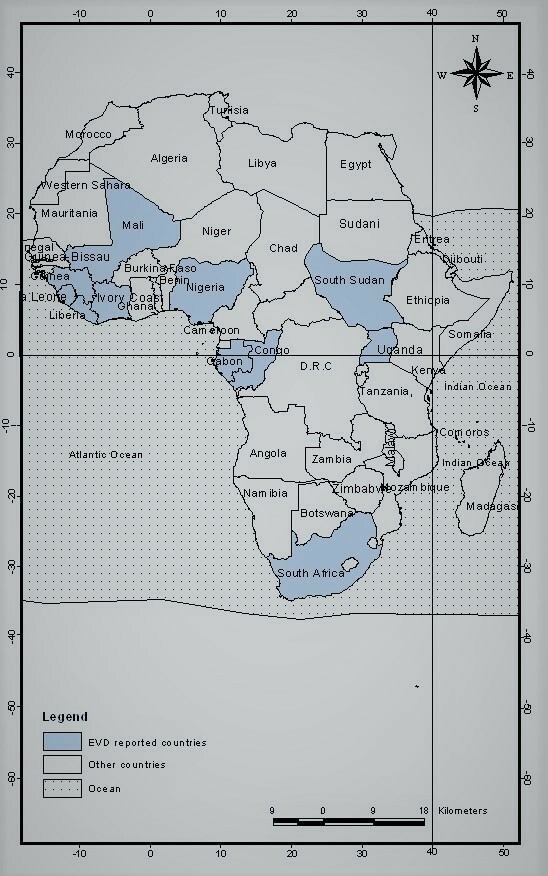
In the past four decades, a total of 34 EVD outbreaks affecting 34 356 cases and causing 14 823 deaths were reported in 11 countries in Sub-Saharan Africa. The overall case fatality rate (95% CI) was 66% (62 to 71) and did not change substantially over time (OR in 2019 vs 1976=1.6 (95% CI 1.5 to 1.8), p<0.001). The results of this review indicate that challenges to control EVD outbreaks are related to epidemiological, sociocultural and health system factors.
Sub-Saharan Africa continues to face considerable challenges in EVD control, whereby there are no significant changes in case fatality rates observed during the past four decades. Socioeconomic and cultural processes need to be critically considered to shape the community behaviours that lead to exposure to EVD outbreaks. Areas that need to be addressed to prevent future EVD outbreaks include a broad-based, one-health approach, effective communication, social mobilisation, and strengthening of the health systems.
埃博拉病毒病(EVD)是影响人类和非人类灵长类动物的最致命的出血热之一。自 1976 年首次发现以来,非洲已报告了 34 次暴发。本综述分析了 42 年来的 EVD 暴发情况,确定了在撒哈拉以南非洲控制和预防该病的各种挑战和机遇。
在 PubMed、Web of Science 和 Google Scholar 电子数据库中对有关 EVD 的相关文章进行了文献检索。综述了 1976 年至 2019 年发表的关于 EVD 暴发的报告,以记录撒哈拉以南非洲的 EVD 暴发情况。数据提取的重点是暴发年份、地理传播、涉及的病毒株、病例和死亡人数、病死率以及暴发管理。通过计算时间之间的 OR 来分析病死率趋势的变化。
在过去的四十年中,在撒哈拉以南非洲的 11 个国家共报告了 34 次影响 34356 例病例和造成 14823 人死亡的 EVD 暴发。总体病死率(95%CI)为 66%(62 至 71),且随时间变化不大(2019 年与 1976 年的 OR=1.6(95%CI 1.5 至 1.8),p<0.001)。本综述的结果表明,控制 EVD 暴发的挑战与流行病学、社会文化和卫生系统因素有关。
撒哈拉以南非洲在 EVD 控制方面仍面临巨大挑战,在过去四十年中,病死率未见明显变化。需要批判性地考虑社会经济和文化进程,以形成导致接触 EVD 暴发的社区行为。为防止未来发生 EVD 暴发,需要解决的领域包括采用基础广泛的“同一健康”方法、进行有效沟通、开展社会动员以及加强卫生系统。