Department of Orthopaedic Surgery, Erasmus MC, University Medical Center Rotterdam, Rotterdam, the Netherlands.
Department of Radiology, Erasmus MC, University Medical Center Rotterdam, Rotterdam, the Netherlands.
Scand J Med Sci Sports. 2020 Jul;30(7):1221-1231. doi: 10.1111/sms.13660. Epub 2020 Apr 6.
Conflicting and limited high-quality prospective data are available on the associations between cam morphology and hip and groin symptoms and range of motion (ROM).
This cross-sectional cohort study investigated associations between cam morphology presence, size and duration and symptoms and ROM.
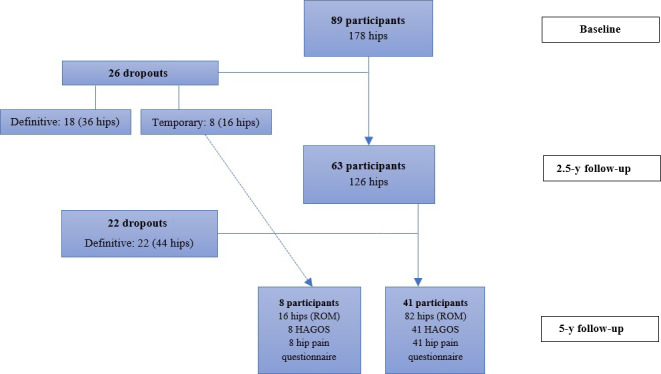
Academy male football players (n = 49, 17-24 years) were included. Standardized antero-posterior pelvic and frog-leg lateral radiographs were obtained at baseline, 2.5- and 5-year follow-up. The femoral head-neck junction was quantified by: Visual score. Cam morphology (flattening or prominence), large cam (prominence). Alpha angle. Cam morphology (≥60°), large cam (≥78°). Cam morphology duration was defined as long (first present at baseline) or short (only from 2.5- to 5-year follow-up). Current symptoms at 5-year follow-up were assessed using a hip and groin pain question and by the "Hip and Groin Outcome Score" (HAGOS). HAGOS scores were categorized into: most symptoms (≥2 domains in lowest interquartile range [IQR]), least symptoms (≥2 domains in highest IQR). Hip ROM was measured by goniometry at 5-year follow-up.
Large cam morphology based on visual score was associated with hip and groin pain (23.8% vs. 7.1%, OR: 3.17, CI: [1.15-8.70], P = .026), but not with HAGOS scores. Cam morphology presence, size, and duration were associated with limited flexion of around 6° and/or 3° to 6° for internal rotation.
Cam morphology presence, size, and duration were associated with limited hip flexion and/or internal rotation, but differences might not exceed the minimal clinical important difference. Whether cam morphology results in symptoms is uncertain.
关于凸轮形态与髋部和腹股沟症状以及活动范围(ROM)之间的关联,目前存在相互矛盾且有限的高质量前瞻性数据。
本横断面队列研究旨在探讨凸轮形态的存在、大小和持续时间与症状和 ROM 之间的关联。
纳入了学院男性足球运动员(n=49,17-24 岁)。在基线、2.5 年和 5 年随访时,获得了标准的前后骨盆和蛙腿侧位 X 线片。股骨头颈交界处通过以下方法进行量化:视觉评分。凸轮形态(变平或突出),大凸轮(突出)。α 角。凸轮形态(≥60°),大凸轮(≥78°)。凸轮形态的持续时间定义为长(首次出现在基线时)或短(仅在 2.5 年至 5 年随访期间存在)。在 5 年随访时,使用髋部和腹股沟疼痛问题和“髋部和腹股沟结局评分”(HAGOS)评估当前症状。HAGOS 评分分为:最严重症状(最低四分位距 [IQR] 中有 2 个以上领域),最轻微症状(最高 IQR 中有 2 个以上领域)。在 5 年随访时,使用测角器测量髋关节 ROM。
基于视觉评分的大凸轮形态与髋部和腹股沟疼痛相关(23.8%比 7.1%,OR:3.17,CI:[1.15-8.70],P=0.026),但与 HAGOS 评分无关。凸轮形态的存在、大小和持续时间与髋关节屈曲受限约 6°和/或内旋受限 3°至 6°相关。
凸轮形态的存在、大小和持续时间与髋关节屈曲和/或内旋受限相关,但差异可能不会超过最小临床重要差异。凸轮形态是否导致症状尚不确定。