Helix Centre, Royal College of Art, London, UK
Helix Centre, Imperial College London, London, UK.
BMJ Open. 2020 Mar 23;10(3):e034936. doi: 10.1136/bmjopen-2019-034936.
Arm weakness is a common problem after stroke (affecting 450 000 people in the UK) leading to loss of independence. Repetitive activity is critical for recovery but research shows people struggle with knowing what or how much to do, and keeping track of progress. Working with more than 100 therapists (occupational therapists and physiotherapists) and patients with stroke, we codeveloped the OnTrack intervention-consisting of software for smart devices and coaching support-that has the potential to address this problem. This is a protocol to assess the feasibility of OnTrack for evaluation in a randomised control trial.
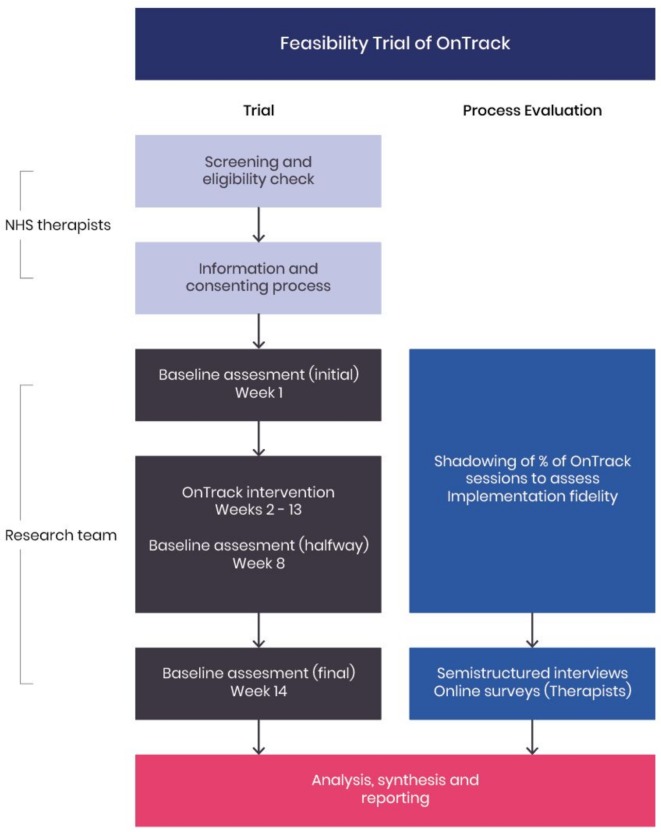
A mixed-method, single-arm study design will be used to evaluate the feasibility of OnTrack for hospital and community use. A minimum sample of 12 participants from a stroke unit will be involved in the study for 14 weeks. During week 1, 8 and 14 participants will complete assessments relating to their arm function, arm impairment and activation. During weeks 2-13, participants will use OnTrack to track their arm movement in real time, receive motivational messages and face-to-face sessions to address problems, gain feedback on activity and receive self-management skills coaching. All equipment will be loaned to study participants. A parallel process evaluation will be conducted to assess the intervention's fidelity, dose and reach, using a mixed-method approach. A public and patient involvement group will oversee the study and help with interpretation and dissemination of qualitative and quantitative data findings.
Ethical approval granted by the National Health Service Health Research Authority, Health and Care Research Wales, and the London-Surrey Research Ethics Committee (ref. 19/LO/0881). Trial results will be submitted for publication in peer review journals, presented at international conferences and disseminated among stroke communities. The results of this trial will inform development of a definitive trial.
NCT03944486.
手臂无力是中风后的常见问题(影响英国 45 万人),导致丧失独立性。重复活动对康复至关重要,但研究表明,人们很难知道该做什么或做多少,也很难跟踪进展。通过与 100 多名治疗师(职业治疗师和物理治疗师)和中风患者合作,我们共同开发了 OnTrack 干预措施-包括智能设备软件和辅导支持-有潜力解决这个问题。这是一项评估 OnTrack 在随机对照试验中进行评估的可行性的协议。
将采用混合方法、单臂研究设计来评估 OnTrack 在医院和社区使用的可行性。将有 12 名来自中风病房的参与者参与该研究 14 周。在第 1、8 和 14 周,参与者将完成与手臂功能、手臂损伤和激活相关的评估。在第 2-13 周,参与者将使用 OnTrack 实时跟踪他们的手臂运动,接收激励信息和面对面的会议来解决问题,获得对活动的反馈,并接受自我管理技能辅导。所有设备都将借给研究参与者。将采用混合方法来评估干预的保真度、剂量和范围,同时进行平行过程评估。一个公众和患者参与小组将监督研究,并帮助解释和传播定性和定量数据的结果。
国家卫生服务健康研究管理局、威尔士卫生和保健研究以及伦敦-萨里研究伦理委员会(参考号 19/LO/0881)已批准该伦理。试验结果将提交给同行评审期刊发表,在国际会议上展示,并在中风社区中传播。这项试验的结果将为制定一项确定性试验提供信息。
NCT03944486。