Department of Pharmacology and Toxicology, College of Medicine, University of Arkansas for Medical Sciences, 4301 W. Markham St. Little Rock, Little Rock, AR, 72205, USA.
Department of Internal Medicine, College of Medicine, University of Arkansas for Medical Sciences, Little Rock, AR, USA.
BMC Med Educ. 2020 Mar 24;20(1):87. doi: 10.1186/s12909-020-02003-w.
Strong learner-teacher relationships are associated with more successful learning outcomes. With shortened modular curricula and increased availability of online resources, fostering faculty interaction with preclinical medical students has become more challenging. We sought to enhance learner-teacher relationships by engaging in discussion with preclinical medical students in their own online space.
We utilized a closed Facebook discussion group, where faculty and students voluntarily joined in informal discussions and shared announcements related to their courses. The closed discussion group allowed only participating students and faculty to see others' posts within the group. This provided a platform to freely interact within the confines of the group while maintaining privacy for the personal Facebook accounts of both faculty and students. We utilized the discussion group through three separate organ system-based modules for 14 weeks. Afterward, students were asked to complete an anonymous, voluntary online survey about their experience.
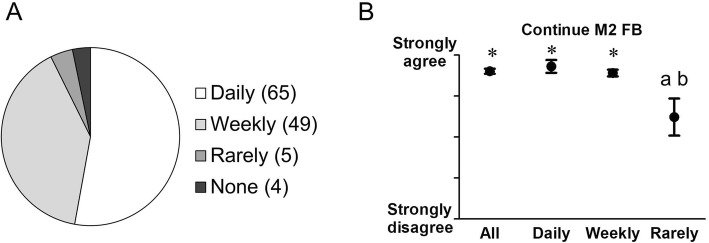
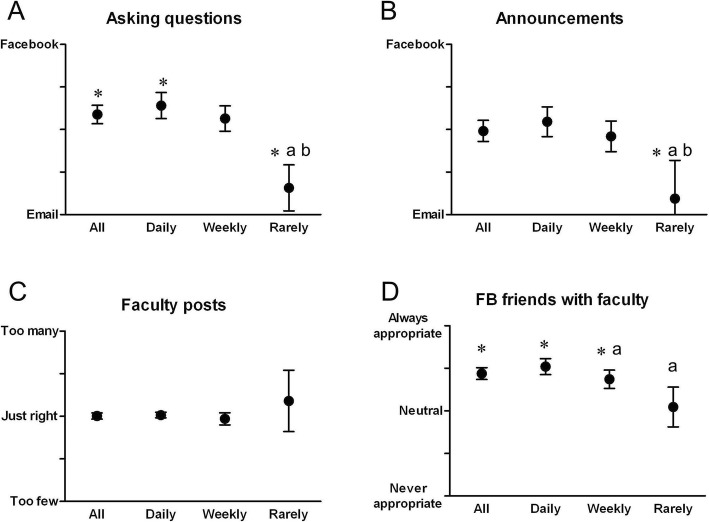
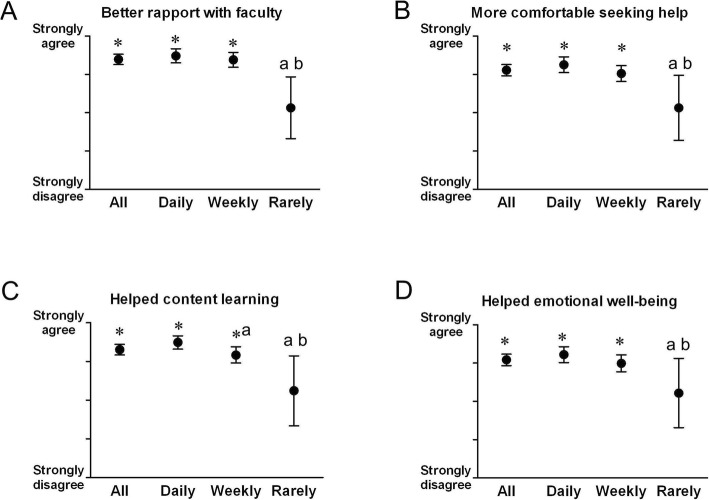
94.1% (160/170) of enrolled second-year medical students joined the voluntary FB discussion group. There were 214 posts, 628 comments, and 4166 reactions in this discussion group during the three modules. Of the students in the group, 74.4% (119/160) responded to the online survey. Overall, students strongly agreed that the Facebook discussion group fostered better rapport with faculty, helped content learning, and improved emotional well-being. Also, they felt more comfortable seeking academic help after using the discussion group. They reported a slight preference for Facebook over email as a medium for asking questions, but no preference for either as a medium for distributing announcements. Students overwhelmingly recommended that the discussion group should be continued in future years.
The Facebook discussion group was a free, efficient, and effective method of cultivating the learner-teacher relationship with the preclinical medical students, resulting in reported enhancement of learning and morale.
强有力的师生关系与更成功的学习成果相关。随着模块化课程的缩短和在线资源的增加,促进教师与临床医学前期学生的互动变得更加具有挑战性。我们试图通过在学生自己的在线空间中与临床医学前期学生进行讨论来增强师生关系。
我们利用了一个封闭的 Facebook 讨论组,教师和学生自愿加入其中进行非正式讨论,并分享与课程相关的公告。封闭的讨论组仅允许参与的学生和教师在组内看到其他人的帖子,这为在组内自由互动提供了平台,同时又保护了教师和学生个人 Facebook 账户的隐私。我们在三个独立的基于器官系统的模块中使用了该讨论组,为期 14 周。之后,学生被要求完成一项关于他们体验的匿名、自愿在线调查。
注册的二年级医学生中有 94.1%(160/170)加入了这个自愿的 Facebook 讨论组。在三个模块期间,该讨论组共有 214 个帖子、628 条评论和 4166 个点赞。在组内的学生中,74.4%(119/160)回答了在线调查。总体而言,学生强烈认为 Facebook 讨论组促进了与教师更好的关系,有助于内容学习,并改善了情绪健康。此外,他们在使用讨论组后更愿意寻求学术帮助。他们表示,更喜欢使用 Facebook 而不是电子邮件作为提问的媒介,但在发布公告方面,他们对两者都没有偏好。学生强烈建议在未来几年继续使用讨论组。
Facebook 讨论组是一种培养临床医学前期学生与教师关系的免费、高效且有效的方法,据报告,这提高了学习和士气。