Teymoori Ali, Gorbunova Anastasia, Haghish Fardzadeh E, Real Ruben, Zeldovich Marina, Wu Yi-Jhen, Polinder Suzanne, Asendorf Thomas, Menon David, V Steinbüchel Nicole
The Department of Social Psychology, Helmut Schmidt University, 22043 Hamburg, Germany.
The Institute of Medical Psychology and Medical Sociology, Georg August University, 37073 Göttingen, Germany.
J Clin Med. 2020 Mar 23;9(3):873. doi: 10.3390/jcm9030873.
The dimensionality of depression and anxiety instruments have recently been a source of controversy.
In a European-wide sample of patients after Traumatic Brain Injury (TBI), we aim to examine the factorial structure, validity, and association of the Patient Health Questionnaire for depression (PHQ-9) and the Generalized Anxiety Disorder (GAD-7) instruments. This study is based on longitudinal observational data. We conducted analyses of factorial structure and discriminant validity of outcomes six-months after TBI. We also examined the prevalence, co-occurrence, and changes of scores on the PHQ-9 and GAD-7 at 3-, 6-, and 12-month post-TBI assessments.
At six-months post-TBI assessment, 2137 (738 (34.5%) women) participants completed the PHQ-9 and GAD-7 questionnaires. For the longitudinal analysis, we had 1922 participants (672 (35.0%) women).
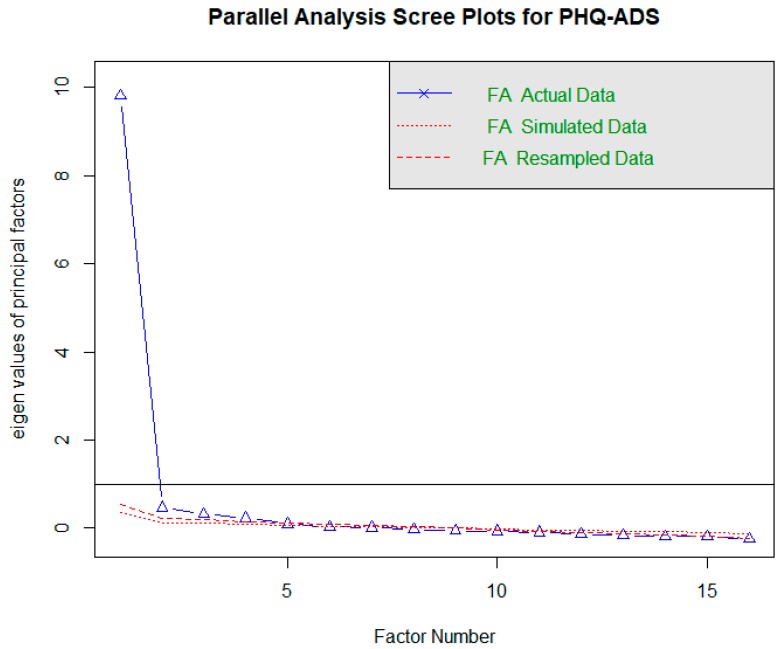
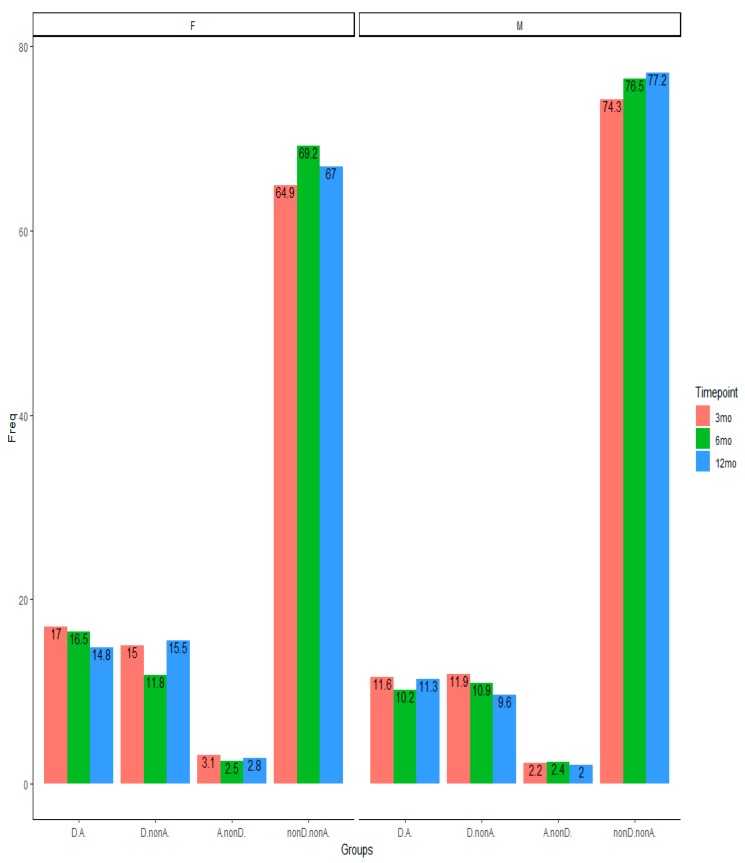
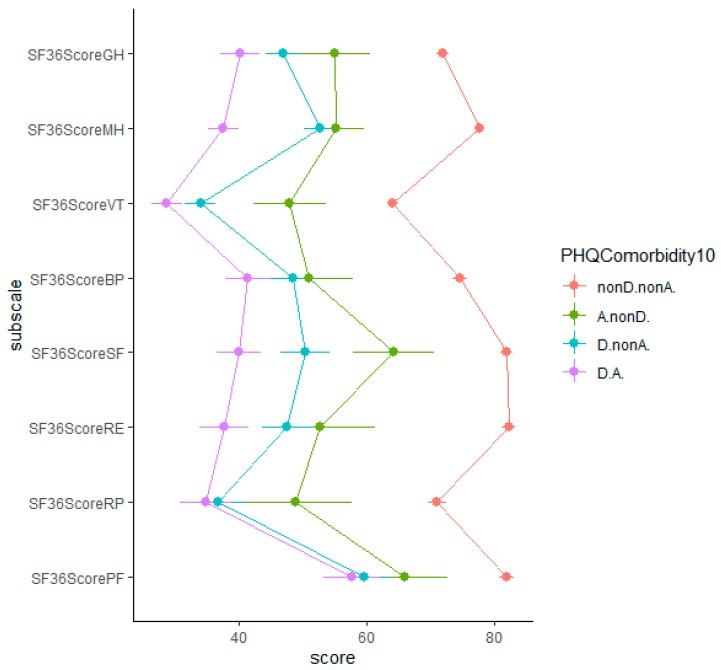
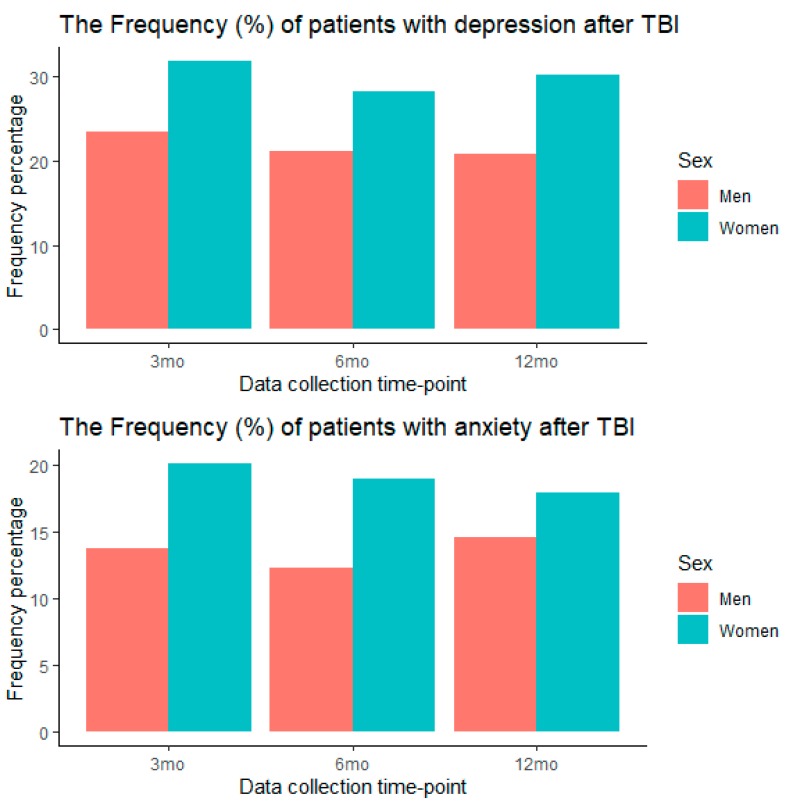
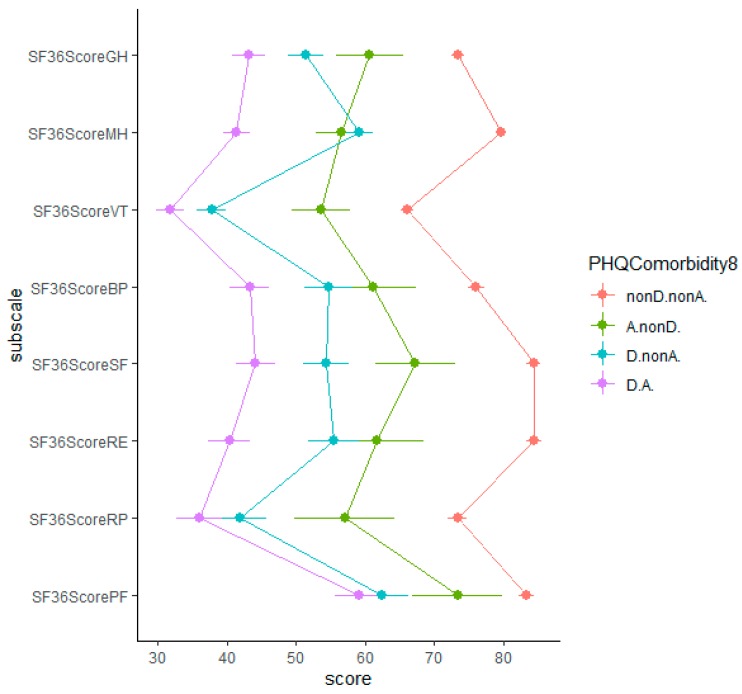
The results of exploratory factor analysis suggested a general latent construct underlying both PHQ-9 and GAD-7 measures. Confirmatory factor analyses showed a slight improvement in the fit indices for the bifactorial model. The Omega hierarchical test clearly differentiated two subfactors of PHQ-9 and GAD-7 items over and above the underlying general factor; however, most of the variance (85.0%) was explained by the general factor and the explained variance of the subfactors was small. The PHQ-9 and GAD-7 performed similarly in detecting post-traumatic stress disorder (PTSD). As defined by conventional cut-offs, depression and anxiety have different prevalence rates in the sample. The scales also differed in their relationships with the short form of health survey (SF-36v2) subscales. The longitudinal analysis showed high stability of depression and anxiety symptoms: 49-67% of the post-TBI patients with comorbid depression and anxiety reported the persistence of the symptoms over time.
The factorial structure analysis favors a general latent construct underlying both depression and anxiety scales among patients after TBI. We discuss the implications our findings and future research directions.
抑郁和焦虑量表的维度最近一直是争议的来源。
在欧洲范围内的创伤性脑损伤(TBI)患者样本中,我们旨在研究用于评估抑郁的患者健康问卷(PHQ - 9)和广泛性焦虑障碍量表(GAD - 7)的因子结构、效度及相关性。本研究基于纵向观察数据。我们对TBI后六个月的结果进行了因子结构分析和区分效度分析。我们还检查了TBI后3个月、6个月和12个月评估时PHQ - 9和GAD - 7得分的患病率、共现情况及变化。
在TBI后六个月的评估中,2137名参与者(738名(34.5%)女性)完成了PHQ - 9和GAD - 7问卷。对于纵向分析,我们有1922名参与者(672名(35.0%)女性)。
探索性因子分析结果表明,PHQ - 9和GAD - 7测量背后存在一个一般潜在结构。验证性因子分析显示双因子模型的拟合指数略有改善。欧米伽层次检验清楚地区分了PHQ - 9和GAD - 7项目的两个子因子,超出了潜在的一般因子;然而,大部分方差(85.0%)由一般因子解释,子因子的解释方差较小。PHQ - 9和GAD - 7在检测创伤后应激障碍(PTSD)方面表现相似。按照传统临界值定义,样本中抑郁和焦虑的患病率不同。这些量表与健康调查简表(SF - 36v2)子量表的关系也有所不同。纵向分析显示抑郁和焦虑症状具有高度稳定性:49 - 67%的TBI后合并抑郁和焦虑的患者报告症状随时间持续存在。
因子结构分析支持TBI后患者抑郁和焦虑量表背后存在一个一般潜在结构。我们讨论了研究结果的意义及未来研究方向。