Department of Radiation Sciences, Oncology, Umeå University, Umeå, Sweden.
Department of Medical Biosciences, Pathology, Umeå University, Umeå, Sweden.
Sci Rep. 2020 Mar 24;10(1):5336. doi: 10.1038/s41598-020-62129-1.
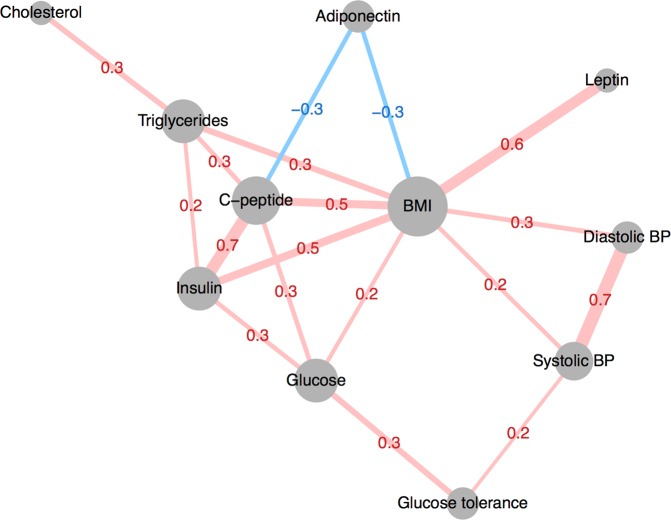
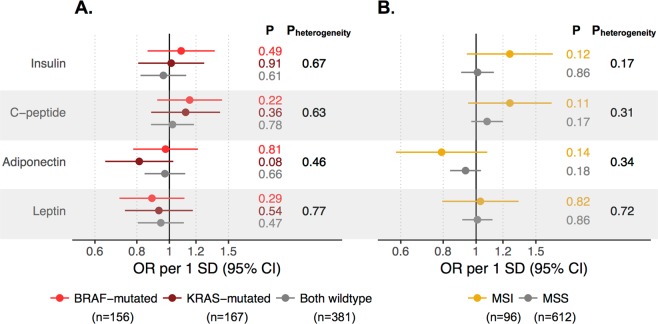
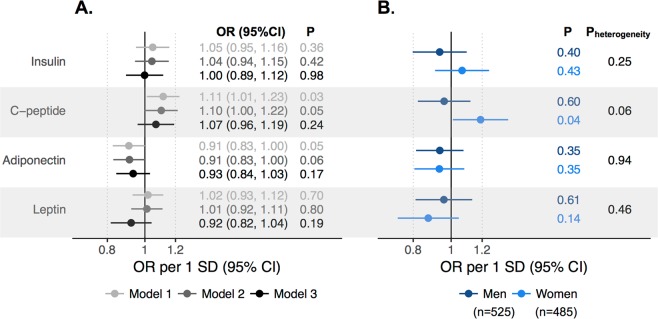
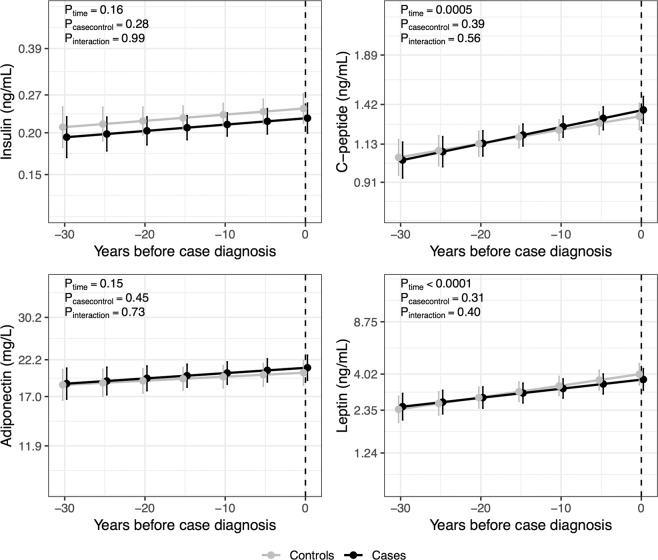
Body fatness increases the risk of colorectal cancer (CRC). Insulin resistance and altered adipokines are potential mechanisms, but previous biomarker studies have been inconsistent. Intertumoral heterogeneity might provide an explanation. We investigated insulin, C-peptide, adiponectin, and leptin in relation to CRC molecular subtypes using a nested case-control design (1010 cases, 1010 matched controls, median 12.3 years from baseline to CRC diagnosis) from the population-based Northern Sweden Health and Disease Study. Repeated samples were available from 518 participants. Risks of CRC and subtypes, defined by tumor BRAF and KRAS mutations and microsatellite instability (MSI) status, were estimated using conditional logistic regression and linear mixed models. Higher C-peptide and lower adiponectin were associated with increased CRC risk (odds ratios per standard deviation increase (95% CI): 1.11 (1.01, 1.23) and 0.91 (0.83, 1.00), respectively), though weakened when adjusted for body mass index. Insulin and leptin were not associated with CRC risk. Within-individual time trajectories were similar in cases and controls, and no subtype-specific relationships were identified (all P > 0.1). Adiponectin was weakly inversely associated with the risk of KRAS-mutated (P = 0.08) but not BRAF-mutated or KRAS/BRAF-wildtype CRC, consistent with the one previous study. These findings contribute to an increased understanding of the complex role of body size in CRC.
体脂肪增加结直肠癌(CRC)的风险。胰岛素抵抗和脂肪因子改变是潜在的机制,但之前的生物标志物研究结果并不一致。肿瘤间异质性可能提供了一种解释。我们使用基于人群的瑞典北部健康与疾病研究中的巢式病例对照设计(1010 例病例,1010 例匹配对照,从基线到 CRC 诊断的中位随访时间为 12.3 年),研究了胰岛素、C 肽、脂联素和瘦素与 CRC 分子亚型的关系。518 名参与者中有重复样本。使用条件逻辑回归和线性混合模型估计了 CRC 和亚型(通过肿瘤 BRAF 和 KRAS 突变和微卫星不稳定性(MSI)状态定义)的风险。C 肽每标准差增加(95%CI)与 CRC 风险增加相关(优势比:1.11(1.01,1.23)和 0.91(0.83,1.00)),但在调整体重指数后减弱。胰岛素和瘦素与 CRC 风险无关。病例和对照组的个体内时间轨迹相似,未发现特定亚型的关系(所有 P > 0.1)。脂联素与 KRAS 突变(P = 0.08)但与 BRAF 突变或 KRAS/BRAF 野生型 CRC 的风险呈弱负相关,与之前的一项研究一致。这些发现有助于更好地理解身体大小在 CRC 中的复杂作用。