Hattori Sachiko
Department of Endocrinology and Metabolism, Tohto Clinic, 4-1 Kioi-Cho, Chiyoda-Ku, Tokyo, 102-0094 Japan.
Diabetol Metab Syndr. 2020 Mar 24;12:24. doi: 10.1186/s13098-020-00533-3. eCollection 2020.
Omarigliptin is a potent, selective, oral dipeptidyl peptidase 4 (DPP4) inhibitor with a half-life that allows weekly dosing. Inflammation or insulin resistance might be pathological mediators of cardiovascular events in patients with type 2 diabetes.
Whether omarigliptin has anti-inflammatory effects that result in decreased levels of high-sensitivity C-reactive protein (hsCRP) and anti-insulin resistance effects that decrease levels of homeostatic model assessment of insulin resistance (HOMA-IR) were investigated. Patients were allocated to continue with daily DPP4 inhibitors (control, n = 28) or to switch from daily DPP4 inhibitors to weekly omarigliptin (omarigliptin, n = 56). Fasting blood and urine samples were collected before, and every 3 months after intervention for 1 year.
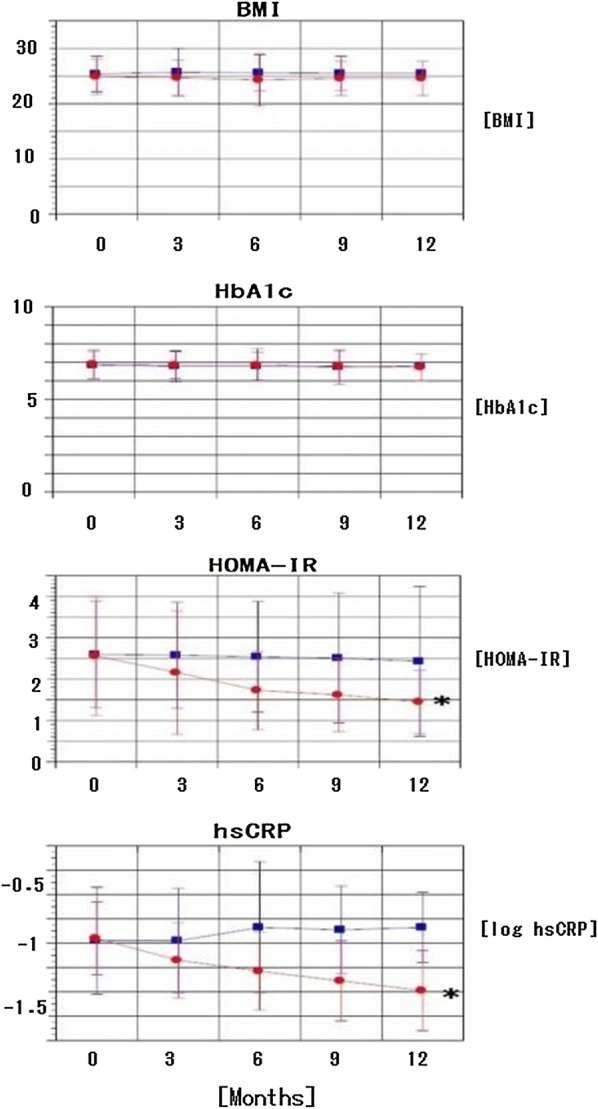
Omarigliptin tended to elicit reductions in fasting blood glucose (FBG), LDL-cholesterol, triglyceride, aspartate aminotransferase (AST), alanine aminotransferase (ALT), gamma-glutamyl transpeptidase (γ-GTP), the urinary albumin-to-creatinine ratio (ACR) with logarithmic transformation (log ACR), and systolic and diastolic blood pressure, but the differences did not reach statistical significance compared with control. Values for HDL-cholesterol tended to increase, but also did not reach statistical significance compared with control. Omarigliptin significantly decreased HOMA-IR, remnant-like particle cholesterol (RLP-C), and hsCRP with logarithmic transformation (log hsCRP) compared with control. However, omarigliptin did not affect hemoglobin A1c (HbA1c), body mass index (BMI), and estimated glomerular filtration rates (eGFR).
Omarigliptin decreased inflammation and insulin resistance without affecting HbA1c or BMI. Although how DPP4 inhibitors affect cardiovascular (CV) outcomes remains uncertain, omarigliptin might confer CV benefits at least in part, via pleiotropic anti-inflammatory or anti-insulin resistance effects. UMIN Clinical Registry (UMIN000029288). Registered 22 September, 2017, https://upload.umin.ac.jp/UMIN000029288.
奥格列汀是一种强效、选择性口服二肽基肽酶4(DPP4)抑制剂,其半衰期允许每周给药一次。炎症或胰岛素抵抗可能是2型糖尿病患者心血管事件的病理介质。
研究了奥格列汀是否具有抗炎作用,从而导致高敏C反应蛋白(hsCRP)水平降低,以及是否具有抗胰岛素抵抗作用,从而降低胰岛素抵抗稳态模型评估(HOMA-IR)水平。患者被分配继续使用每日一次的DPP4抑制剂(对照组,n = 28),或从每日一次的DPP4抑制剂转换为每周一次的奥格列汀(奥格列汀组,n = 56)。在干预前以及干预1年期间每3个月收集空腹血液和尿液样本。
奥格列汀有降低空腹血糖(FBG)、低密度脂蛋白胆固醇、甘油三酯、天冬氨酸转氨酶(AST)、丙氨酸转氨酶(ALT)、γ-谷氨酰转肽酶(γ-GTP)、经对数转换的尿白蛋白与肌酐比值(ACR)(log ACR)以及收缩压和舒张压的趋势,但与对照组相比,差异未达到统计学意义。高密度脂蛋白胆固醇值有升高趋势,但与对照组相比也未达到统计学意义。与对照组相比,奥格列汀显著降低了HOMA-IR、残粒样颗粒胆固醇(RLP-C)以及经对数转换的hsCRP(log hsCRP)。然而,奥格列汀对糖化血红蛋白(HbA1c)、体重指数(BMI)和估计肾小球滤过率(eGFR)没有影响。
奥格列汀可降低炎症和胰岛素抵抗,而不影响HbA1c或BMI。尽管DPP4抑制剂如何影响心血管(CV)结局仍不确定,但奥格列汀可能至少部分地通过多效抗炎或抗胰岛素抵抗作用带来心血管益处。UMIN临床注册库(UMIN000029288)。于2017年9月22日注册,https://upload.umin.ac.jp/UMIN000029288 。