Hattori Sachiko
Department of Endocrinology and Metabolism, Tohto Clinic, 4-1, Kioi-Cho, Chiyoda-Ku, Tokyo, 102-0094 Japan.
Diabetol Metab Syndr. 2018 Dec 18;10:93. doi: 10.1186/s13098-018-0395-5. eCollection 2018.
Inflammation might be a pathological mediator of cardiovascular events in patients with type 2 diabetes and high cardiovascular risk.
We investigated whether empagliflozin (EMPA) exerts anti-inflammatory effects that are reflected in decreased high-sensitivity C-reactive protein (hsCRP) values. Patients were allocated to receive a placebo (n = 51) or EMPA (n = 51) as an add-on treatment. Fasting blood samples were collected before and every 3 months after this intervention for 1 year.
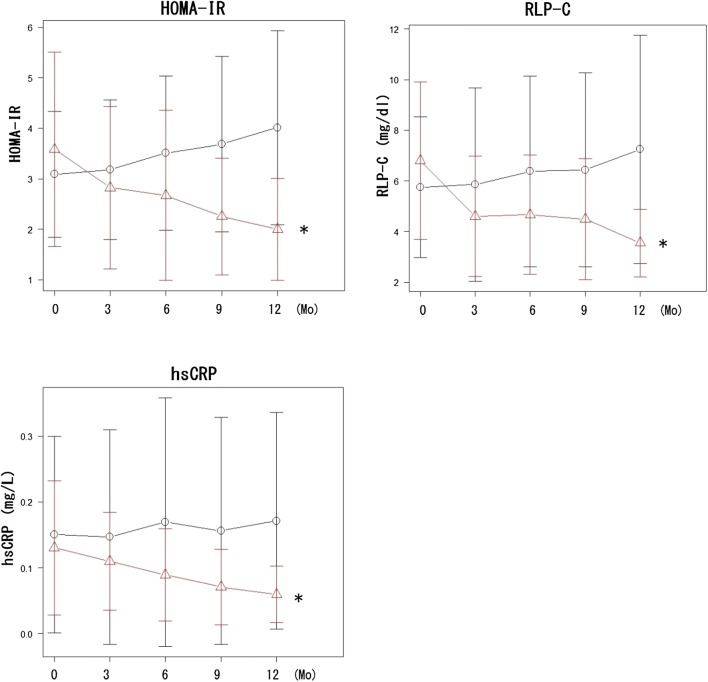
Empagliflozin tended to elicit reductions in BMI, HbA1c, aspartate aminotransferase, alanine aminotransferase (ALT), and gamma-glutamyl transpeptidase compared with the placebo, but the differences did not reach statistical significance. Levels of LDL-cholesterol, HDL-cholesterol, and triglycerides were unaltered, significantly increased, and decreased, respectively, by EMPA, but the differences were not statistically significant compared with the placebo. Empagliflozin for 12 months notably reduced the homeostatic model assessment of insulin resistance (HOMA-IR), remnant-like particle cholesterol (RLP-C), and hsCRP by 43%, 52% and 54%, respectively. The time courses of these reductions significantly differed from those of the placebo. Systolic and diastolic blood pressure were also significantly reduced by EMPA compared with the placebo. We applied multiple linear regression analysis to determine which factors were associated with changes in hsCRP induced by EMPA. The results revealed that alterations in hsCRP values (log [hsCRP at 12 months] minus log [hsCRP at month 0]) were significantly associated with changes in HOMA-IR, RLP-C, systolic blood pressure, HDL-C and ALT.
Empagliflozin decreased hs-CRP and lowered levels of remnant related lipoproteins probably via ameliorating insulin resistance. The cardiovascular benefits conferred by EMPA might be driven at least partly by anti-inflammatory effects, and this mechanism might cooperate with other EMPA-induced changes including reduced blood pressure, to achieve the degree of cardioprotection revealed by the EMPA-REG OUTCOME trial. UMIN Clinical Registry (UMIN000021552). Registered 21 March 2016, https://upload.umin.ac.jp/UMIN000021552.
炎症可能是2型糖尿病和心血管疾病高风险患者心血管事件的病理介质。
我们研究了恩格列净(EMPA)是否具有抗炎作用,这可通过高敏C反应蛋白(hsCRP)值的降低体现出来。患者被分配接受安慰剂(n = 51)或恩格列净(n = 51)作为附加治疗。在干预前及干预后每3个月采集空腹血样,持续1年。
与安慰剂相比,恩格列净有降低体重指数、糖化血红蛋白、天冬氨酸转氨酶、丙氨酸转氨酶(ALT)和γ-谷氨酰转肽酶的趋势,但差异未达到统计学显著性。恩格列净使低密度脂蛋白胆固醇、高密度脂蛋白胆固醇和甘油三酯水平分别未改变、显著升高和降低,但与安慰剂相比差异无统计学意义。恩格列净治疗12个月显著降低胰岛素抵抗稳态模型评估(HOMA-IR)、残粒样颗粒胆固醇(RLP-C)和hsCRP,分别降低43%、52%和54%。这些降低的时间进程与安慰剂有显著差异。与安慰剂相比,恩格列净也显著降低收缩压和舒张压。我们应用多元线性回归分析来确定哪些因素与恩格列净诱导的hsCRP变化相关。结果显示,hsCRP值的变化(12个月时hsCRP的对数减去0个月时hsCRP的对数)与HOMA-IR、RLP-C、收缩压、高密度脂蛋白胆固醇和ALT的变化显著相关。
恩格列净可能通过改善胰岛素抵抗降低hs-CRP并降低残粒相关脂蛋白水平。恩格列净带来的心血管益处可能至少部分由抗炎作用驱动,并且这种机制可能与恩格列净诱导的其他变化(包括血压降低)协同作用,以达到EMPA-REG OUTCOME试验所揭示的心脏保护程度。UMIN临床注册中心(UMIN000021552)。2016年3月21日注册,https://upload.umin.ac.jp/UMIN000021552 。